September 3, 2026
In every Indian kitchen there is a spice box. Inside lies a handful of earth-brown crescents called Jeera that crackle the moment they touch hot ghee. Many think it is just tadka. Ayurveda has always known – it is not just flavour, it is medicine.
Botanists call it Cuminum cyminum Linn, of the Apiaceae family. A shy, slender annual, barely a meter tall, that grows in the winter sands of Rajasthan, Punjab, Kashmir and Kumaon. It flowers in February, fruits by March, and finishes its life in just three months – as if in a hurry to reach the kitchen. It is called Jeerige in Kannada, Jeera Safed in Hindi.
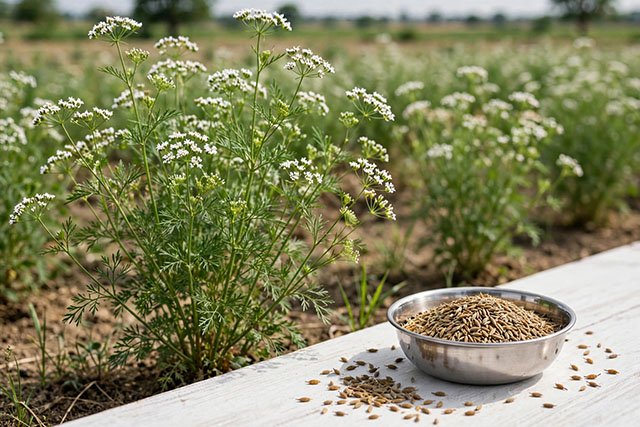
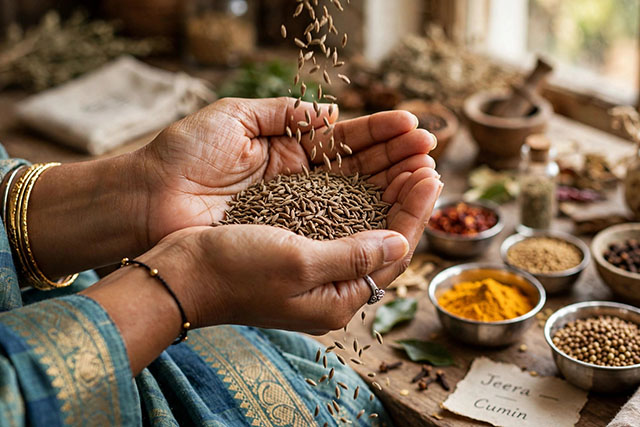
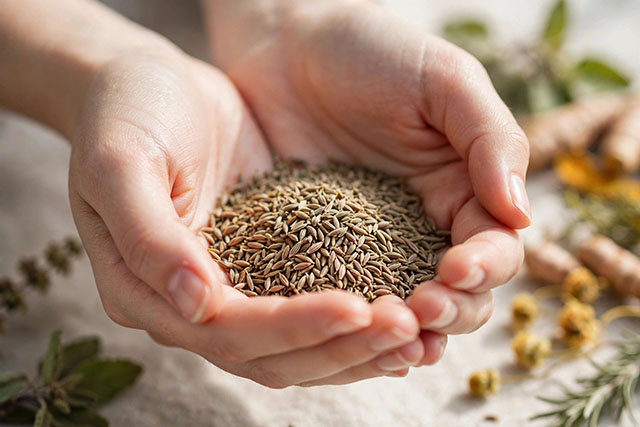
To the eye it is a tiny ovoid fruit, 4 to 6 mm long, ridged like a tiny boat. To the nose, it is warm and piercing. That aroma is not an accident. It is Thymene, cuminaldehyde, p-cymene and thymol – 3.5 to 5.2 percent volatile oil locked inside 14.5 percent fixed oil. Hidden beneath that aroma is a surprise – 66 mg of iron in every 100 grams, the highest of any spice, along with calcium, magnesium and fourteen flavonoids that quietly fight oxidation.
Ayurveda tasted it long before chemistry. Rasa – Katu, pungent. Guna – Rooksha, Laghu, Ushna – dry, light, hot. Veerya – Ushna. Vipaka – Katu again. It pacifies Kapha and Vata, but can stir Pitta if overused. It is Deepaka – kindles digestive fire or Jataragni. Pachaka – digests undigested matter or Ama. Krimighna – expels worms. Ruchya – brings taste back to a tasteless tongue. For women, it is Garbhashaya Shuddhikara – one that cleanses and strengthens the womb.
What can a pinch of Jeera heal?
The bloated belly: When gas is trapped and the abdomen feels like a drum, cuminaldehyde calls bile and pancreatic juices – amylase and lipase – and wind finds its way out.
The loose gut: In Grahani and IBS, when food slips out undigested, Jeera with takra – buttermilk – becomes Grahi, holding and healing. Studies show relief in just two weeks.
The nauseous status: A few seeds crushed with lemon juice cool acidity and settle the stomach.
The fever with no hunger: In early stage of fever when tongue is coated and hunger is low, Jeera can be given.
The woman's health care: For centuries, Jeera is given to women after delivery because it increases milk production and also acts as uterine tonic that eases the ache of dysmenorrhea.
The itching skin: Simple paste with water, applied externally, calms swelling and itching. Labs call it anti-inflammatory and antifungal. Tradition simply calls it soothing.\
The sting: In villages, scorpion sting is still washed with Jeera decoction, or powder mixed with ghee and rock salt – a folk analgesic that works.
The painful mouth ulcers, bad breath, loss of taste: Just chew a few seeds – it kills bacteria and wakes up taste buds.
The heavy body: Three grams in curd every day for three months – clinical trials showed trimmed weight, waist, cholesterol, LDL, triglycerides, raised HDL, and lowered fasting sugar and HbA1c.
The invisible army: Cumin oil is larvicidal, antibacterial. But remember – grind it fine and half its volatile oil flies away in an hour. So store whole, roast fresh.
Caution: Jeera when opted as medicine should be taken under doctor supervision. Otherwise it may produce adverse effects like increasing bleeding risk if on blood thinners, may lower blood sugar in diabetic patients, excess may cause heartburn, liver-kidney stress, high dose in pregnancy may stimulate uterus, it may also interact with antibiotics and anti-diabetic drugs.
Simple Home Remedies:
- Jeera + Dhania + Saunf tea for acidity, UTI, burning urination.
- Jeera + Buttermilk for piles, IBS, diarrhea.
- Jeera + Lemon water for weight management.
- Jeera + Guda / Jaggery for period pain.
- Jeera water – 1 tsp soaked overnight in 1 glass water, boiled and filtered in morning.
Ayurvedic formulations like Jeerakadyarishta, Jeerakadi Leha, Jeerakadi Modaka, Panchajeeraka Kashaya, Panchajeeraka Paka / Gudam, Hingvashtaka Churna / Hinguvachadi Churna contain jeera. Homeopathy also uses cumin in dyspepsia, flatulence, colic, heaviness after eating, IBS, nervous debility, hysterical flatulence, irregular menses, leucorrhoea, after effects of delivery, chronic catarrh cough with mucus. Unani considers formulations containing jeera like Muhallil-e-Riyah as carminative, Hazim as digestive, Muqawwi-e-Meda as stomach tonic, Mudirr-e-Baul as diuretic, Mudirr-e-Haiz as emmenagogue, Muqawwi-e-Jigar as liver tonic, Dafe Tashannuj as antispasmodic, Muqawwi-e-Raham as uterine tonic.
Jeera is praised by all medical systems for its action towards digestion and metabolism, proving Jeera is not just tadka but a complete medicine healing the world in a unique way.