August 29, 2026
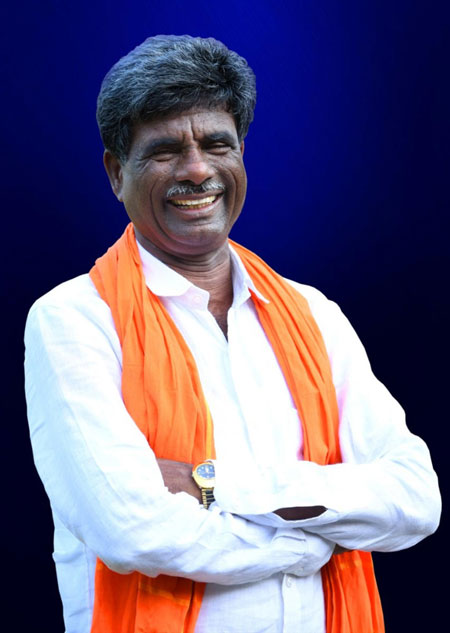
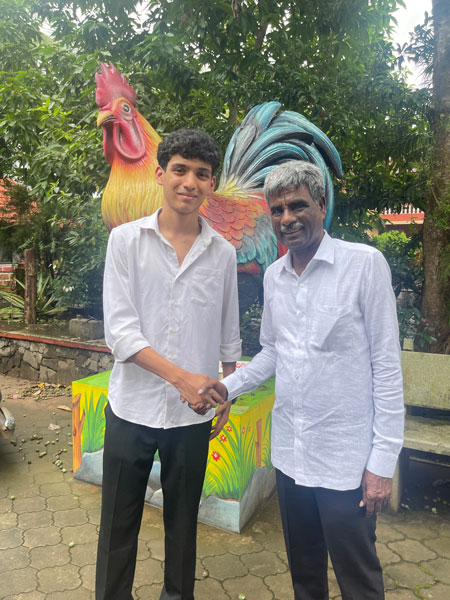
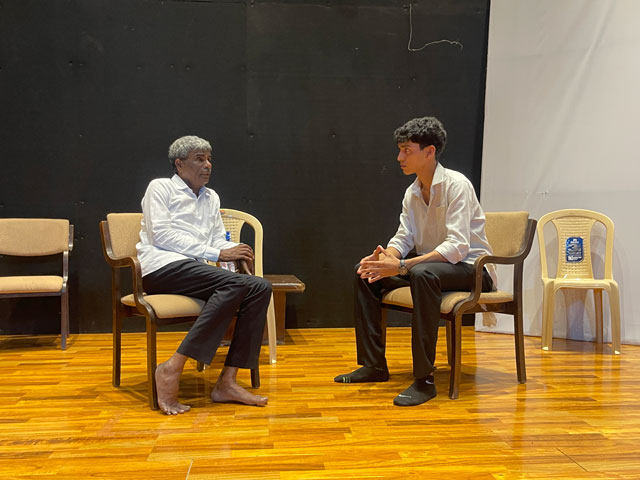
Some conversations begin with questions. Others begin with a setting that quietly tells you there is more to the person sitting across the table. My conversation with Kota Srinivas Poojary at the Shivaram Karanth Theme Park in Kotathattu was one such encounter. I had expected to hear about Parliament, politics, development and the responsibilities of representing Udupi-Chikkamagaluru. Instead, the conversation took me much further back — to a childhood of thatched homes, agricultural hardship and daily-wage work, and to a young boy who had no idea that life would eventually take him all the way to Parliament.
What made the conversation particularly fascinating was that Poojary did not narrate his journey as a carefully designed political ascent. There was no childhood declaration that he would become an MLA or an MP. There was simply a young man trying to build a life with whatever came his way. Somewhere along that road, politics found him. And from that first local election, one responsibility led to another.
Before politics, there was simply life
The Kotathattu of Poojary’s childhood was a world removed from the one we know today. He remembers a village of around 600 to 700 homes where perhaps only one or two had tiled roofs. Most were thatched houses, often covered with coconut leaves. Agriculture sustained almost everyone, but many families were tenant farmers who had to surrender a share of their produce to the landowners. The arrival of land reforms gradually changed that equation. His family eventually gained ownership of the small piece of land it cultivated. But poverty did not disappear overnight.
Leaving school after Class 7 to support his family, Poojary entered the local workforce through manual labor before learning photography and opening Swathi Studio in his village. Through the lens of his camera and brief civic dispatches written for regional newspapers like Mungaru, he began documenting the daily life and grievances of his community. Survival, not political ambition, was the driving force of those early years.
The election that changed everything
Politics entered his life almost accidentally.
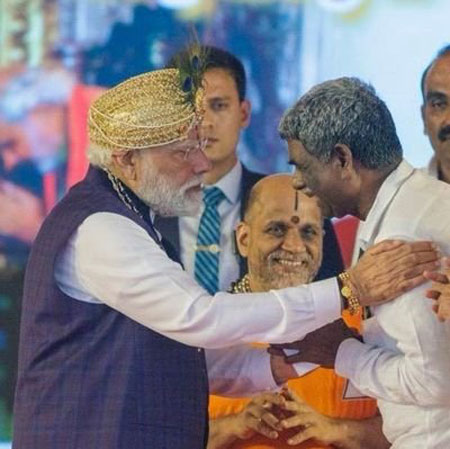
Friends encouraged him to contest the gram panchayat election, and he entered politics through the Bharatiya Janata Party. What followed was a progression few could have predicted at the beginning — gram panchayat, taluk panchayat, zilla panchayat, the Legislative Council, ministerial responsibilities and eventually the Lok Sabha.
That progression was not without its trials. Facing two electoral setbacks from the Brahmavar Assembly constituency at a time when organizational support was lean and resources were scarce, Poojary chose not to retreat. Instead, those losses anchored him deeper into grassroots work, reinforcing his conviction that public trust is built by remaining on the ground when the tides are low, not just when victory is guaranteed.
His own description of the journey is perhaps its most revealing aspect: he never planned it all in advance. The opportunities came one after another, and he accepted the responsibility that came with each.
The village that remained his anchor
Even after reaching Parliament, Poojary’s strongest emotional connection remains Kotathattu.
That deep-rooted pride in his heritage directly inspired the establishment of the Kota Shivarama Karanth Theme park in Kotathattu. The installation of a decommissioned MiG-21 fighter aircraft within the grounds was a deliberate choice—an effort to bring a piece of national history directly to rural youth, showing them that a small coastal village can connect directly to the broader canvas of the nation.
But the significance of Kotathattu goes deeper than heritage.
It was here that he became a gram panchayat member. Here he began the political journey that took him through successive levels of public life. For Poojary, the village is not merely his birthplace; it is the place that gave him his first opportunity.
Preserving Cultural Memory Through Local Heritage
Beyond his political appointments, Poojary has maintained a deep, personal commitment to preserving Coastal Karnataka’s cultural memory. From quietly supporting local Yakshagana troupes and traditional artists to documenting folk traditions during his early years, he views regional heritage not as a passive relic of the past, but as a vital social anchor that keeps rural communities grounded amid rapid modern urbanization.
Public life, without making it personal
One quality repeatedly associated with Poojary is accessibility. He himself, however, does not regard it as something extraordinary. People approach elected representatives with requests for jobs, education, medical assistance and government schemes. A politician cannot personally solve every problem, he points out. Governance works through laws, rules, institutions and administrative procedures.
But a representative can listen. A representative can guide. And, within the limits of the system, a representative can try.
That sense of responsibility, he says, comes directly from the vote. If people have trusted a person with their vote, that person owes them sincerity and responsiveness.
The lessons of his mentors
Mentored by institutional figures like Dr V S Acharya and A G Kodgi, Poojary practices what has become a rare discipline in modern public life: administrative restraint. ‘Politics should never be reduced to personal malice,’ he maintains. For Poojary, ideological disagreement is a natural element of democracy, but character assassination represents a failure of character—opponents remain political adversaries, never personal enemies.
For an increasingly combative political environment, it is a remarkably restrained philosophy.
A message for the next generation
His advice to young people is equally practical. Government jobs, he believes, can employ only a fraction of the population. The larger opportunity lies in entrepreneurship, self-employment, startups and building careers independently. His message to young people is to develop skills, work with discipline and stand on their own feet.
For aspiring politicians, his advice is even simpler: work before seeking recognition.
Political competition has increased, opportunities are limited, and there are more aspirants than ever before. But those who consistently work among people, avoid unnecessary controversies and contribute sincerely to their organisation can eventually be noticed.
His own life is the evidence he offers
The boy who once left school after Class 7 to work for a living never sat down with a blueprint for Parliament. Yet, one election at a time and one responsibility at a time, he travelled from a village panchayat to the nation’s highest democratic institution.
Perhaps that is what stayed with me most after the conversation. Kota Srinivas Poojary’s story is not simply about how a politician reaches Parliament. It is about how an ordinary beginning can quietly gather momentum until, years later, the distance travelled becomes extraordinary.
From the fields and thatched homes of Kotathattu to the chambers of Parliament, Kota Srinivas Poojary’s journey is ultimately a story of opportunity meeting perseverance — and of a man who kept taking the next step without knowing where the road would finally lead.