July 12, 2026
India is pushing to make E20 petrol—a blend with 20% crop-based ethanol—the standard fuel. This has sparked a lively national debate. The government promotes the change as a key move to cut carbon emissions and lower costly oil imports. However, regular drivers are experiencing a different reality. Protesters in Delhi are questioning the financial benefits of this rollout. They argue it harms them through reduced fuel efficiency, which strains their monthly budgets, and leads to engine wear and performance issues, like decreased acceleration. Affordable alternatives are lacking since unblended or lower-blend petrol is heavily taxed and can cost up to 50% more.
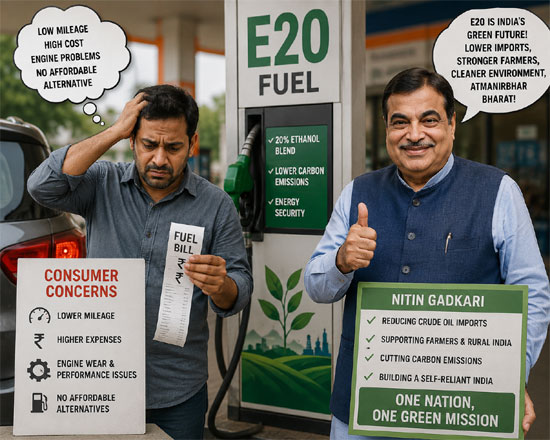
AI-generated image
There is a significant gap between official positions and public feelings. The Federation of Automobile Dealers Associations (FADA) and major car manufacturers claim they haven't received official complaints. Yet surveys reveal that 66% of petrol vehicle owners who purchased their cars before 2023 have seen a drop of over 10% in fuel efficiency since E20 became widely available. This problem relates to vehicle compatibility and fuel chemistry. Modern engines can handle E20, but older cars, designed for E10 or less, are suffering because ethanol absorbs moisture from the air, leading to corrosion and fuel system issues.
The mandate has also turned into a political issue, balancing policy and profits. Opposition leaders have raised concerns about possible conflicts of interest, claiming the government initiated the rollout to help the commercial ethanol lobby. They specifically highlight the financial benefits accruing to companies linked to the Road Transport and Highways Minister. In response, the government firmly denies these claims. Minister Nitin Gadkari insists that his personal stake in these companies is a mere 0.07%, providing no financial influence. The government also stresses that the Ethanol Blended Petrol (EBP) program is a joint Cabinet decision involving various ministries and scientific organizations, not just one ministry's directive. Additionally, it points out that the family-linked companies produce less than 0.5% of the total ethanol output in India, with over 550 ethanol-producing units nationwide.
Amidst confusion about whether the Road Transport Ministry or other agencies hold the ultimate responsibility for engine emissions and compatibility standards, the government stands firm on its broader economic defense. It argues that the transition is crucial for India’s stability. The aim is to reduce crude oil import costs to protect the economy against geopolitical uncertainties while also providing significant advantages to farmers by turning excess crops into valuable ethanol.
To manage this transition, vehicle owners are adopting practical strategies to protect their engines. Experts recommend that owners of cars made before 2023 upgrade factory fuel lines and gaskets with alcohol-resistant materials. They also suggest using aftermarket fuel conditioners to prevent phase separation, using upper-cylinder lubricants to combat internal rust, and finding premium fuel options with lower ethanol levels. There is a growing demand for consumer choice and fuel access, with calls for fuel stations to offer various petrol grades—including E5, E10, and E20—so owners of both older and newer vehicles can select the blend that best fits their engines while the transition continues gradually.