April 11, 2026
1980. The centenary year of the beginning of St Aloysius College. In befitting celebrations, many VIPs descended that year in Mangalore, including the President of India, Neelam Sanjeeva Reddy. Fr Pedro Arupe SJ, the Jesuit General, had come to grace the centenary celebrations in what was called the first visit by a Jesuit General to India. Fr Arupe was a Spaniard and is credited with reforming the Society of Jesus, started by Ignatius of Loyola around 480 years ago.
Melwin Joseph, a high school student, was just seventeen years old in 1980. He was a student of St Aloysius High School. Young Melwin was around the Jesuit residence on the first floor of the now 146-year-old building, which still functions as the Jesuit residence of the college. While passing through the corridors, Fr Arupe remarked to the innocent-looking Melwin, “Young boy, will you become a Jesuit?” Fr Arupe’s prophetic words turned out to be true when, in 1997, he was ordained a Jesuit priest and became a talented Jesuit of the Karnataka Jesuit Province. His smile was more dominant than his cassock. With his affability, he lit up the whole campus of St Aloysius, and the whole campus too smiled. Fr Melwin Joseph Pinto SJ was a rare combination of humanity, pastoral care, and a down-to-earth personality, who shed all trappings of the post of Rector of St Aloysius College. The Rector of St Aloysius College was a prestigious position marked with years of legacy.
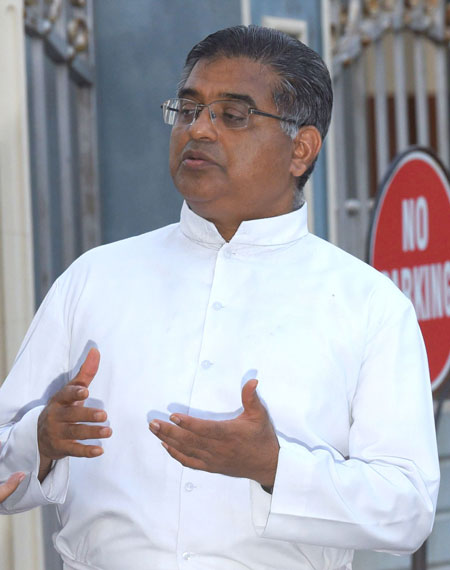
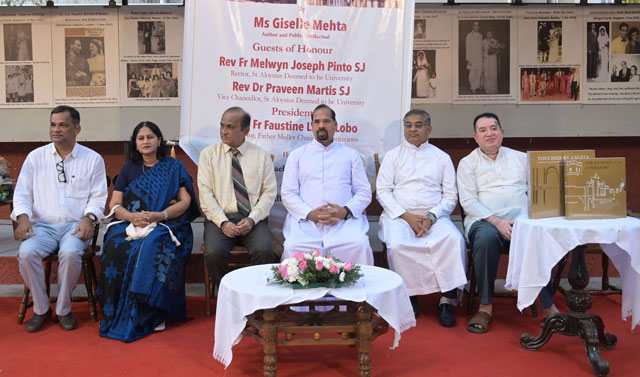
Long ago, on Edgha Hill or the Lighthouse Hill, or the place around it, there were three lords - the Bishop of Mangalore, the judge who had a bungalow at the present site of the college building, and the Rector of the college. The post was much respected, if not feared, in the years that went by. Fr Melwin laughed when he was informed, “As Rector of St Aloysius College, you are one of the three lords.” He practiced what he preached, and his sermons were well prepared, apt to the occasion, and directed at enlightening the young minds to whom he had to address very often. In the course of my research for The Echoes of the Corridors – A Portrait of St Aloysius College, I had met him several times. “Let us think out of the box,” I said while in conversation. He went one step ahead and said, “Let us throw the box itself.”
The duo, Fr Melwin and Fr Praveen Martis, burnt the midnight oil in securing university status for an institution that was 144 years old. It was only in 2024 that a university was created, and it stands as an enduring symbol of Jesuit ingenuity and munificence. Fr Aloysius Ambruzzi, the Rector and Principal, the last Italian to lead St Aloysius, had said in 1932, “Very soon we will have a university,” signifying that the thought of a university was already churning in the minds of Jesuits who came after that. But it was only 92 years later that it came to reality.
St Aloysius College, from the beginning, has been a witness to epoch-making developments in the educational scenario in Mangalore. It had envisaged grander plans by putting up buildings, creating academic courses, introducing innovative measures, following government regulations, meeting people of goodwill who would contribute to the building of the institution, and many other things. And the college grew step by step. Rectors who occupied the chair sometimes had to be innovative, or continue the innovation started by their predecessors, or at times had to maintain the status quo and just go on. In short, the Rector was a pivot around which the entire institution revolved.
Among the many responsibilities he handled, perhaps the Rectorate at St Aloysius College became the epitome of his personality. The process of availing university status for the college was highly regulatory and labyrinthine. In the Jesuit hierarchy, obedience to the superior plays a major role, as personal preferences take a back seat and decisions are largely dependent on the superior of the community. The making of the university was a long-drawn process, where grit and determination, coupled with Jesuit training, were put to practical use. There were numerous visits to the corridors of power that Fr Praveen made to fulfil the regulatory conundrum that came as a challenge one after the other, with renewed vigour. The thought of giving up on the efforts occurred many times to both of them. Come the next morning, they would gather energy and pursue it with new vigour. “Let us not give up,” they said to themselves, even while looking at the dismal scenario that surrounded Indian higher education.
Their efforts were in sharp contrast to those of corporates who managed educational institutions. They had ways through the system which yielded quick university status to many institutions despite their recent beginnings. St Aloysius, with its long-standing contribution to education, had to stand in a long queue for that coveted moment to arrive. Fr Praveen and Fr Melwin, however, persevered, waiting for hours in the offices of the HRD Minister, UGC offices, several other government departments, and with political functionaries, almost like people out to perform an impossible task.
2026. The efforts led by Fr Melwin Joseph are there for everyone to see on the ground. As the university status was availed, St Aloysius has become a symbol of pride for Mangalore and Karnataka. The campus is home to almost 14,000 students who are scholars, beginning from LKG to PhD degrees. Apart from adding several courses, the streams of Law and Engineering were added from 2025, and Mangalore Jesuits are the first to introduce Law and Engineering degrees in Jesuit institutions.
All this change was possible due to the open mind and liberal thoughts of Rector Fr Melwin Joseph Pinto, who facilitated the smooth flow of things. His “throwing the box” meant that one can do good things even when there are rules. He believed innately that rules are meant to help people and not act against them. Today, looking back at what he has done for the institution, one can say, “He was a revolutionary,” in a most silent and unassuming way. Behind a visionary man was a hidden mentor to many, who used the mandate of his ordination to bring solace to the weak and marginalised. He was a ray of hope for students who could not afford their school fees and would walk that extra mile to become their support. He would elaborate many times on the wisdom behind the Jesuit education motto, “Forming men and women for others and with others.”
He has set a benchmark for the institution, a new direction into the challenging times of the world. There would be no reverse from such a position, but only an option to walk in the steps shown by Rector Fr Melwin Joseph. He has formed a legacy that needs to be continued. In his untimely departure, he has made a point—and in a very telling manner—that the time to do good things is right now, and everything else can wait for tomorrow, which no one has seen.
Following is excerpt of his Rectorate from the coffee table book – The Echoes of the Corridors- A Portrait of St Aloysius College
‘Fr Melwin Joseph Pinto became the 27th Rector of the College when he assumed the post in 2020. The time he took over was critical as the pandemic did not show any signs of departure. The college which bustled with cackles and hoots of the students had fallen silent. The campus had never witnessed such absence in its life. There was a sense of fear in everyone and the Rector echoed the same when he said “The whole humanity is trying to recuperate from its effect. The loss of livelihoods has been traumatic especially for the poor and the needy. The catastrophic socio-economic impacts have affected us on an unprecedented scale. And yet there always appears a ray of hope. We have learnt to survive in this transitionary world with a new set of priorities. That is precisely seeing things anew.” There were indeed challenges and Rector Fr Melwin was anchoring ably these turbulent times. The Colleges and Schools gave enough fee concession to the many needy students and many were helped. In a true Jesuit spirit, food supplies were given to many needy and marginalised people. The raging effects of the pandemic remained for almost two years during which to think of undertaking any new venture was out of place. But academically, there have been changes with the introduction of National Education Policy -2020 and its implementation was an engrossing task. The NAAC Assessment- 2023 has enhanced the ranking of the College to A++ with 3.67 cumulative grade points out of 4, giving the College a crown of academic and overall excellence. Fr Melwin Joseph guided all affairs during these critical academic exercises. The Paintings in the father’s rectory in the old building were in total state of decay, were restored by his initiative. A separate archive section was created with the airconditioned space and order was introduced to the careful preserving of documents. The commissioning of coffee- table book covering the growth trajectory of the College was undertaken by Fr Melwin’s initiative.’