April 3, 2026
Most of the people know that Good Friday is the day Jesus Christ was crucified and died on the cross. Then why is the gruesome, terrifying day of death is called Good Friday instead of Sad Friday or Bad Friday?
It is because Christians believe that:
- Jesus Christ, the God, the creator of the universe, took humanity to redeem mankind from the sin inherited by the disobedience (to God) of the first man, Adam. Jewish religious leaders, out of jealousy, falsely accused innocent Jesus and pressured the Roman Governor of the region Pilate (Jews were under the Roman Kingdom) to crucify Jesus.
- Even though He was innocent, Jesus did not retaliate; He did not use His divine power. Instead, He humbled, sacrificed Himself on the Cross, taking sins and inequities of humanity of all generations upon Him. This was foretold a few centuries ago in the Scripture Isaiah 53 and written in Psalms 22 and Jesus fulfilled them on the Cross, completing His mission of redemption of the mankind from the sins and inequities. Christians believe that those who accept Jesus as the saviour and confess their sins receive forgiveness and thereby eternal life.
That is why the day is an eventful day, it is the greatest day that brought hope to humanity and is really Good Friday!
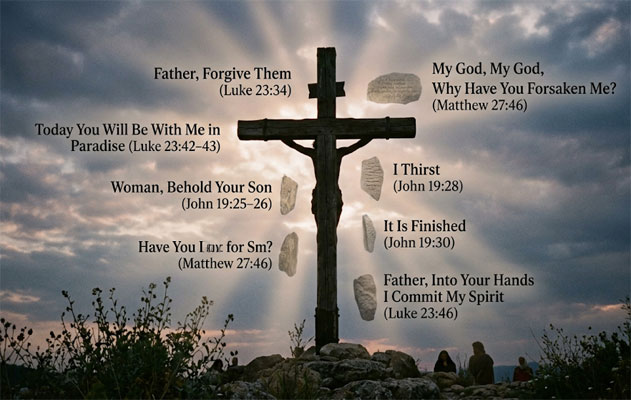
Cross and Last 7 Words of Jesus on the Cross
Most of us have heard about the cross. Some of us have grown up with it on our walls, around our necks, on the cover of the Bibles. But familiarity can be dangerous, as it can make us forget what the cross really was. In reality, death on the cross (Crucifixion) was a terrifying death to the victims, with intense suffering and torment as the body hangs on nails, difficulties in breathing due to body weight is pulling down, and slow death by bleeding. It was the capital punishment in the Roman Kingdom for criminals in those centuries.
A real man Jesus, was nailed to the Cross, suffering excruciating pain, bleeding out in front of a watching crowd. And in the middle of all that, He spoke. Seven times. Not in panic. Not in rage. Each word deliberate, each word weighted with meaning that we are still unpacking two thousand years later.
Let's slow down and see.
1. "Father, Forgive Them"
Luke 23:34
This is the first thing Jesus says from the cross. Not a scream. Not a curse. A prayer for the people killing Him. Think about that for a moment. The soldiers driving the nails. The religious leaders who engineered His death. The crowd jeering below. And Jesus looks up and says, "Father, forgive them. They don't know what they're doing."
This wasn't weakness. This was a man who had spent His entire life teaching His followers to love their enemies, pray for those who hurt them, forgive without limit. And now, at the moment of maximum pain, He did exactly that. He didn't just preach it, He lived it, even as He died.
The prophet Isaiah had written, centuries before, that God's Servant would "intercede for the transgressors" (Isaiah 53:12). Here it was happening. In real time. On a hill outside Jerusalem. He could have called down judgment. Instead, He prayed for mercy. That's the kind of Saviour He is.
2. "Today You Will Be With Me in Paradise"
Luke 23:42–43
Two criminals were crucified alongside Jesus that day — one on each side. They had both seen the same thing. Heard the same prayer. Watched the same man suffer. One mocked Him. One turned to Him. The one who turned had nothing to offer. No good deeds. No religious credentials. No time left to clean up his life. He was a man at the end of everything, asking simply — "Remember me." And Jesus said, "Today." The most immediate, generous, unconditional response imaginable.
This man's story is really every person's story. We are all, in some way, at the end of our rope, guilty, helpless, with nothing to bring. And the offer of Jesus is exactly the same: come as you are. Today.
3. "Woman, Behold Your Son"
John 19:25–26
Most people had run. When Jesus was arrested, His disciples scattered. But a small group stayed among them, His mother Mary, and His closest friend, John. Mary couldn't stand to watch. But she couldn't leave either. A sword was piercing her heart just as old Simeon had warned her thirty years before when Jesus was a baby (Luke 2:34–35).
And Jesus, even now, notices her. Even in His dying moments, He looks at His mother and makes sure she will be cared for. He entrusts her to John and John to her. This is a deeply human moment. A son, thinking of his mother. Making arrangements. Making sure she won't be alone.
But it is also a deeply profound moment. Even at the cross, Jesus models what it looks like to honour the people who raised us. He had been doing it His whole life as a child in Nazareth (Luke 2:51), as a teacher who never let spiritual devotion become an excuse to neglect family responsibility. Spiritual life and human responsibility are not opposites. Jesus held them together, right to the end.
4. "My God, My God, Why Have You Forsaken Me?"
Matthew 27:46
This is the word that stops you cold. He had been silent through so much — the betrayal, the false trial, the flogging, the nails. But now, at the darkest hour, He cries out. Not to the crowd. Not even to His mother. To God. And God seems silent. What was happening in that moment is the deepest mystery of the cross. Jesus was not simply dying a painful death. He was bearing something far heavier — the full weight of human sin. Everything that separates us from God. He was taking it on Himself.
The Bible says sin leads to death — and to separation from God. That's just the honest description of what sin does. It breaks the connection. It cuts us off. And Jesus, the one who had never sinned, experienced that separation, so we wouldn't have to. He was forsaken, so we could be forgiven. He was cut off, so we could be brought near.
5. "I Thirst"
John 19:28
Two simple words. This is the God of the universe, in a human body, genuinely thirsty. He didn't use some divine power to bypass His own pain. He felt it all. Every burning hour of it.
That matters. Because when life becomes genuinely hard for you, when you're exhausted, when you feel forgotten, when suffering doesn't seem fair, you have a Saviour who knows what that feels like from the inside. Not theoretically. He's been there.
6. "It Is Finished"
John 19:30
In Greek, one word: Tetelestai. It was the word written across a paid debt in the ancient world. Stamped across an account. Settled. Cleared. Done. The work He came to do, to save people from sins fully, finally, completely done. Nothing left to add. No further payment required. He paid it all. This is the most powerful word that Jesus spoke at the cross, which resounds through generation. No more need of any work to be forgiven from sins, just believing and accepting what Jesus finished for us.
7. "Father, Into Your Hands I Commit My Spirit"
Luke 23:46
His last word. And notice , after the silence of God. Even after the darkness. He lays down His life not because it was taken from Him, but because He chose to give it. The mission was complete. He gave life so that we may have life in abundance.
Christians believe Jesus remembered all of us when he was at the cross. He loves us. Death couldn’t hold him back; He is risen and alive today. Those who believe in Him, will have eternal life. Let us celebrate Jesus!