February 4, 2026
“So, Mr. Dsouza, what is your preferred choice of drink?”
The man seated next to me on the flight had grown quite comfortable after the congenial chat we’d shared over the last fifteen minutes—a conversation that drifted across varied topics, from Costa Rica’s Blue Zone to the Masai Mara reserve, from the intricacies of flight operations to the nitty-gritties of how many drinks one is allowed to consume on a three-hour flight.
On a short Air India flight from Dubai to Mumbai, I thought I had finally found some good company. That was until the gentleman, likely in his early fifties, popped the aforementioned question.
The in-flight service had just begun, and the delightful air stewardess even handed me a couple of extra packs of peanuts along with my glass of water, clearly remembering that we hailed from the same town.
“Well, water,” I said, pointing to the glass.
“Well, that is disappointing,” came the immediate reply.
“Well, sir, I’ve had worse reactions than this. I’d take ‘disappointing’ any day over being called useless,” I said matter-of-factly.
“Mangaloreans are wonderful people who know how to enjoy life, and here you are, denying free spirits,” he remarked.
I’ve always been uncomfortable with the way everyone from Mangalore to Kundapur—and further along the coast—is conveniently bundled under the label Mangaloreans. A friend once explained this to me, not without a hint of arrogance: “Mangalore is the biggest city around. The smaller towns don’t really matter.” It’s a pill that has been hard to swallow and I find don’t find any truth in it.
The irony became evident when his father seemed genuinely astonished that small towns even had marriage halls, upon receiving an invitation to my marriage with Verina.
“Well, Mangaloreans are free-spirited, Sir, we don’t need any spirits inside us to enjoy ourselves,” I replied, not one to be bogged down
There was an awkward silence between us.
“Well, sorry for generalizing. I have quite a few friends from Mangalore, and you guys are wonderful, sweet people,” he tried to cover his tracks.
“Not all, sir,” I laughed.
He got my point, and for the next hour, we continued our conversation, hopping from travel tales to cultural quirks, all the while keeping an eye on the beverage cart. I was getting high on orange juice, while my friend was filling his belly with beer (he had five beers in those 2 hours 45 minutes)
It was rare to find someone who could effortlessly combine knowledge, humour, and curiosity in equal measure. I realized that sometimes the best part of a flight isn’t the view or the service—it’s the company you keep and the stories you collect along the way.
All the while, as we talked, my mind wandered to the image the world has of a Mangalorean—or perhaps it had something to do with the faith I follow, or maybe even my name. I’m not sure. I think it’s the name. People tend to find religion in names.
This wasn’t my first experience of being singled out for being from the coastal province of Karnataka. There had been numerous occasions across the country, but this one hit closer to home, because it involved me being called a drunkard, perhaps. How could someone assume I drink because of where I come from? It did not sit well with me.
Not that I don’t drink—I enjoy an occasional glass of wine or a good whiskey or a good pint —but freeloading on an airplane just because drinks are being served? A big No, at least for me. ( I have seen many people do it, not only in Air India Express, but many other well knows flights, especially in higher classes ??. Who am I to stereotype?)
The stewardess came up with our food. I usually opt for vegetarian food while travelling.
We both looked at each other.
The gentleman had an expression of “Really? WTF” written all over his face.
We laughed.
“You taught me a big lesson today” he said, as he turned his focus on his tray of food.
I just nodded, being polite, the way most Mangaloreans or Coastal Karnataka dwellers are—well, if we are to be generalized, it better be for our good habits and not the bad ones.
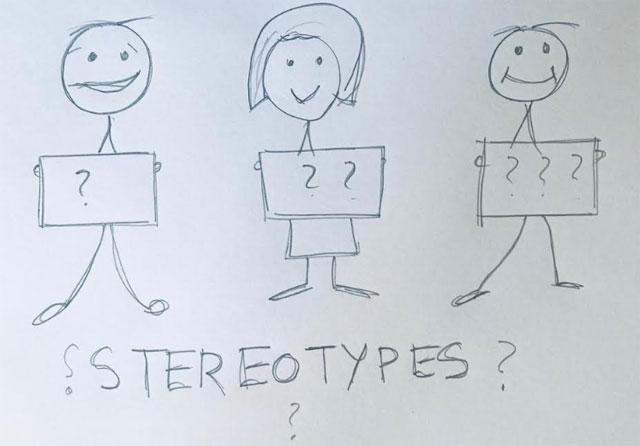
Why do we have this habit of generalizing? Why do we consider Goans laid-back, Mangaloreans drunkards or dons, Gujaratis thrifty, Parsis wealthy, Punjabis loud, Keralites educated, Tamilians traditional, Bengalis artistic, Delhiites aggressive, and so on and so forth?
As the flight neared Mumbai, our conversation drifted to lighter topics—food, local festivals, and travel anecdotes that made both of us laugh like old friends. Yet, in the back of my mind, the earlier exchange lingered. It wasn’t just about drinks; it was about assumptions, how easily a person can reduce someone’s identity to a stereotype, a word, a region. Why do we stereotype people and not look at them individually? A thought that constantly swirled around my brain.
And yet, here we were, two strangers on a plane, proving that stereotyping can go horribly wrong.
As our flight began descending, he sheepishly said, “You know, I really shouldn’t have jumped to conclusions. I just assumed—” He paused, searching for words. “I assumed things about Mangaloreans. I didn’t think twice.”
“No problem at all, sir. Happens all the time. To be honest with you, I too had a picture of you in my mind, but the five beers you guzzled down have completely changed it,” I replied with a smile.
People are much more interesting than the boxes we put them in. As we moved to the snaking immigration line, I thought about all the stereotypes people cling to, how wrong we could be sometimes, and how right we could be many times. Maybe it’s human nature to box people for easy reference, only to realize that when we look outside the box, the real stories are waiting to be discovered.
With a happy smile, I thanked the beer-guzzling stranger for an enlightening 2 hours and 45 minutes.