January 16, 2026
Just out in 2026, the book by two great scholars and well-known authors, Lancy Lobo and Denzil Fernandes, is bound to make waves of no small proportion. One significant sentence captures its essence: “During the last three decades, Hindutva nationalism and authoritarian populist majoritarianism have crept into the socio-political ethos of the country, which stands in complete contrast to the spirit of the official Indian Constitution, which is liberal, inclusive, pluralistic, and democratic.”
This book keeps pace with the ongoing debate in India on Christians and their credibility and is seen as optimistic and positive, as facts cannot be ignored or swept under the proverbial carpet. People and critics are aware of the truth and reality of Christianity in India, which has followed a conservative growth trajectory. Christianity arrived in South India (Kerala) in 53 AD through the Syrian Apostle Thomas, just 20 years after the crucifixion of Jesus Christ, even before it reached the West. In a nutshell, the book states that “Christianity in India is as old as Christianity itself.” The recognisable spread of Christianity took root around 500 years ago, following the arrival of Europeans in the 1500s.
This compact book carefully documents the contributions and generosity of Christians, mainly Roman Catholics, and their marked impact on the Indian subcontinent before and after Independence in 1947. Published by world-renowned publishers, it is a book that must be read by educated and enlightened readers interested in the new scenario India finds itself in within the 21st-century world order of 2026 and beyond. The erudite authors have dedicated their 152 closely packed pages, along with superbly selected black-and-white portraits, to “Christian men and women working in different fields for the progress and development of India.” Let us take a brief look at the salient details of this book through its own content, which is set to soon become a “best seller.”
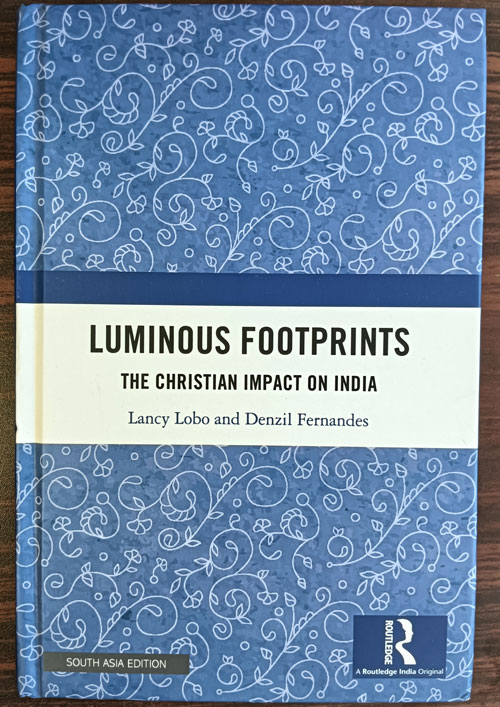
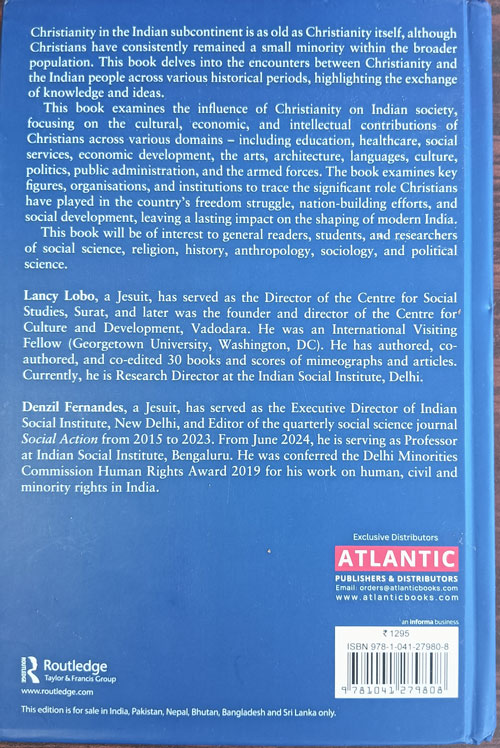
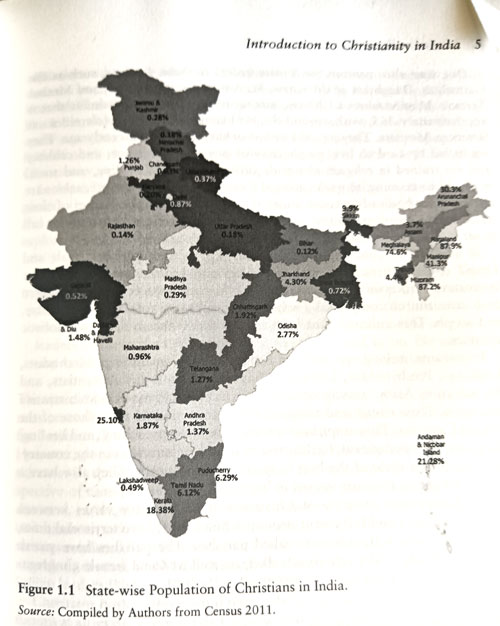
Indeed, Christianity in the Indian subcontinent is as old as Christianity itself, although Christians have remained a balanced, traditional small minority within the broader population. This book delves into encounters between Christianity and the Indian people across various historical periods, highlighting exchanges of knowledge and ideas. It examines the influence of Christianity on Indian society, focusing on the cultural, economic and intellectual contributions of Christians across diverse domains, including education, healthcare, social services, economic development, the arts, architecture, languages, culture, politics, public administration and the armed forces. The book studies key figures, organisations and institutions to trace the significant role Christians have played in the country’s freedom struggle, nation-building efforts and social development, leaving a lasting impact on the shaping of modern India. It will be of interest to general readers, students and researchers in social science, religion, history, anthropology, sociology and political science.
The foreword by Neera Chandhoke, Distinguished Fellow at the Centre for Equity Studies, New Delhi, does justice with punch and impact. To quote her words for clearer understanding: “Today, at a time when minority religions are disrespected, and an unnecessary focus is placed on upper-caste, Sanskritised, Brahmanical Hinduism as the only culture that defines India, it is important to reflect on how different cultures have contributed to the creation of a plural society. A plural society is marked by the juxtaposition of various cultures in the social, cultural, aesthetic and literary realms. As we walk through the gardens of many religions and their cultures in India—Hinduism, Buddhism, Jainism, Sikhism, Islam and Christianity—we become conscious that our cultural contexts are shaped by the poetry of Ghalib, the teachings of Christ and Guru Nanak, the imaginaries of Gautama Buddha, as well as the magnificent prose of Munshi Premchand. Our thinking and language acquire depth and profundity. We attain freedom from the weight of one tradition that bears heavily upon the present. The moment we recognise that shared traditions have contributed to our culture, we do not need a fixed identity marker or a hook we desperately cling to for security. We do not look for an unbreakable anchor that connects us to land because we tremble in fear at the stormy waters of the sea. We delight in our freedom to choose our own anchor or none. We are intellectually free because we can transcend bonds.”
She further writes: “This volume lets us understand that Christianity in India is as ancient as the religion itself. This is needed to understand and appreciate our rich cultural heritage because we are not only speaking of academic debates on conducting a historical investigation. When ruling classes tie history to their projects of power, the past is interpreted in simplistic and often crude terms. This is particularly true of the right wing in India, which reads the entirety of Christianity in India as one of conversion, overlooking the contributions of the faith to the building of national culture.”
Referring to the 650th anniversary of the great poet and statesman Amir Khusro, she recalls Jawaharlal Nehru’s speech titled “Amir Khusrau—Symbol of India’s Composite Culture.” Nehru said India has a dream—sometimes realised and sometimes lost. What is that dream? “Many streams and rivers of ideas, language and cultures have flowed into India from other countries and joined her vast cultural bloodstream. For thousands of years, it has been India’s consistent effort to synthesise and adopt the thoughts and ideas that flowed in, and to change and be changed by them.” She adds that ugly majoritarianism has gripped culture and society in a closed fist, diminishing the Indian mind and constricting imagination and inventiveness. Recollecting shared legacies and remembering how different cultures came together is what India owes to history, the present and the foreseeable future. A deep introspection, she notes, will result in insights.
Amit Mitra, Independent Researcher, New Delhi, comments: “Christians see themselves as Indians first, with their religious identity taking a secondary place. The forces of Hindutva oppose them because, being based on high levels of social and gender inequality, a large section of the Hindu population is excluded and deprived due to the caste system. Drawing on Jesus’ teachings and practices, missionaries seek to bring about equality but end up becoming a thorn in the flesh for Hindutva forces, who falsely claim to be Hindus. I would strongly recommend that this book be widely disseminated in society at large, especially among those seeking to understand the interrelationship between power, religion and nation-building.”
Brief on the authors:
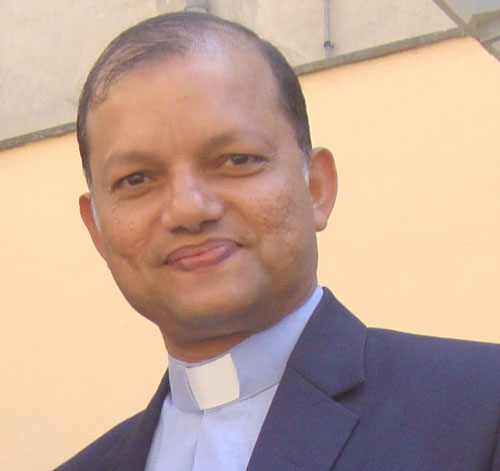
Lancy Lobo, a Jesuit, has served as Director of the Centre for Social Studies, Surat, and later as founder and director of the Centre for Culture and Development, Vadodara. He was an International Visiting Fellow at Georgetown University, Washington, DC. He has authored, co-authored and co-edited 30 books, along with numerous mimeographs and articles. He is currently Research Director at the Indian Social Institute, Delhi.
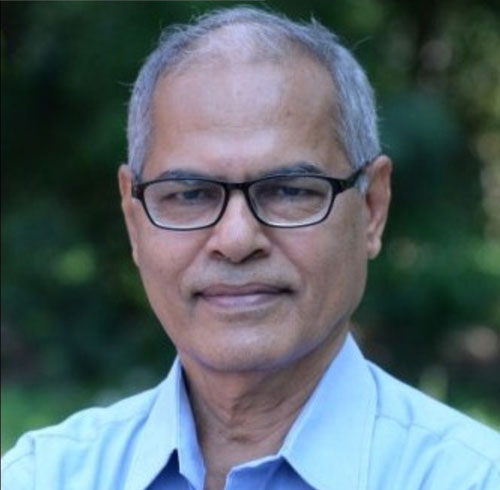
Denzil Fernandes, a Jesuit, has served as Executive Director of the Indian Social Institute, New Delhi, and as Editor of the quarterly social science journal Social Action from 2015 to 2023. Since June 2024, he has been serving as Professor at the Indian Social Institute, Bengaluru. He was conferred the Delhi Minorities Commission Human Rights Award in 2019 for his work on human, civil and minority rights in India.
The final paragraph of the book, on page 140, is insightfully prophetic and perhaps divinely inspired. It states: “India has a laudable aim of becoming a global superpower by 2047. To achieve this, it has to speedily upgrade the country’s education and health levels to global standards. However, prevailing Hindutva ideological compulsions are more interested in romanticising the past than crafting a new future. The rise of an unscientific temper, eagerness to replace history with mythology, science with metaphysics and knowledge with religious piety will put roadblocks to India becoming a superpower. India needs a vision that believes in equality, inclusiveness and growth with equity for all its citizens. Christians in India are committed to realising this vision.”
With this, readers are left to digest this significant book and reflect on priorities for just action as common citizens.
Note to get the book:
Exclusive distributors: Atlantic
Email: orders@atlanticbooks.com
ISBN: 978-1-041-27980-8
Published by: Routledge