From Deadly Venom to Life-Saving Medicine: India’s Hidden Potential

January 8, 2026

When I first learned that more than 58,000 people die every year in India due to snakebites, my immediate reaction was fear. For centuries, snakes have been associated with danger and death. Yet modern science has revealed a surprising truth: the same venom that kills can also save lives. Nobel laureate Dr David Julius, whose research transformed pain biology, has observed that “venoms are incredibly powerful tools for understanding biology because they act with extraordinary precision.” This precision is exactly what makes venom so valuable to modern medicine. Snake venom, once regarded only as a lethal poison, is now helping scientists develop important drugs. What appears to be a contradiction is, in reality, one of the most compelling stories in biomedical science.
The Medicine Hidden in Venom

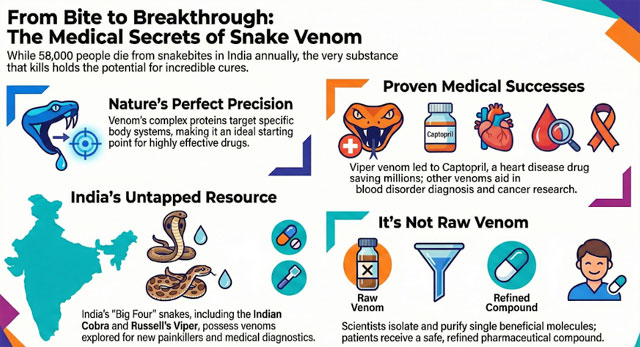
This story begins not in India, but in Brazil. In the 1960s, Brazilian researcher Dr Sérgio Ferreira discovered that compounds in the venom of the Brazilian pit viper could regulate blood pressure. His work eventually led to the development of captopril, one of the world’s first and most widely prescribed drugs for hypertension and heart disease. Reflecting on such discoveries, Nobel Prize–winning pharmacologist Sir John Vane famously remarked that “nature has often been the best chemist.” Venoms, refined through millions of years of evolution, exemplify this idea. This was not a one-time breakthrough. Venom from the saw-scaled viper is now used in laboratories to diagnose blood-clotting disorders. Compounds derived from black mamba venom are being studied as potential painkillers that may avoid the addictive risks of opioids. Copperhead venom has shown promise in cancer research by interfering with the spread of tumour cells.

India’s Snakes and Their Scientific Promise

India is home to some of the world’s most medically significant snakes, including the well-known “Big Four”: the Indian cobra, Russell’s viper, the saw-scaled viper, and the common krait. While these species are responsible for many snakebite deaths, their venoms also possess immense scientific value. Leading toxinologist Professor Bryan Fry has highlighted that “venoms have evolved to be exquisitely selective, making them ideal starting points for drug development.” This selectivity explains why venom-based research continues to attract global scientific attention. Indian cobra venom is being explored for applications in pain management and cancer therapy, while Russell’s viper venom is already used in diagnostic tests for blood coagulation disorders. These examples reveal an important reality: India’s snakes are not only a public health challenge, but also a largely untapped biomedical resource.

Why Venom Works So Well

Snake venom is not a single toxin. It is a complex mixture of proteins and enzymes, each designed to target specific physiological systems such as nerves, blood, or cells. This natural targeting ability is exactly what modern drug discovery strives to achieve. Importantly, venom itself is never used directly as medicine. Scientists isolate beneficial molecules, modify them to ensure safety, and test them rigorously over many years. What reaches patients is a refined pharmaceutical compound—not venom.

The Road Ahead

India has more than 300 snake species, many of which remain poorly studied. Institutions such as the Institute of Bioinformatics and Applied Biotechnology in Bengaluru and the Irula Snake Catchers Cooperative Society in Tamil Nadu are supporting ethical venom research while promoting conservation and public safety. Transforming venom into medicine is slow and uncertain, and many promising compounds fail along the way. Yet when research succeeds, the impact can be extraordinary. Captopril alone has saved millions of lives worldwide. India faces a severe snakebite crisis, but it also holds the potential for future cures. When understood and used responsibly, nature’s deadliest substances can become powerful tools for healing.


By Aryan Vasishta
Aryan Vasishta is a BTech biotechnology 2nd semester student at NMAM Institute of Technology, Nitte (Deemed to be University). He is interested in biomedical research, toxicology, and science communication, and writes on biotechnology, the intersection of public health, and biodiversity.
To submit your article / poem / short story to Daijiworld, please email it to news@daijiworld.com mentioning 'Article/poem submission for daijiworld' in the subject line. Please note the following:

  • The article / poem / short story should be original and previously unpublished in other websites except in the personal blog of the author. We will cross-check the originality of the article, and if found to be copied from another source in whole or in parts without appropriate acknowledgment, the submission will be rejected.
  • The author of the poem / article / short story should include a brief self-introduction limited to 500 characters and his/her recent picture (optional). Pictures relevant to the article may also be sent (optional), provided they are not bound by copyright. Travelogues should be sent along with relevant pictures not sourced from the Internet. Travelogues without relevant pictures will be rejected.
  • In case of a short story / article, the write-up should be at least one-and-a-half pages in word document in Times New Roman font 12 (or, about 700-800 words). Contributors are requested to keep their write-ups limited to a maximum of four pages. Longer write-ups may be sent in parts to publish in installments. Each installment should be sent within a week of the previous installment. A single poem sent for publication should be at least 3/4th of a page in length. Multiple short poems may be submitted for single publication.
  • All submissions should be in Microsoft Word format or text file. Pictures should not be larger than 1000 pixels in width, and of good resolution. Pictures should be attached separately in the mail and may be numbered if the author wants them to be placed in order.
  • Submission of the article / poem / short story does not automatically entail that it would be published. Daijiworld editors will examine each submission and decide on its acceptance/rejection purely based on merit.
  • Daijiworld reserves the right to edit the submission if necessary for grammar and spelling, without compromising on the author's tone and message.
  • Daijiworld reserves the right to reject submissions without prior notice. Mails/calls on the status of the submission will not be entertained. Contributors are requested to be patient.
  • The article / poem / short story should not be targeted directly or indirectly at any individual/group/community. Daijiworld will not assume responsibility for factual errors in the submission.
  • Once accepted, the article / poem / short story will be published as and when we have space. Publication may take up to four weeks from the date of submission of the write-up, depending on the number of submissions we receive. No author will be published twice in succession or twice within a fortnight.
  • Time-bound articles (example, on Mother's Day) should be sent at least a week in advance. Please specify the occasion as well as the date on which you would like it published while sending the write-up.

Comment on this article

  • Rudolf Rodrigues, Mumbai-Mangalauru

    Fri, Jan 09 2026

    Dear Aryan; very informative article; keep writing on such, otherwise, untouched subjects! BTW; there is a doctor, named Himmatrao Bhavaskar, in Maharashtra who has dedicated his life to the study of scorpion venom deaths, which would kill a lot of villagers there; he has also found a potential remedy for Brugadda Syndrome from scorpion venom; also his deep study on the subtle, initial, symptoms of Krait bite! Please do read his book and works; you'll widen your knowledge base!

  • Jossie Mascarenhas, Bajpe

    Thu, Jan 08 2026

    Really insightful piece! It’s fascinating how something as feared as snake venom is now being studied to develop life-saving medicines. The article highlights both the danger and immense potential of venom in modern biomedical science, showing that nature often holds the keys to healing. It’s inspiring to see Indian scientific efforts and global research coming together in this field. Thanks to the author (Mr. Aryan) and DW for bringing such an informative and thought-provoking topic to light - a great read for everyone interested in science and health!

  • Rita, Germany

    Thu, Jan 08 2026

    Dear young man ,It is a very interesting and informative article too.There are many deaths due to snake bites in India ,not getting medicine in time.Mostly in rural areas.Wish it would be better in future .In Australia also there are many poisonous snakes like black Mamba .Hope India may provide antivenom Sera to save normal people.Wishing you all the best in future and studies.


Leave a Comment

Title: From Deadly Venom to Life-Saving Medicine: India’s Hidden Potential


You have 2000 characters left.

Disclaimer:

Please write your correct name and email address. Kindly do not post any personal, abusive, defamatory, infringing, obscene, indecent, discriminatory or unlawful or similar comments. Daijiworld.com will not be responsible for any defamatory message posted under this article.

Please note that sending false messages to insult, defame, intimidate, mislead or deceive people or to intentionally cause public disorder is punishable under law. It is obligatory on Daijiworld to provide the IP address and other details of senders of such comments, to the authority concerned upon request.

Hence, sending offensive comments using daijiworld will be purely at your own risk, and in no way will Daijiworld.com be held responsible.