December 22, 2025
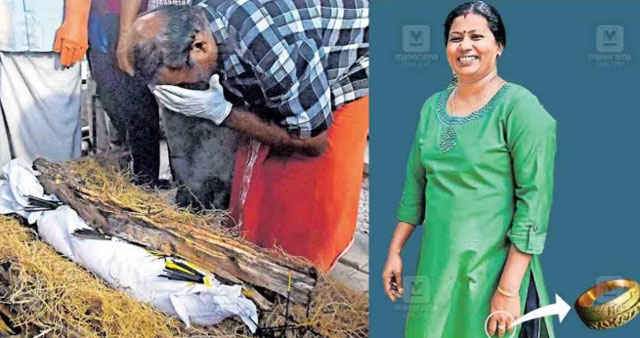
The picture above is a pyre, an unusual one, because it contains only the hand of a dead body that was discovered from the river as it swelled with a cloud burst, resulting in sudden flash floods. Two hundred and twenty-nine people died and another hundred went missing in Wayanad in Kerala in early August 2024. The weeping man, Ramaswamy, is the father of Jisha, whose hand was kept for cremation that alone was what he got from the flooded river. The hand was recognised as that of Jisha because of a ring on one of her fingers, which had the name of her husband Murugan. Ramaswamy’s wife Thankamma, his son-in-law Murugan and his two year old grandchild Akshay died in the floods. Jisha’s body was never recovered, except for the hand. Just as Murugan, Thankamma and Akshay could not be recovered, the old man could do the obsequies only for the hand.
The picture and the connected information would wake up an abundance of unregulated emotions creating self-piercing thoughts that crowd in any human mind which stays stunned, unable to respond to the pitiful realities. This is because every person has the essential goodness as a human which is vastly different from other living creatures. This essential goodness is what every human is born with. True enough; an individual could have inherited through traits, an essential element of the human body and mind which can shower shadows on this essential goodness.
Concern for other beings is an inherent nature of all humans and they get expressed at times of suffering as well as ecstasy, both can become uncontrollable too.
It is useful to refer to a recent instance that happened in my drawing room. A neighbour of mine was in a casual discussion with me and it narrowed down to one of the estates that I built up in the Guthigar village of Sullia Taluk a few years ago. The subject of discussion was on the miserable state of casual workers. I was narrating the story of a worker, whose one year old child passed away and the information was brought to me by a messenger. I immediately summoned him from the work spot and asked him to go home. I did not give him the truth about the sad demise of the child. I mentioned to him that the child was seriously ill. He went away and came back by lunch time, providing me with a big shock. Of course, he was downcast but joined the other workers. I called the supervisor and asked him why that man had returned to work, after seeing his dead child. Reluctantly, the supervisor mentioned to me that the man was worried that he would lose his attendance and thus lose a day’s payment for work if he did not come back. I instructed the supervisor to mark him present and send him home to be with his wife. By the time I finished my story, my neighbour who was listening to the story was crying and with his right hand he closed his mouth so that he would not make any noise of his crying. He did not know the worker or his family, he had never met them, the actual incident happened several years ago, the subject came up accidently. Yet my neighbour was in tears.
It is human nature to grieve and feel for others including other beings. No man can stop doing it. Of course, some people have learnt to regulate such feelings for others.
Consider the story of six year old Hind Rajab who pleaded to be rescued after her family’s car came under fire in the war ravaged Gaza city, where six members of her family were killed. Her cousin, fourteen years old Layan Hamade, was also not killed. She telephoned the Palestine Red Crescent Society which sent two paramedics who reached the spot and within twenty-five feet of reaching the car, they were killed by the Israeli forces. A little later Layan Hamade was shot dead at close range. However, Hind Rajab was not noticed, and therefore, she phoned the same number again. While she was pleading to the person at the other end of the phone to save her because she was scared, there was a loud explosion, followed by silence from Rajab’s phone. Rescue workers later noticed that in the explosion, the back torso, the hands and a foot of the child were blown up. They also counted three hundred and fifty-five bullet holes on the car which was in pieces.
Kaouther Ben Hania, a Tunisian filmmaker made a short film, titled ‘Voice of Hind Rajab’ on the incident, which won the Grand Jury Prize and Silver Lion award at the Venice International Film Festival two thousand twenty-four. After the screening, the spectators and the organisers stood up and clapped for a long twenty-four minutes, a record in appreciation of anything in the world.
The long applause was for the young child by the whole world, indeed a sign of mature expression of human concern for others, for especially those who were in pain, more especially for children in distress. These are natural and cannot be regulated at all.
Tickles of kindness and concern can influence others to join in, transforming the resulting trickles into rivers of consideration for others. This indeed is natural.
Saugandhika, Udaya and Sachitra are members of a forest saving organisation. In Vithura Ponnudi Road they saw two young monkeys falling down after both of them came into contact with a high tension power line. While one of them fell on the branch of a tree and settled there, the other crashed down onto the black topped road, unconscious and with a wound on his forehead. The three women from the Kani Tribal Settlement near Vithura rushed to the scene. One of them immediately administered CardiopulmonaryResuscitation in an attempt to revive it. The baby monkey woke up. The three ladies offered basic treatment to the wound and released the monkey into the forest. A statement made by one of the ladies caught the attention of the world as the news got into channels and newspapers. She said that crops were destroyed by wild animals like boar, elephant and bear incursions, yet the women had always lived alongside the forest and its creatures. “We could never think of turning our back on that baby monkey,” one of them added.
It is inevitable that humans have a direct connection with the animal kingdom. Kindness and concern for animals is a part of the human personality; without these animals, humans cannot exist in the world because that love for the animals is also one of the basis for the love of other human beings by all humans.
Jenny Steppian was standing in front of a church in Pittsburgh, in the United States. She was getting married, a postponed one because of her father’s demise. It was then that a person in his fifties touched her shoulder and introduced himself. He told her, after taking her right hand and putting it on his chest, that she was feeling the heartbeat of her father, who died sometime earlier. Her father was shot dead by a thief and she had decided to donate the heart to a needy person who, in a sense, experienced his second birth by receiving her father’s heart. However, they did not meet each other because there was no rule to publish the name of the organ recipient in the United States. Jenny is supposed to have asked that man to take her to the church as any father would do. Jenny wrote in her post with the title ‘Jenny and her father’s heart, the greatest day in my life’.
There are extremely strange and rare things that can happen in people’s lives. There are no predictions of what happens in human relations, quite often, unpredictable. Indeed, once discovered, these human relations proclaim to the world the sanctity of relating to others.