December 14, 2025
Importance of Monkey Day
Monkey Day is celebrated internationally on 14/12/2025 to raise awareness about non-human primates and to save all their species. This day was founded by Americans Casey Sorrow and Eric Millikin in AD 2000. Monkeys are intelligent animals after humans. Monkey Day was founded to celebrate monkeys, as well as “all things simian,” which includes lemurs, tarsiers, apes and other non-human primates.

It is a great day when it comes to raising awareness about different types of monkeys and primates around the world, as well as the issues they face and how we can help them. Monkey Day is particularly popular among animal rights and environmental activists, and visual artists and arts institutions. It also calls us to be compassionate towards all animals, as they also have the same right to live as we would in their place.
Celebration on Monkey Day
In India, the Indira Gandhi Zoological Park holds a number of different programmes so that children can become educated about issues facing wildlife and people are encouraged to adopt monkeys. The list doesn’t end there. In Pakistan, the Lahore Zoo goes the extra mile. They hold educational events and art competitions about monkeys, including performances highlighting the threats they face, poetry readings about monkeys, and much more. People celebrate by dressing in costumes, visiting zoos, creating art, and learning about primate species.
How monkeys look like
Scientifically, humans came into existence through monkeys in different stages. Thus, monkeys have a close relationship with humans. Their DNA is very close to human DNA. Monkeys closely resemble humans in their faces, hands, activities, behaviour and way of eating. They have fur all over their bodies except for their faces and hands, and their noses are flat like their faces.
Species of Monkeys
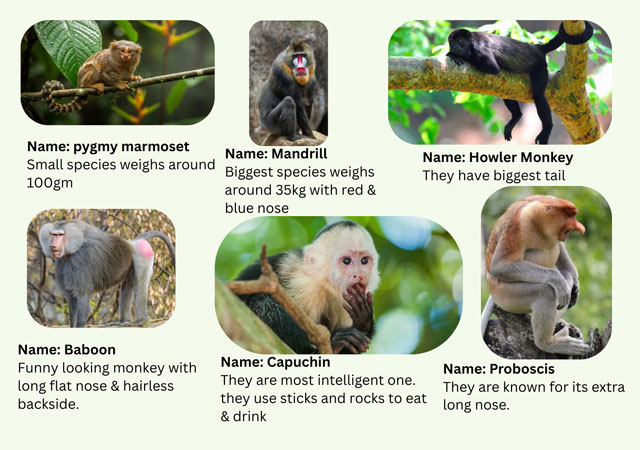
There are around 300 different types of monkeys on Earth, all of which look different and have different habits. From the world’s smallest monkey, the ‘pygmy marmoset,’ which weighs as little as 100 gram, to the world’s largest monkey, the ‘mandrill,’ weighing as much as 35 kg. It’s not just the size of their bodies that makes monkeys unique.
-
Proboscis – known for its extra-long nose
-
Spider monkey – known for its extremely long limbs and tail
-
Some monkeys have prehensile tails, and these act like an arm for jumping on trees
Monkey troops work together to find food, care for their young and protect one another. They socialise through sound. Howler monkeys are so loud that they can be heard up to 3 miles away.
Apes & Monkeys
Gorillas, orangutans and chimpanzees are not actually monkeys. They are apes. Apes lack tails, have broader chests, a more upright posture and greater intelligence and tool use, while most monkeys have tails for balance, narrower bodies, move quadrupedally (on all fours) and are generally smaller. Apes are not part of the monkey family but are closely related.
Where monkeys live
Monkeys live mostly in trees, forests and mountains where there are many trees to climb. They can even swim between trees. Some monkeys never leave the trees. They have extremely sharp nails to help them climb.
What monkeys eat
Monkeys normally eat bananas and even peel them much like humans do. That’s not all they eat. They also eat insects, leaves, berries and bugs. Larger species even eat small birds and creatures.
What monkeys do most of the time
Monkeys spend most of their time finding food. They invest a lot of energy grooming one another and hauling things out of one another’s fur. Some groups of monkeys rest during the day and come out in the evening.
Where do monkeys sleep?
Interestingly, monkeys sleep in nests which they build either in trees or on the ground using plants. They do not make much effort to make them comfortable, as they usually live in them only once.
How the monkey tail works
Monkey tails are long and can be very strong. Some species have tails strong enough to pick things up. They use their tails to balance while climbing trees and can even hang upside down from branches.
Monkeys communication
Monkeys communicate in many different ways, such as using facial expressions or hugging each other. In some cases, monkeys yell, chatter and click to send messages to one another.
How about monkeys’ intelligence
Unlike many other animals, monkeys are very smart and love to learn and solve puzzles. They can be taught tricks and use tools to get food and water. Monkeys can swim as well, and their intelligence helps them survive in most situations.
Baby monkeys
Mother and baby monkeys stay together most of the time. The mother plays with and cuddles the baby, helping them bond. Baby monkeys spend a lot of time on the backs of their mothers.
The life of a monkey
Female monkeys mature earlier than males. They can have babies between the ages of 4 and 8 years. Under normal conditions, monkeys can live up to 30 years.
How humans are dangerous to monkeys
Humans are dangerous to monkeys. Even though we do not eat them, we destroy their habitats. Some monkeys are seen as pests and are killed by farmers. Some hunters steal baby monkeys to sell them to circuses or keep them as pets. Many monkeys also die every day due to accidents.
How monkeys are helpful to humans
Monkeys help humans in many ways. They play an important role in seed dispersal in plantations. They are also used in the safety testing of new medicines and vaccines.
On this Monkey Day, let us be compassionate towards monkeys and all other animals. They reciprocate love equally and feel pain equally. Let us choose compassion.