Daijiworld Media Network - Washington
Washington, Nov 28: The US military has disabled a merchant vessel in the Gulf of Oman after it allegedly attempted to evade the American naval blockade of Iranian ports, the US Central Command (CENTCOM) said on Friday.
A US military aircraft fired precision munitions at the stern of the Palau-flagged merchant vessel M/V Pacific Archer on Thursday, disabling its propulsion system. The civilian crew aboard the vessel remained unharmed, according to CENTCOM.
The vessel had departed from the Iranian port of Bandar Abbas before attempting to breach the blockade. Ship-tracking websites listed Singapore as its destination.
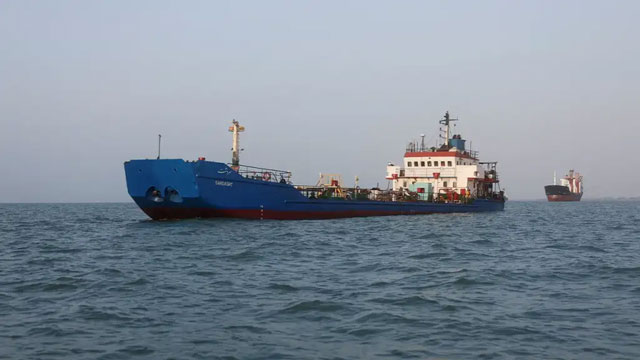
According to the US military, its forces issued multiple warnings before carrying out the strike. The incident marks at least the 15th publicly disclosed case of a merchant vessel being disabled since the blockade began in April and the sixth since it was reinstated in July. The previous vessel was disabled on November 7.
The US military said it had redirected 158 commercial vessels since the blockade was resumed, while taking action against those that refused to comply with its instructions.
The latest strike comes amid continuing uncertainty over the future course of the conflict with Iran, which began in late February and has settled into a prolonged military stalemate in recent months.
The Trump administration is weighing its options as diplomatic efforts continue to prevent a fresh escalation. Earlier this month, regional officials told The Associated Press that Israeli Prime Minister Benjamin Netanyahu was pressing Washington to resume military operations against Iran or allow Israel to launch airstrikes targeting Iranian nuclear facilities and missile capabilities.
Meanwhile, officials from Persian Gulf countries, Pakistan and Turkey have been engaged in diplomatic efforts, including telephone conversations with senior US officials, to prevent another round of fighting.
US President Donald Trump has sent mixed signals about the conflict, alternating between threats of further large-scale military strikes against Iran and assertions that the war was "militarily effectively over".
The US military has maintained a substantial naval presence in the region, including two aircraft carriers and several other warships.
Washington initially imposed its blockade of Iranian ports in April. It was temporarily lifted during negotiations with Tehran before being reinstated in July. The operation is aimed at restricting maritime trade and preventing vessels from transporting goods and resources from Iranian ports.
The blockade has also raised concerns over the safety of commercial shipping, particularly following a deadly incident in June involving the Palau-flagged tanker M/T Settebello.
In that incident, American forces struck the tanker while it was allegedly attempting to evade the blockade, killing three Indian sailors, according to Indian officials. The attack drew condemnation from the head of the International Maritime Organization (IMO), a United Nations agency responsible for maritime safety and shipping regulations.
CENTCOM has consistently maintained that its forces issue multiple warnings to merchant vessels before resorting to military action.
Meanwhile, Iran's Islamic Revolutionary Guard Corps (IRGC) on Friday claimed that two oil tankers attempted to navigate the Strait of Hormuz through what it described as an unauthorised route.
According to a statement carried by Iran's state broadcaster, one of the tankers struck a naval mine, while the other was forced to turn back. The claims could not be independently verified.
The IRGC also said the number of oil tankers attempting to use unauthorised routes through the strategically important waterway had declined sharply in recent days.
Iran has repeatedly warned commercial vessels against transiting the Strait of Hormuz without obtaining approval from Tehran, as tensions over control of the critical shipping corridor continue.
The waterway is one of the world's most important energy transportation routes, connecting the Persian Gulf with international markets through the Gulf of Oman. Any prolonged disruption has significant implications for global oil supplies and maritime trade.
The continuing uncertainty has affected oil transportation through the region. According to energy consultancy Rystad Energy, oil flows during the first two weeks of November declined by approximately 20 per cent to around 13 million barrels per day, compared with October, when exports were estimated at 15–16 million barrels per day, broadly matching pre-war levels.
The decline has been attributed partly to Iranian attacks that have discouraged oil tankers from attempting to cross the Strait of Hormuz. Reduced transportation through a major Saudi pipeline connecting the country's eastern oil-producing region to the Red Sea port of Yanbu has also contributed to the fall in shipments.
The Yanbu route has itself faced repeated attacks, adding to concerns over the reliability of alternative oil transportation corridors.
Separately, a report by the United Nations Conference on Trade and Development (UNCTAD) has warned that disruptions across major international shipping routes, including the Strait of Hormuz, Red Sea, Black Sea and Panama Canal, are increasing pressure on global maritime trade.
According to the report, insecurity and restrictions along these strategic waterways are forcing ships to undertake longer journeys, increasing fuel consumption and operating costs, contributing to port congestion and creating uncertainty across international supply chains.
Although alternative ports, inland transportation networks and revised logistics arrangements have helped maintain the movement of goods, these alternatives have come at considerably higher costs.
UNCTAD's Review of Maritime Transport 2026, released on November 23, projected that global maritime trade would record zero growth this year, compared with 1.9 per cent growth in 2025.
The report highlighted how simultaneous disruptions at major maritime chokepoints are reducing the availability of reliable shipping routes and increasing the vulnerability of international trade.
The latest developments underline the growing impact of the US-Iran confrontation on commercial shipping, energy supplies and global trade, with diplomatic efforts yet to produce a lasting resolution.