Daijiworld Media Network - Shenzhen
Shenzhen, Nov 19: The first-ever trilateral summit involving US President Donald Trump, Russian President Vladimir Putin and Chinese President Xi Jinping is scheduled to take place on Thursday, November 19, on the sidelines of the Asia-Pacific Economic Cooperation (APEC) forum in Shenzhen, China.
Chinese President Xi Jinping welcomed Trump at Shenzhen Bao'an International Airport in Guangdong province on Wednesday. Xi received the US President on the tarmac after Air Force One landed. The two leaders shook hands and embraced at the foot of the aircraft's stairs. A group of dancers also welcomed Trump with flowers and flags.
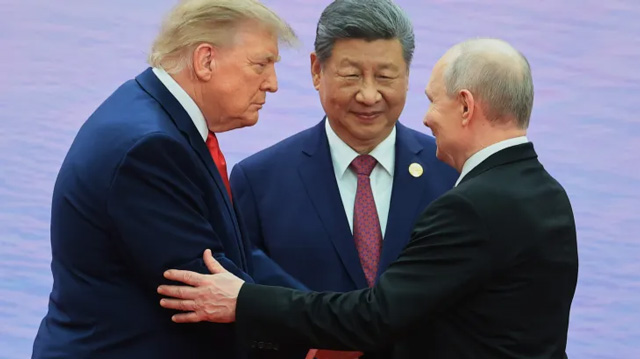
The meeting comes at a time of major international tensions, with nuclear arms control and the ongoing conflict involving Iran expected to feature prominently in the discussions.
A key issue for Washington and Moscow is the New Strategic Arms Reduction Treaty (New START), which expired in February 2026. Signed in 2010, the agreement placed limits on the strategic nuclear arsenals of the United States and Russia.
Russia possesses the world's largest nuclear warhead stockpile, followed by the US, while China ranks third and is rapidly expanding its arsenal.
Trump had earlier rejected Russia's proposal to extend the treaty after its expiry, calling instead for a new, improved and modernised agreement that would also include China. However, Beijing has expressed reluctance to join nuclear disarmament negotiations in which it had no role in the formulation of the agreement.
The leaders may also discuss the regulation of artificial intelligence in nuclear weapons systems and the need to address emerging security challenges. US officials have indicated that the meeting is intended to begin discussions on nuclear arms reduction, with no immediate agreement expected.
The Iran war is another issue expected to come up during the talks. The conflict, launched by the US and Israel on February 28, has disrupted energy supplies and affected global markets.
The strategically important Strait of Hormuz remains closed, with ships attempting to navigate the waterway facing Iranian attacks and sea mines. Before the conflict, around one-third of China's crude oil supplies passed through the strait. The war has also affected demand for Chinese exports.
Russia, meanwhile, has benefited from rising energy prices and the easing of certain US sanctions amid supply shortages, particularly of diesel.
The Ukraine war is unlikely to be part of the trilateral discussions. US officials have indicated that Trump does not intend to raise the issue, as Washington is pursuing a separate diplomatic initiative involving Kyiv and Moscow.
China, which maintains close ties with Russia, has described the Ukraine conflict as a European issue. US officials have also said that China is not involved in the separate peace negotiations and that the matter would therefore not be appropriate for the trilateral meeting.
For Putin, the summit offers an opportunity to demonstrate Russia's continued role in global affairs despite the international isolation it has faced since the start of the Ukraine war. His participation alongside Trump and Xi also highlights Moscow's cooperation with Beijing and their shared opposition to what they describe as unilateral US policies.
China is expected to focus on the impact of the Iran conflict on its energy supplies and avoid being drawn into a nuclear arms control agreement that it had no role in negotiating. Last month, China's Foreign Ministry said it would be neither fair nor realistic to expect Beijing to join trilateral nuclear disarmament negotiations at this stage.
For Trump, the main priority is to bring China and Russia into a new nuclear arms control agreement. White House spokesperson Olivia Wales said the President considers the proliferation of nuclear weapons a serious global danger.
The US President may also use the meeting to seek diplomatic progress on the Iran conflict, as Tehran continues to resist Washington's demands to end the war.