Daijiworld Media Network - Jerusalem
Jerusalem, Nov 8: Israeli President Isaac Herzog has chosen opposition leader and former military chief Gadi Eisenkot to form the country's next government, dealing a major political setback to Prime Minister Benjamin Netanyahu, whose ruling alliance lost its parliamentary majority in the October 27 elections.
Herzog is scheduled to formally hand over the mandate to Eisenkot at a ceremony at the President's Residence in Jerusalem at 5 pm local time on Sunday. Eisenkot will have 28 days to assemble a governing coalition, with the president empowered to grant an additional 14 days if required.
The decision follows consultations with political parties elected to the 120-member Knesset, Israel's parliament. Eisenkot received recommendations from lawmakers representing 67 seats, while Netanyahu secured the backing of representatives of 46 lawmakers. Another seven lawmakers did not recommend either candidate.
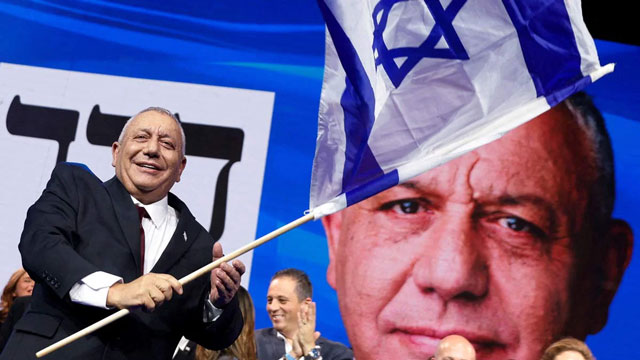
Following further discussions with political leaders, including Netanyahu and Eisenkot, Herzog decided to give the opposition leader the first opportunity to form the government.
The October 27 election produced a fractured parliamentary mandate, with neither major political bloc securing the 61 seats required for a majority in the Knesset.
Netanyahu's Likud party emerged as the largest single party with 27 seats, but his broader religious-nationalist alliance secured only 53 seats, eight short of a majority.
Eisenkot's Yashar party won 21 seats and became the second-largest party. His four-party, Jewish-led opposition bloc secured 48 seats, while two Arab-led parties together won 19 seats. These parties also recommended Eisenkot for the premiership, giving him the support of 67 lawmakers during the presidential consultations.
The recommendations, however, do not automatically translate into a governing majority, as several parties within Eisenkot's broader opposition camp have differences over the possibility of cooperating with Arab lawmakers.
Eisenkot now faces the difficult task of bringing together centrist, right-wing, left-leaning and Arab political representatives to establish a stable government.
One possibility is a minority government that receives outside parliamentary support from Arab parties without formally including them in the coalition. However, some of Eisenkot's potential partners have strongly opposed such an arrangement.
Another possibility involves reaching an understanding with ultra-Orthodox parties, particularly United Torah Judaism, which has seven seats and declined to recommend either Eisenkot or Netanyahu during the presidential consultations.
Avigdor Liberman, leader of Yisrael Beytenu, has reportedly softened his longstanding opposition to working with ultra-Orthodox parties, opening another possible route for an anti-Netanyahu coalition. However, disagreements over compulsory military service for ultra-Orthodox men could complicate negotiations.
A broader national unity government involving Likud is another possibility, although Eisenkot has repeatedly ruled out joining a government headed by Netanyahu.
Eisenkot has also laid down four broad conditions for potential coalition partners. These include recognising Israel as a Jewish, democratic, liberal and egalitarian state; respecting the principles of the country's Declaration of Independence; supporting military or national service for all citizens; and recognising Hamas as a terrorist organisation while backing the dismantling of its military and governing capabilities in Gaza.
Netanyahu has strongly opposed the prospect of a government dependent on Arab parliamentary support and has called for a broad national unity administration.
Reacting to the possibility of Eisenkot forming a coalition with the backing of Arab lawmakers, Netanyahu warned against what he described as a government dependent on supporters of terrorism.
"There is someone who wants to hastily swear in a government, already next week, with terrorism supporters," Netanyahu said.
He further argued that establishing a government with parties allegedly seeking the elimination of Israel would undermine national security and weaken the country's ability to confront Hamas and protect Israeli soldiers.
Netanyahu has also appealed to opposition parties to reconsider their position and join a broad unity government under his leadership. However, Eisenkot has consistently rejected the possibility of serving in a government headed by the incumbent prime minister.
Despite the setback, Netanyahu has not been removed from office. He continues to serve as caretaker prime minister, while Likud remains the largest individual party in the Knesset.
Gadi Eisenkot, 66, is a former chief of staff of the Israel Defense Forces (IDF) who entered politics in 2022. His military background and security credentials have been central to his political campaign against Netanyahu.
Following Hamas' October 7, 2023, attack on Israel, Eisenkot briefly joined Netanyahu's wartime government as part of the emergency national unity arrangement. However, he subsequently returned to the opposition and became increasingly critical of the government's handling of the Gaza war and its broader security policies.
His family has also suffered heavy losses during the conflict. His son and two nephews were killed while fighting in Gaza.
During the election campaign, Eisenkot presented himself as a security-focused alternative to Netanyahu, arguing that Israel required new political leadership and a different approach to national security.
He has also criticised violence by Israeli settlers against Palestinians and opposed the influence of far-right leaders in Netanyahu's government, particularly National Security Minister Itamar Ben-Gvir and Finance Minister Bezalel Smotrich. Both have faced sanctions from some Western countries over their positions and actions concerning Palestinians.
The role of Arab lawmakers has become one of the most contentious aspects of Israel's government formation process. The two Arab-led parties, which together hold 19 seats, recommended Eisenkot during consultations with Herzog. Their support has strengthened his parliamentary position, although they have not necessarily committed to joining his government.
Eisenkot's potential partners remain divided over whether an administration should depend on Arab parliamentary support, either through formal participation or an outside arrangement.
Netanyahu has portrayed such support as a security threat, while Arab political leaders have accused his government and far-right allies of pursuing discriminatory policies against Israel's Arab minority.
The political developments have also exposed changing alliances within Israel's opposition. Liberman's willingness to consider cooperation with ultra-Orthodox parties, despite his earlier opposition, could provide Eisenkot with an alternative to relying on Arab lawmakers. However, differences over military service requirements and other religious and political issues remain significant obstacles.
Under Israel's government formation process, Eisenkot has 28 days from receiving the mandate to assemble a coalition, with the possibility of a 14-day extension granted by the president.
If he fails, Herzog can give another political leader, potentially Netanyahu, an opportunity to form a government. If subsequent attempts also fail, lawmakers can nominate another candidate under the parliamentary procedure.
The process must be completed within the stipulated constitutional framework, failing which Israel could face another election.
For now, Herzog's decision marks a significant shift in Israel's political landscape after years of Netanyahu's dominance. Although the opposition leader has secured the first opportunity to form a government, the real challenge will be converting the 67 recommendations into a stable parliamentary majority.
The coming weeks of coalition negotiations will determine whether Eisenkot can end Netanyahu's tenure or whether the incumbent prime minister will get another opportunity to return with a governing majority.