Daijiworld Media Network - Washington
Washington, Nov 5: NASA’s Neil Gehrels Swift Observatory, which spent nearly 22 years studying some of the most powerful explosions in the universe, re-entered Earth’s atmosphere and burned up over Indonesia on Wednesday, November 4, bringing an end to its extended scientific mission.
The US Space Force confirmed that the 3,200-pound (1,452-kg) spacecraft re-entered the atmosphere at 7.39 am Eastern Standard Time (12.39 GMT) over North Sumatra province in Indonesia, travelling at approximately 22 times the speed of sound. The re-entry took place around 200 miles (322 km) north of the equator.
NASA had expected the intense heat generated by atmospheric friction to destroy most of the satellite, although some fragments could survive the descent and reach the ground. The agency reported no damage or injuries resulting from the re-entry.
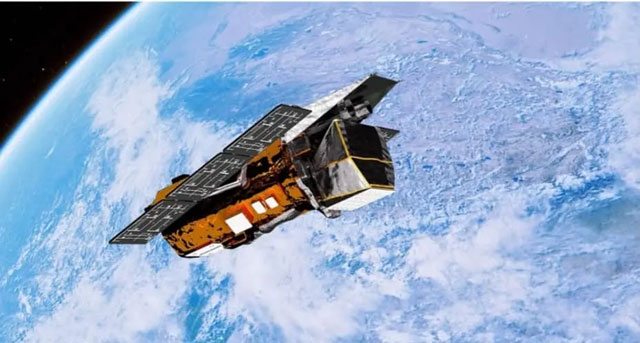
The US Space Force had earlier assessed the risk of debris causing harm to anyone on Earth at approximately one in 2,100, describing the likelihood as very low. The exact proximity of the re-entry location to Medan, the provincial capital and largest city of North Sumatra, was not immediately clear. Medan has a population of around 2.5 million, while the province is home to approximately 16 million people.
Aerospace engineer Dean Sladen of British industrial parts supplier Accu Components had said before the re-entry that only a handful of small, scorched fragments were expected to survive, with nothing resembling an intact telescope likely to reach the surface. He also noted that satellites of similar size regularly re-enter the atmosphere and that no person had been killed by falling space debris in nearly 70 years of spaceflight.
The satellite’s descent came less than three months after a rescue mission intended to extend its operational life was abandoned. NASA had partnered with Arizona-based space technology company Katalyst Space Technologies to develop a robotic servicing spacecraft named LINK, which was launched in July to approach Swift, attach itself to the observatory and raise it into a higher, more stable orbit.
However, LINK developed problems with its attitude-control systems and began spinning uncontrollably after reaching orbit. Despite efforts to stabilise the spacecraft, NASA and Katalyst announced on August 19 that LINK would not attempt to capture and boost Swift. The rescue mission was subsequently scaled back to demonstrate rendezvous and proximity-operation technologies for future satellite-servicing missions.
Swift did not have its own propulsion system to raise its orbit. Its gradual descent accelerated because of atmospheric drag, which was intensified by increased solar activity. NASA had originally designed the observatory for a two-year mission, but it continued operating for more than a decade beyond its planned lifespan.
The observatory ended its scientific operations on October 20, after its orbit dropped to approximately 171 miles (275 km) above Earth. At that altitude, increased atmospheric drag made it difficult for the spacecraft to keep its telescopes steadily pointed at astronomical targets. NASA formally concluded the mission, although the observatory had resumed some scientific observations after the rescue attempt was abandoned.
Launched in November 2004, Swift was primarily designed to detect and study gamma-ray bursts, the most powerful known explosions in the universe. These brief but extraordinarily energetic events are associated with the collapse of massive stars and the merging of compact stellar objects.
The observatory was equipped with three telescopes that could observe cosmic events across gamma-ray, X-ray, ultraviolet and visible wavelengths. Its ability to rapidly turn towards newly detected bursts and alert other observatories made it an important instrument for astronomers studying short-lived events in deep space.
Over its operational lifetime, Swift also investigated hundreds of supernova explosions, black holes tearing apart stars, X-ray flares from stars, and objects such as asteroids and comets. Its observations contributed to approximately 7,000 published scientific papers, making it one of NASA's significant long-running astrophysics missions.
The spacecraft was named the Neil Gehrels Swift Observatory in 2018 in honour of Neil Gehrels, its principal investigator, following his death in 2017. Its departure marks the end of a mission that substantially expanded scientific understanding of high-energy events and helped astronomers coordinate observations using other space and ground-based telescopes.
NASA has described Swift's scientific legacy as a major achievement, particularly because the observatory continued delivering valuable observations long after its original design life.