Daijiworld Media Network - Thimphu/Siliguri
Thimphu/Siliguri, Oct 30: A glacial lake outburst flood (GLOF) in Bhutan has damaged infrastructure, disrupted a solar-powered irrigation project and blocked a section of a highway with debris, prompting flood alerts in parts of West Bengal and Assam over a possible surge in the Sankosh River. No casualties have been reported so far.
The sudden release of water from Shintaphu Lake in Bhutan's Gasa district on Thursday evening triggered a flash flood in the mountainous region. The incident prompted authorities in neighbouring India to issue precautionary warnings and evacuate thousands of people from vulnerable areas along the river system.
In Bhutan, the Solar Irrigation Lifting System in Dochhukha-Dzomlingthang-Ritsa Chiwog under Guma Gewog in Punakha was partially damaged by the flood. The system, which had been installed earlier this year to address water shortages faced by local residents, has stopped functioning. The full extent of the damage is yet to be assessed.
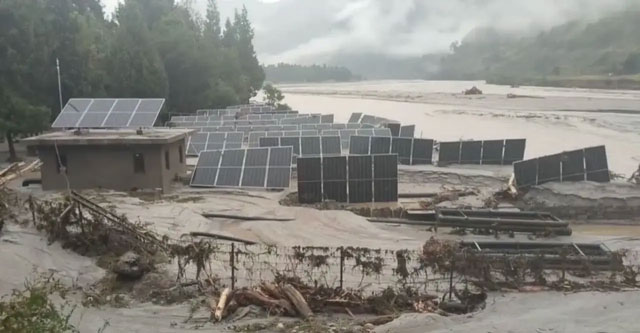
The flash flood also carried debris onto a section of the Punakha-Gasa Highway in the Dzomlingthang area, disrupting road connectivity. The damage was reported by the Tshogpa, the local government representative of Dochhukha-Dzomlingthang-Ritsa village.
The outburst was reported at Shintaphu Lake, also known as Shintaphu Tsho, located below Wakila Mountain in Bhutan's Gasa district. The lake lies in the upper reaches of the Mo Chhu river basin, with its waters flowing southwards towards the Punatsangchhu river system.
Shintaphu is among Bhutan's 17 potentially dangerous glacial lakes. An official of the National Centre for Hydrology and Meteorology (NCHM) said a water-level monitoring station was located at Taktsimakhang. However, no alert had been triggered at the station when the initial reports emerged.
The exact volume of water released and the full extent of the downstream impact were initially unclear.
A glacial lake outburst flood occurs when water accumulated in a lake formed by melting glaciers is suddenly released following the failure or breach of a natural barrier. Such floods can travel rapidly through mountain valleys, carrying enormous quantities of water, rocks and debris and damaging roads, bridges, settlements and agricultural land.
India issues flood warning
The incident triggered concerns in India because the Mo Chhu and Punatsangchhu river systems are connected to the Sankosh River, which enters India and flows through parts of West Bengal and Assam.
The Government of India issued a special advisory warning of a possible sudden rise in water levels along the Sankosh River. Authorities cautioned that the flash flood could affect West Bengal's Alipurduar district and Assam's Dhubri district.
Alerts were also issued in vulnerable areas of North Bengal, including the Darjeeling hills, Jalpaiguri and Cooch Behar districts.
According to the advisory, floodwater was expected to reach the India-Bhutan border within six to eight hours. District administrations were instructed to closely monitor river levels and undertake precautionary measures.
National Disaster Response Force (NDRF) and State Disaster Response Force (SDRF) teams were mobilised in Tufanganj and Boxirhat in Cooch Behar district, both located near the Sankosh River and the Assam border.
West Bengal Forest Minister and Kumargram MLA Manoj Kumar Oraon appealed to residents living along the Sankosh River in Alipurduar district to move to safer locations.
In a video message posted on Facebook, Oraon warned that a sudden surge of water could reach the Kumargram area within the next one to one-and-a-half hours. He urged residents to cooperate with the administration and evacuate as a precaution.
BJP MP from Darjeeling Raju Bista also issued a public safety advisory, asking people living along the Sankosh River and its connected tributaries to move to safer places.
In a post on X, Bista said a glacial lake outburst had been reported in Bhutan and that the overflowing water was moving downstream through the Mofu River towards the Sunkosh River.
He appealed to residents of the Darjeeling hills, Terai and Dooars regions to remain alert and follow safety instructions.
Thousands moved to safer locations
Meanwhile, authorities in West Bengal said the immediate flood threat had eased and the situation was under control, although monitoring continued.
Alipurduar Superintendent of Police Amit Kumar Shaw said there was no need for panic as the administration was maintaining close coordination with Bhutanese authorities.
Speaking to news agency ANI, Shaw said approximately 4,000 to 5,000 people had been moved to shelters, with school buildings being used as temporary relief centres. More than 6,000 additional people had also been relocated to safer locations as a precaution.
He said police, district administration and disaster response agencies were working together to manage the situation. SDRF personnel had been deployed, while an NDRF team was also being mobilised. Civil Defence personnel were assisting with emergency preparations.
Shaw said the intensity of the water flow had reduced slightly, according to the latest information received from Bhutan. However, a red alert remained in force for the Sankosh river system.
The administration had arranged dry food, drinking water and other essential facilities, including toilets, at the relief centres.
He also cautioned residents that the floodwater could carry dead fish, large pieces of wood and concrete debris, posing additional risks to people near the riverbanks.
According to the Kumargram block administration, residents had been shifted to 18 flood shelters across the block. Schools, community halls, religious institutions and tea garden facilities were being used to accommodate displaced families.
Residents from parts of neighbouring Assam had also moved to safer locations.
Bhutan assesses damage
In Bhutan, authorities continued assessing the impact of the outburst, particularly in the Gasa region. Reports indicated that the flood had damaged infrastructure around Gasa Tshachu, a popular natural hot-spring destination, while sections of the road towards Laya had become impassable.
According to international media reports, the affected area had been evacuated before the floodwaters arrived, preventing casualties. The extent of the damage could not immediately be established because of darkness and strong water currents.
The incident has once again highlighted the vulnerability of Himalayan communities to glacial lake outburst floods and the importance of early warning systems and coordination between Bhutan and India.
Both countries have existing arrangements for sharing hydrological information and flood forecasts to protect downstream communities in West Bengal and Assam.