Daijiworld Media Network - New Delhi
New Delhi, Oct 26: The Election Commission of India (ECI) has told the Supreme Court that a petition seeking to restrain Chief Election Commissioner (CEC) Gyanesh Kumar from functioning is not maintainable, asserting that the CEC can be removed only in the same manner and on the same grounds as a judge of the apex court.
In a counter-affidavit filed before the Supreme Court, the poll panel also defended its decision-making process and the conduct of the Special Intensive Revision (SIR) of electoral rolls.
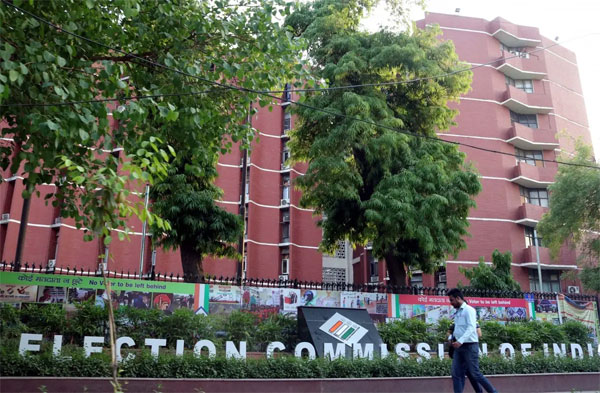
The ECI said the petition questioning whether Kumar could individually exercise or represent powers vested in the multi-member Commission was based entirely on a single newspaper report and sought extraordinary relief without establishing the factual basis for its allegations.
"The averments in the Writ Petition are admittedly based solely on a single newspaper report," the affidavit stated, adding that the petitioner had neither attempted to ascertain the factual position from the Commission nor made any representation to it.
The poll panel said the petitioner had himself described the material relied upon as an "investigative reportage" requiring verification. It argued that a newspaper report could not be treated as evidence of the facts narrated in it.
"A public interest petition built on such material calls for its conclusions to be examined with circumspection," the affidavit stated.
The ECI further submitted that the petition did not dispute that the Commission had been constituted in accordance with the law and that the petitioner had accepted Kumar's appointment as CEC. It, therefore, termed the prayer seeking a writ of quo warranto misconceived.
Opposing the request to restrain Kumar from functioning, the ECI invoked Article 324(5) of the Constitution, which stipulates that the CEC cannot be removed from office except in the same manner and on the same grounds as a Supreme Court judge.
"The prayers in the Writ Petition for passing of an order restraining the CEC would not be maintainable," the affidavit stated.
The Commission also argued that restraining the CEC would run contrary to Section 18 of the Chief Election Commissioner and other Election Commissioners (Appointment, Conditions of Service and Term of Office) Act, 2023, which governs the transaction of business by the poll panel.
The provision requires the Commission to endeavour to take decisions unanimously, with matters on which members differ being decided by a majority. The ECI contended that any order restraining the CEC would hamper the functioning and decision-making of the constitutional body under the statutory framework.
"Any such prayer shall also not be maintainable being in the teeth of/contrary to the provisions of Section 18 of the 2023 Act," it submitted.
On the Commission's decision-making process and the SIR exercise, the counter-affidavit, filed through Deputy Election Commissioner Bhanu Prakash Yeturu, said decisions on matters placed before the ECI were taken after deliberations. Files and relevant documents were circulated among the two Election Commissioners and the CEC for approval, with decisions recorded in official files and implemented through the Commission's Secretariat, it added.
The affidavit stated that the present counter-affidavit had been approved unanimously by all three members of the Commission, including the CEC and the two Election Commissioners.
It also clarified that suggestions, observations or queries exchanged among members or with officials during the decision-making process did not, by themselves, constitute a decision of the Commission under Section 18 of the 2023 Act.
The ECI maintained that its orders initiating the SIR exercise on June 24, 2025, October 27, 2025, and May 14, 2026, had been issued unanimously and in compliance with Article 324 of the Constitution and the applicable statutory provisions.
Rejecting allegations that it had improperly amended Form 6, the poll panel said the declaration accompanying applications for inclusion in electoral rolls was a separate document prescribed under the SIR orders and did not form part of the statutory Form 6 under the Registration of Electors Rules, 1960.
According to the ECI, the revised declaration enabled applicants to provide details linking themselves or their parents or grandparents to earlier electoral rolls, potentially eliminating the need to submit additional documents during the claims and objections stage.
The Commission also cited the Supreme Court's May 27, 2026, judgment, which upheld the documentation framework for the SIR exercise and recognised the ECI's authority to prescribe an appropriate framework, provided it had a rational nexus with the objective sought to be achieved.
The affidavit said the SIR process was being conducted in accordance with applicable law and that steps had been taken to facilitate voters. These included home visits by Booth Level Officers (BLOs) to collect documents from people who received notices over discrepancies or the absence of links with previous electoral rolls.
The ECI urged the Supreme Court to dismiss the petitions, maintaining that the allegations against the poll panel were misconceived and that the extraordinary reliefs sought were not legally maintainable.