Daijiworld Media Network – Mumbai
Mumbai, Oct 15: The 26/11 Mumbai terror attacks have been revisited countless times through news reports, television programmes and films, often narrating the tragedy from the perspectives of the terrorists and their victims. However, Prahaar: The Untold Story of Ujjwal Nikam takes a different route, focusing on the courtroom battle that followed the attacks and the legal process that brought Pakistani terrorist Ajmal Kasab to justice.
Starring Rajkummar Rao as special public prosecutor Ujjwal Nikam, the film explores why India had to follow a lengthy judicial process despite the overwhelming evidence against Kasab and why capturing him alive was crucial to the investigation. At its core is a powerful reminder that the Constitution cannot be set aside even in the face of public anger and national grief.
A line attributed to Nikam captures the film’s central argument: “Justice delayed is justice denied, but justice hurried is justice buried.” The statement underlines the importance of due process, even when the accused is responsible for one of the deadliest terror attacks in India's history.
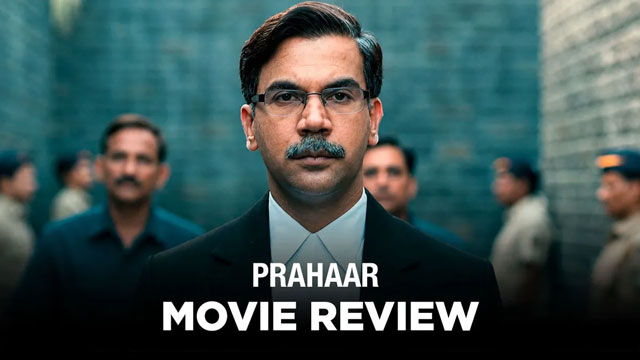
The film opens with Nikam celebrating his victory in the 1993 Bombay blasts case. Years later, as he prepares for his daughter's wedding, the November 2008 Mumbai attacks change the course of his life, drawing him into a high-profile legal battle that would become one of the defining cases of his career.
Rajkummar portrays Nikam as an intense, fiery prosecutor who insists that the Constitution must remain paramount. One of the film's strongest arguments concerns the decision to capture Kasab alive rather than kill him. As a surviving attacker, Kasab was a crucial source of evidence about the terror network operating across the border, including how young men were radicalised, trained and sent to India to carry out attacks.
The film also attempts to examine Kasab's mindset without excusing his crimes. Played by Lalit Prabhakar, the terrorist is shown hearing the azaan, or Islamic call to prayer, and being told that it is Eid. His bewildered question, “India mein Eid manane ki ijazat hai?” — meaning, “Is it allowed to celebrate Eid in India?” — becomes a chilling illustration of how radicalisation can distort a person's understanding of the world. The scene highlights how hatred and indoctrination can turn individuals into instruments of violence.
However, the film takes considerable time to reach its emotional core. The courtroom proceedings and legal arguments establish the stakes, but the narrative struggles to build a sustained emotional connection until a 10-year-old terror attack survivor, played by Diorr Varghese, takes the stand and testifies against Kasab. This becomes one of the film's most affecting sequences, bringing the suffering of innocent victims into sharp focus.
Just when the courtroom drama begins to gather momentum, the screenplay shifts its attention to Nikam's personal life. His strained family relationships and the sacrifices demanded by his profession receive considerable screen time. Living in a hotel room, he misses important moments in his children's lives and spends little time with his wife.
In one revealing scene, Nikam blesses his grandchild and tells the child always to love the family, prompting a snigger from his son. The moment conveys the emotional distance that years of professional commitments have created within the family. While these details offer insight into the personal cost of a demanding career, their extended treatment often slows the central narrative.
The result is a stop-start screenplay that repeatedly builds anticipation before diverting attention elsewhere. The courtroom battle offers the ingredients for a compelling legal drama, but the film struggles to maintain its focus long enough to realise its full potential.
Lawyer Kazmi, played by Sikandar Kher, is another significant character. He faces hostility for defending Kasab and finds himself isolated even within sections of his own community. As he questions police officers, photographers and witnesses, the audience is confronted with the uncomfortable distinction between defending an accused person's legal rights and endorsing their actions.
Kazmi also points out that his Muslim surname has complicated his professional life. These moments introduce an important perspective, emphasising that the right to legal representation remains fundamental regardless of the nature of the allegations against an accused person.
Jaideep Ahlawat makes a strong impression in a cameo as Pakistani lawyer Chaudhary Zulfiqar. His courtroom exchanges with Rajkummar are marked by professional rivalry, sharp remarks and clashes of ego. However, a quieter scene involving Bombil fish briefly softens their relationship as the two discuss the personal sacrifices their professions have demanded.
Ahlawat's character also quotes poet Sahir Ludhianvi to reflect on the ultimate cost of conflict: human life. It is among the film's more nuanced moments, allowing the message to emerge without excessive explanation.
Rajkummar is committed to his portrayal of Nikam, but his performance occasionally feels overly constructed. Known for bringing naturalism to his characters, the actor appears so focused on reproducing Nikam's mannerisms that the performance sometimes feels more like an imitation than a lived-in portrayal.
His climactic monologue about waging war against India is likely to elicit applause, but theatrical intensity does not necessarily translate into emotional depth. The performance has moments of conviction, yet it does not consistently achieve the authenticity that the role demands.
Wamiqa Gabbi also struggles to make her portrayal of Mrs Nikam feel convincing, with expressions and mannerisms that sometimes appear stiff. Sumit Roy's dialogues have their moments, while Kasab's confession offers a disturbing glimpse into the process of radicalisation. Ultimately, however, the screenplay's uneven pacing and lack of tighter editing weaken the overall impact.
For a film centred on the 26/11 attacks, the biggest disappointment is how rarely it conveys the full emotional weight of the tragedy. The story cannot be only about Ujjwal Nikam and his courtroom victories. It must also reckon with the attackers, the victims and the countless lives devastated by the violence.
By concentrating so heavily on its central prosecutor, Prahaar often loses sight of the larger human tragedy that gives the story its significance. The subject had enough emotional force to leave audiences shaken, but the film repeatedly stops short of delivering that impact.
Verdict: Prahaar: The Untold Story of Ujjwal Nikam raises important questions about justice, constitutional safeguards and the cost of professional dedication. Despite committed performances and several compelling courtroom moments, an uneven screenplay prevents it from becoming the powerful legal drama its subject deserved.