Media Release
Mangaluru, Sep 7: Completing cancer treatment is a major milestone, but some patients may continue to face complications caused by treatment. A 63-year-old woman, Savitha, who was treated for uterine cancer, recently underwent complex surgery at KMC Hospital, B R Ambedkar Circle, Mangaluru, after radiation therapy caused severe damage to her intestine. She has now regained the ability to eat normally.
Savitha underwent radical hysterectomy, a surgery to remove the uterus and nearby tissues, followed by radiation therapy in 2024. Over the next year, she developed severe abdominal pain and vomiting whenever she tried to eat solid food. Doctors diagnosed her with radiation-induced intestinal strictures, meaning radiation had caused scar tissue to form inside the intestine and narrowed the passage through which food moves. As a result, she could tolerate only liquids and gradually became severely weak and malnourished.
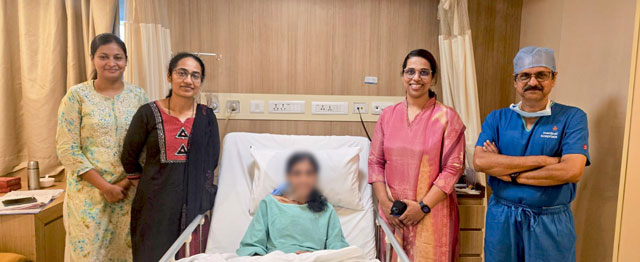
By the time she reached KMC Hospital, Mangaluru, Savitha had lost more than 20 kg and weighed only 30 kg. Doctors also found a painful lump in her abdomen. A PET scan, which is used to look for cancer activity in the body, showed no evidence that the cancer had returned or spread.
Dr Vidya Bhat, consultant, surgical gastroenterology, and her team initially tried to manage her condition without surgery. A Ryle's tube, a thin tube passed through the nose into the stomach to remove accumulated fluid and reduce vomiting, was inserted. However, even liquids continued to cause severe pain.
Surgery was eventually performed after the risks were discussed with her family. During the nearly eight-hour operation, doctors found extensive adhesions, which are bands of internal scar tissue that can cause the intestines to stick together. Around 70 to 80 cm of her small intestine had become tightly stuck together, almost like a cocoon. Some parts also had a poor blood supply and were at risk of developing gangrene, where tissue begins to die because it is not receiving enough blood.
The damaged portion of the intestine and the caecum, the first part of the large intestine, were removed. The remaining intestine was then joined to allow food to pass normally again. During surgery, Savitha had significant bleeding and her blood pressure fell to around 50 mmHg. Dr Madhusudan, anaesthesiologist, and the surgical team stabilised her and successfully completed the procedure. She was monitored in the ICU for two days.
Today, Savitha can eat both liquids and solid food without the severe pain and vomiting that had affected her for months. Since part of her intestine has been removed, she will continue to receive nutritional monitoring to ensure her body is absorbing essential nutrients properly.
Dr Vidya Bhat said, "Surgery was a difficult decision because she was severely malnourished and had already received radiation therapy. However, even liquids were causing significant pain. After discussing the risks and options with her family, we felt surgery offered her a chance to eat normally and regain a better quality of life. Her recovery has been very encouraging."
Dr Swathi, consultant, surgical gastroenterology said, "Radiation therapy can sometimes cause changes in the intestine that may appear months or even years after treatment. Persistent vomiting, abdominal pain or difficulty eating should not be assumed to be a normal part of recovery. In cancer survivors, such symptoms need timely evaluation, particularly when they begin to affect nutrition and body weight."
Pramod Kunder, cluster director, Manipal Hospitals said, "Managing a case this complex requires close coordination between multiple specialties, supported by the right infrastructure and critical care facilities. At KMC Hospital, Mangaluru, the surgical gastroenterology, anaesthesia and ICU teams worked together through a prolonged and high-risk procedure and the patient's recovery. Cases such as Savitha's also reflect the importance of having specialised teams and advanced hospital facilities available to manage complications that can arise after cancer treatment."
For cancer survivors, persistent abdominal pain, repeated vomiting, difficulty eating or unexplained weight loss should not be ignored. These symptoms may sometimes be linked to previous treatment and need medical evaluation. For patients like Savitha, recovery means more than being cancer-free. It also means being able to eat without pain, regain strength and return to everyday life.
About Manipal Hospitals
Manipal Hospitals is one of India’s leading integrated healthcare providers serving 8 million patients annually, focussed on providing accessible, high-quality healthcare services. Manipal’s integrated network today has a pan-India footprint of 50 hospitals with over 13,400 licensed beds across 14 States & Union Territories. The network is India’s largest multispecialty hospital network by bed capacity, supported by a talented pool of 11,000+ doctors and an employee strength of over 25,000.
With a commitment to provide patient-centric care, Manipal Hospitals combines clinical expertise with advanced technology, research and innovation to serve a multitude of patients across the globe. Its continued focus on clinical quality and operational excellence is reflected in its NABH accreditation, with several of its hospitals also accredited by NABL and recognised for its excellence in nursing and emergency care.