Daijiworld Media Network - Pune
Pune, Aug 22: Congress leader and Leader of Opposition in the Lok Sabha Rahul Gandhi on Saturday described India’s women as the country’s “greatest strength and asset” while addressing students at the fourth edition of the ‘Chatron Ki Gunj’ event in Pune.
Speaking to Gen-Z students under the theme ‘Pinjra Toda’ (Break the Cage), Gandhi launched a sharp criticism of the ideology of the Manusmriti and urged young women to break free from societal restrictions and assert their independent identities.
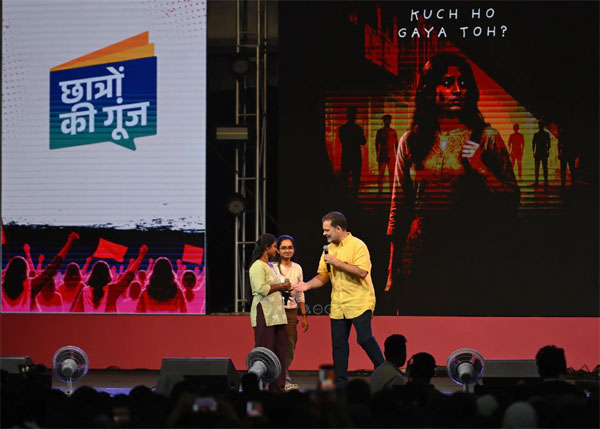
“I have not come here today to speak on politics,” Gandhi said during the interaction.
“When asked about India’s main strength, people point to the economy, the military, healthcare, or overall population. But my position is crystal clear: India’s 70 crore women are the nation’s greatest power,” he said.
Gandhi said women possess immense empathy, sensitivity and strength and argued that their dreams and journeys represent the true pride and wealth of the country.
He also noted that women independently own only eight per cent of property in India.
Gandhi attacks patriarchal restrictions
Gandhi strongly criticised traditional frameworks that, he said, restrict women’s independence.
Referring to the Manusmriti, he said the ancient text suggests that a woman should live for her father during childhood, her husband during youth and her sons in old age.
He termed the idea that women should never be independent unacceptable and shameful.
Gandhi urged women not to allow their identities to be defined only by traditional roles such as daughter, wife or mother.
While acknowledging the importance of these relationships, he said, “You are not dependent on anyone. Your relationships do not define your core identity—you have an individual identity of your own.”
He said the underlying design of the Manusmriti was aimed at preventing women from becoming independent or self-reliant by keeping them under external control.
Gandhi also expressed concern over societal restrictions and discrimination in education faced by young women despite their achievements in different fields.
Tribal students raise grievances
During the event, a student named Nisha raised the problems faced by tribal students and submitted a memorandum detailing their demands to Gandhi.
“This story isn't just about one Nisha—it represents all tribal students, the entire nation, and Maharashtra, which is why I am presenting it in Marathi,” she said.
Nisha said tribal students had been on a hunger strike at Manjari in Pune for the past 10 days. She said two female students and male students were among those protesting, with one female student having to be hospitalised after her health deteriorated.
She alleged that when representatives of the protesting students visited the Mantralaya, the Tribal Development Minister expressed helplessness and said the matter was solely in the hands of the Chief Minister.
Nisha said ministers who could not deliver development for tribal students had no moral right to remain in office.
Food, hostel facilities highlighted
Nisha raised concerns about central kitchens operating in tribal schools, saying food prepared at one location is transported 70 to 80 km away, resulting in spoilage and incidents of food poisoning.
She said tribal ashram schools also lacked basic facilities, including beds and drinking water.
According to Nisha, three students recently died of snakebites involving Bungarus, or krait, species in Gadchiroli, while three others were undergoing treatment in hospitals.
She demanded at least Rs 1 crore in compensation for the families of the deceased students.
She also highlighted problems faced by tribal students living in hostels in Pune. She said hostels located in distant areas such as Manjari and Kondhwa forced students to spend nearly four hours a day travelling, leaving them with less time for studies.
Nisha further alleged that female students from Gadchiroli staying in tribal hostels were subjected to mandatory pregnancy tests when they returned to the hostels after visiting their homes during Diwali.
Gandhi accepts invitation to protest site
After hearing the grievances, Gandhi asked Nisha why she had not invited him to the protest site.
Nisha then invited him to visit the protesting students.
Accepting the invitation, Gandhi assured her, “Invite me to the protest site, and I will come. My presence will build pressure on the administration.”
Several other female students also shared their views during the interaction.
Heavy security at Pune event
The Pune programme was the fourth edition of the ‘Chatron Ki Gunj’ initiative, organised against the backdrop of recent youth protests in Delhi.
Large numbers of students from across Maharashtra gathered for the event, which was attended by senior state Congress leaders.
Gandhi also met state party leaders in Pune to review organisational strategies and encourage party cadres.
Heavy security was deployed around the venue following clashes between members of the Akhil Bharatiya Vidyarthi Parishad (ABVP) and the National Students’ Union of India (NSUI) in Pune a day before the programme.
The event concluded without further disruption.