Daijiworld Media Network - Beijing
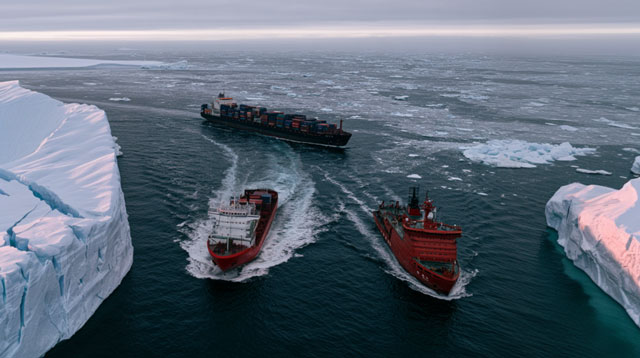
Beijing, Aug 17: Chinese shipping company Sea Legend has launched the first regular weekly container service through the Arctic’s Northern Sea Route (NSR), connecting China with Europe via Russia’s northern coast.
The service, launched on August 15, is called the China-Europe Arctic Express, also known as the “Ice Silk Road”. It offers a shorter alternative to the traditional Suez Canal route at a time when disruptions and security concerns around key West Asian shipping chokepoints have prompted countries and shipping companies to explore alternative trade routes.
Sea Legend’s service connects Ningbo-Zhoushan in eastern China with Felixstowe in the United Kingdom, travelling along Russia’s northern coastline through the NSR. The Arctic route stretches for around 5,500 km along the Russian coast.
According to Sea Legend Chief Operating Officer Li Xiaobin, the direct journey can take as little as 18 days, compared with more than 40 days through the Suez Canal, The Guardian reported.
The first scheduled sailing is being operated by the 1,740-TEU container vessel Dubai Tower, which is travelling from Ningbo-Zhoushan to Felixstowe. Sea Legend has planned eight weekly sailings between August and October during the Arctic navigation season.
The Northern Sea Route is navigable only for part of the year. According to Reuters, it is typically open from July 1 to October 1. Sea Legend plans to operate the service during the warmer months before increasingly difficult ice conditions restrict navigation.
The shorter route could help reduce sailing time and fuel consumption. The Wall Street Journal reported that Sea Legend completed a trial voyage from Asia to Europe in 2025 in about 20 days, roughly half the time required for a voyage around the Cape of Good Hope.
The Arctic route has become more accessible as summer sea ice has declined. Nearly half of the Arctic’s summer ice has melted over the past five decades, according to reports.
The Arctic has also warmed about four times faster than the global average over the past four decades, extending the seasonal window available for commercial shipping, Reuters reported.
Growing concerns over disruptions along traditional shipping routes have further increased interest in the Arctic corridor. Li told The Guardian that the West Asia crisis had highlighted the vulnerability of the Suez Canal and Strait of Hormuz and increased the need for alternative China-Europe trade routes.
However, the Arctic route faces several limitations. Its seasonal nature remains a major challenge, while difficult weather conditions, shifting ice floes and the need for icebreaker assistance can increase operational risks.
Insurance costs are also higher. According to The Wall Street Journal, insurance premiums for Arctic shipping are around 40 per cent higher than those for the Cape of Good Hope route.
The NSR also remains relatively small compared with established global shipping corridors. A record 23 cargo ships used the route last summer, compared with more than 30 ships transiting the Suez Canal every day, The Wall Street Journal reported.
“It’s not the Suez Canal but it’s a significant number for the Arctic. It shows there is potential,” Malte Humpert, founder of the Arctic Institute, told the newspaper.
Environmental concerns pose another challenge. Heavy fuel oil spills can be particularly difficult to clean up in Arctic conditions, while black carbon emissions from ships can contribute to further warming, The Guardian reported.
China’s latest move follows several years of increasing activity along the Northern Sea Route. Russia currently controls much of the route, with its state nuclear energy company Rosatom issuing navigation permits and providing nuclear-powered icebreakers to vessels requiring assistance.
The Arctic corridor is also seeing increased use for Russian oil shipments. Reuters reported last week that seven crude oil cargoes carrying around 6 million barrels were already heading towards Asia through the NSR. The volume is nearly half of the amount shipped through the route during the whole of 2025.