Daijiworld Media Network – New Delhi
New Delhi, Jul 20: Heavy deployments of security forces thwarted protesters of the Cockroach Janta Party (CJP) on Monday, actively countering their planned march toward the Parliament with intensive crowd-control measures. Security personnel resorted to baton charges and fired tear gas as thousands of students and youth activists attempted to breach barricades in the high-security zone of the national capital. The Delhi Police placed the entire New Delhi district on high alert, enforcing prohibitory orders under Section 163 of the BNSS to strictly ban unauthorized assemblies.
The march witnessed several violent confrontations between demonstrators and law enforcement across central Delhi. Protesters marching from the Sansad Marg side were stopped by security forces outside the Sansad Marg Police station, where police personnel used batons to control the swelling crowd, causing minor injuries to a few protesters who received first aid on site. As crowds pushed forward, security forces fired tear gas shells at protesters who had reached Raisina Road, barely 200 metres from the Parliament building, as well as near the Press Club of India to disperse the gathering. Earlier, a scuffle-like situation ensued near Parliament Street when thousands of protesters tried to push through multiple barricades, prompting a baton charge that left both protesters and police personnel with minor injuries. Around 10 to 15 protesters were detained during this breach attempt.
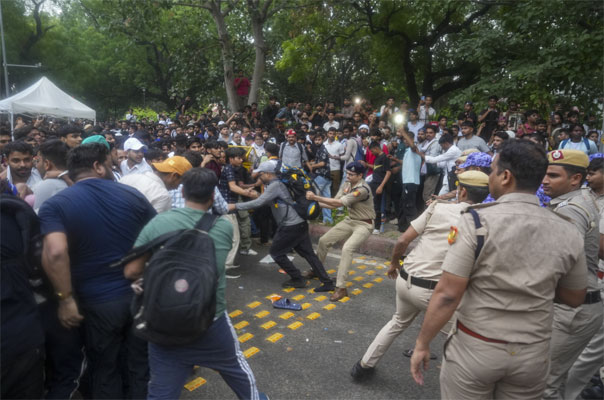
Furthermore, students staging a sit-in protest at the Rafi Marg area were detained by the police to clear the zone. The children and youth who were chased away from Rafi Marg poured into the India Gate lawns, where police motorcycles and vans drove directly onto the lawns to chase the remaining protesters away. As the situation escalated, authorities blocked vehicular movement at Vikas Marg in ITO and shut down mobile internet services in parts of central Delhi, severely restricting the flow of live updates from the ground. The Delhi Metro Rail Corporation also announced the closure of Janpath, Rajiv Chowk, Patel Chowk, Central Secretariat, and Seva Teerth metro stations due to security reasons. While the gates of Central Secretariat and Rajiv Chowk were opened later for interchange facilities, staff at Rail Bhawan were not permitted to exit their office as protesters gathered outside, prompting the deployment of a riot control vehicle nearby.
CJP demands and government negotiations
The CJP protesters launched the march to demand accountability over alleged examination irregularities and the NEET-UG paper leak, alongside demanding the release of climate activist Sonam Wangchuk. Initially, the government reached out to the CJP team for talks through the New Delhi deputy commissioner of police Sachin Sharma. The CJP members successively rejected offers to hold dialogues with the District Magistrate, a secretary to the Union government, and a minister of state, insisting on a dialogue with the Prime Minister or a cabinet minister.
Eventually, the government facilitated a meeting between CJP spokespersons and the union health minister J.P. Nadda. Spokespersons Saurav Das and Ashutosh Ranka met Nadda at his residence for ten minutes to submit a formal letter outlining their primary demands. The letter includes demands for the immediate release of Sonam Wangchuk from the hospital, the immediate resignation or sacking of the union education minister Dharmendra Pradhan, and a Rs 1 crore compensation for all NEET aspirants who died following the paper leak. Following the meeting, the spokespersons stated that Nadda assured them he would discuss the CJP's demands internally at the appropriate level and requested time to align with the party leadership, though no concrete commitments have been made so far. CJP leaders clarified that another prominent face,? Abhijeet Dipke, is currently not under arrest or detention, but maintained that peaceful protests will continue until their demands are met.
Developments involving activists and hunger strike
In a major development parallel to the unfolding march, three All India Students’ Association (AISA) members, Neha, Manish, and Aameen, officially ended their hunger strike on its 23rd day. They broke their fast following a direct appeal from a high-profile delegation led by parliamentarians Manoj Jha, Rajaram Singh, and Amra Ram, alongside Dr Yogendra Yadav, advocate Prashant Bhushan, professor Atul Sood, and actors Prakash Raj and Shabana Azmi, the latter two having arrived at Jantar Mantar earlier in the day to support the protesters. Despite ending the strike, AISA announced a month-long campaign against the National Testing Agency (NTA) and the NEP 2020 to run parallel to the ongoing Parliament session.
Meanwhile, activist Sonam Wangchuk remains confined at the VMMC and Safdarjung Hospital, where he wrote a formal letter to the hospital director demanding his release so he could participate in the Parliament march. A health bulletin issued by the hospital stated that while his vital parameters remain stable, his blood parameters warrant close clinical observation, making continued medical management necessary to prevent potential complications. In response to his continuous retention, Wangchuk's wife, Dr Gitanjali Angmo—who the CJP alleged was assaulted by the Delhi Police along with a child during the march—has approached a division bench of the Delhi High Court. Her plea challenges a single judge's refusal to transfer Wangchuk from Safdarjung Hospital to Medanta Hospital in Gurugram, and the matter is expected to be mentioned before the court soon.