Daijiworld Media Network – New Delhi
New Delhi, Jul 7: India is poised to become the world's second-largest solar market by annual installations after China, driven by rapid capacity expansion over the past decade. However, industry experts warn that the country's renewable energy ambitions continue to face a significant challenge due to heavy dependence on Chinese imports across the upstream solar manufacturing value chain.
While India's policy push towards renewable energy aims to reduce dependence on imported fossil fuels and achieve net-zero carbon emissions by 2070, analysts say the country remains reliant on China for solar cells, wafers, polysilicon, inverters and manufacturing equipment.
According to Commerce Ministry data, imports of solar cells and modules increased by 11.8 per cent to Rs 35,968.92 crore in FY26 from Rs 32,168.72 crore in FY25. The rise was driven entirely by cell imports, which surged 95 per cent to Rs 27,133.68 crore, while module imports declined by 51.6 per cent to Rs 8,835.24 crore.
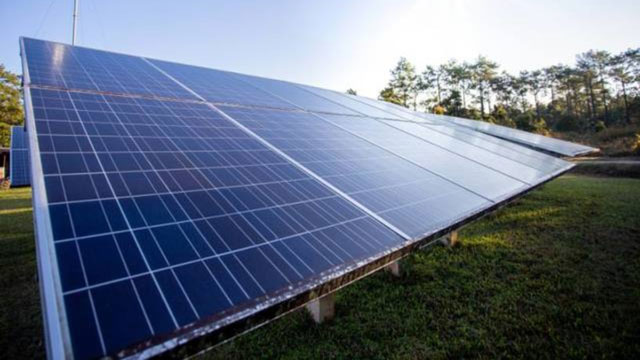
India imported 8.01 billion solar cells during FY26, a 58 per cent increase over the previous year, reflecting continued dependence on overseas supplies despite growing domestic manufacturing.
The country crossed 150 GW of installed solar capacity after commissioning 44.6 GW during FY26. Domestic module manufacturing capacity has expanded sharply from 8.2 GW in 2021 to around 210 GW, while capacity under the Approved List of Models and Manufacturers (ALMM) increased from 67.3 GW in February 2025 to 193.9 GW by May 2026.
The expansion has been supported by the Rs 24,000-crore production-linked incentive (PLI) scheme, basic customs duty on imports and ALMM regulations aimed at promoting domestic manufacturing.
Despite these gains, experts say solar cells remain the biggest bottleneck. Installed cell manufacturing capacity has risen to around 27-30 GW, but effective operational capacity is estimated at only about 20 GW as many newly commissioned production lines are still stabilising.
Crisil Ratings estimates that domestic manufacturers will meet around half of India's projected demand of 60-65 GW of solar cells this fiscal year, compared with roughly one-fourth last year. Manufacturers are investing over Rs 35,000 crore to expand cell manufacturing capacity beyond 70 GW by March 2027 and 100 GW by December 2027.
Industry observers caution that while module manufacturing capacity now exceeds annual installation requirements, dependence on imported wafers and polysilicon continues to expose the sector to supply chain risks.
Imports of undiffused silicon wafers more than doubled in FY26, with China supplying over 99 per cent of India's requirements. China currently accounts for over 93 per cent of global polysilicon production, 97 per cent of wafers, 90 per cent of solar cells, 86.5 per cent of modules and more than 80 per cent of inverters.
Experts believe that building domestic capabilities in wafer and ingot manufacturing will require greater investment and targeted policy support, as these segments are more capital-intensive than module assembly.
Although India has begun diversifying imports from countries such as Indonesia, Ethiopia, Thailand and Vietnam, analysts note that many of these suppliers also depend on Chinese raw materials and machinery.
Industry leaders say true supply chain resilience will require deeper backward integration, greater investment in research and development, advanced manufacturing technologies and broader diversification of sourcing.
Another challenge is cost competitiveness. Chinese manufacturers continue to enjoy lower production costs and invest significantly more in research and development than Indian firms, enabling them to maintain a technological edge as the industry shifts towards next-generation solar technologies.
Experts maintain that while India has largely achieved self-sufficiency in module manufacturing, substantial work remains in strengthening domestic production of cells, wafers, ingots, polysilicon and manufacturing equipment. They say sustained policy support, innovation and investment will be crucial if India is to reduce its dependence on imported solar components while securing its long-term clean energy ambitions.