Daijiworld Media Network - Dhaka
Dhaka, Jun 9: Bangladesh’s worsening measles outbreak has claimed at least eight more young lives, pushing the combined number of confirmed and suspected fatalities to 628 since mid-March, as health authorities struggle to contain one of the country's most severe public health emergencies in recent years.
According to the Directorate General of Health Services (DGHS), the latest deaths were recorded within a 24-hour period ending Monday morning. Of the eight fatalities, one was officially confirmed as a measles-related death, while the remaining seven involved children who exhibited symptoms consistent with the disease.
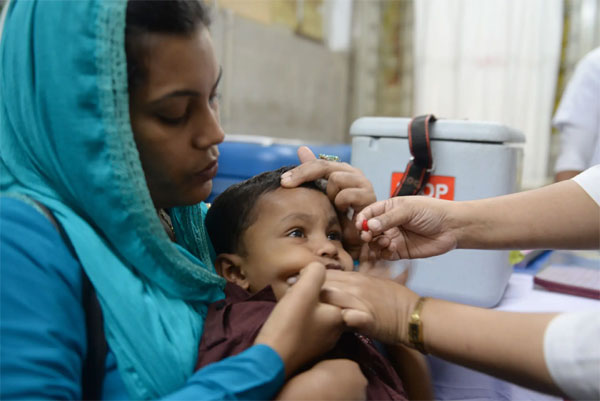
The outbreak has now resulted in 92 confirmed measles deaths, while suspected fatalities have surged to 536, underscoring the scale of the crisis.
Health officials also reported a sharp rise in infections. A total of 1,092 suspected measles cases were identified during the latest reporting period, taking the cumulative number of suspected infections to 80,104. Meanwhile, 93 new laboratory-confirmed cases raised the overall tally of confirmed infections to 9,779.
Despite government claims that the national vaccination campaign achieved coverage exceeding 100 per cent of its target population, the disease continues to spread rapidly across the country, prompting concerns among public health experts about gaps in immunisation effectiveness and actual vaccine reach.
More than a month after an emergency nationwide vaccination drive concluded, hospitals continue to admit over 1,000 children each day with measles or measles-like symptoms, while the death toll continues to rise.
Medical experts have questioned the apparent disconnect between reported vaccination rates and the continuing surge in cases. They argue that high coverage figures alone do not guarantee protection unless vaccinated children develop adequate immunity.
Former disease control chief Be-Nazir Ahmed noted that measles transmission typically declines significantly when immunisation coverage exceeds 90 per cent. He suggested that the current outbreak may indicate shortcomings in vaccine effectiveness, implementation, or the accuracy of population estimates used to calculate coverage rates.
Ahmed also warned that official vaccination statistics can sometimes present a misleading picture, with coverage appearing complete on paper even though significant numbers of eligible children remain unvaccinated.
The outbreak has also become a subject of political debate. The Awami League recently criticised the government’s handling of the crisis, describing it as a failure of governance rather than an unavoidable public health emergency.
The party alleged that the roots of the current situation lie in policy decisions made during the administration of Muhammad Yunus and claimed that subsequent efforts by the current government have not been sufficient to halt the spread of the disease.
Calling for urgent intervention, the opposition urged authorities to declare a national public health emergency, accelerate vaccination and treatment programmes, and introduce transparent reporting mechanisms with international oversight.
With infections continuing to rise and hospitals facing mounting pressure, health experts are warning that stronger containment measures and expanded immunisation efforts will be critical to preventing further loss of life in the coming weeks.