Daijiworld Media Network - Washington
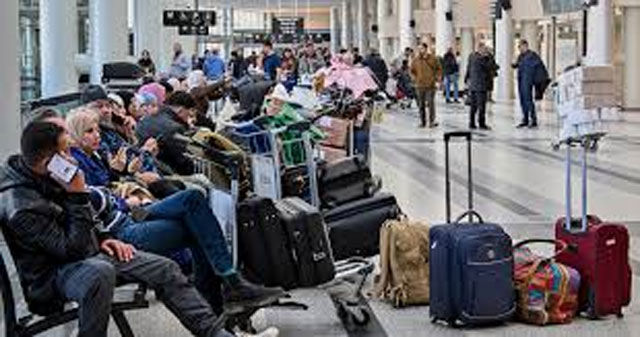
Washington, Mar 5: In the aftermath of the U.S. and Israel launching air strikes against Iran, thousands of American citizens remain stranded across the Middle East, prompting sharp criticism of the Trump administration’s handling of the crisis. Democratic lawmakers and former State Department officials say the situation was predictable and point to failures in planning and consular support.
According to multiple reports, Americans in countries such as Jordan, Kuwait, and the UAE have received conflicting advisories. Some were told to evacuate immediately even though airports were closed, while others attempting to contact U.S. embassies faced busy lines or unresponsive staff.
“You would have had far fewer people in harm's way,” said a senior State Department official, speaking on condition of anonymity.
Democrats in Congress, in a letter to Secretary of State Marco Rubio, criticized the lack of clear communication and preparation, calling it a violation of the department’s core mission to protect U.S. citizens abroad.
Recent days have seen a series of drone attacks on U.S. facilities in the Middle East:
• U.S. Embassy in Jordan evacuated over threats
• U.S. Embassy in Kuwait struck by a drone
• U.S. Embassy in Saudi Arabia caught fire after drone hits
• Drone attack outside U.S. Consulate in Dubai
At least six American service members have died since the strikes began, though no civilian casualties have been reported so far.
White House press secretary Karoline Leavitt defended the administration, stating that Level 4 “do not travel” advisories had been issued for Iran, Iraq, Lebanon, Syria, and Yemen prior to the conflict. Level 3 “reconsider travel” advisories were issued only after the air campaign started, covering Jordan, Kuwait, Oman, Qatar, Saudi Arabia, the UAE, and Cyprus.
The Defense Department is deploying C-17 cargo planes to assist evacuation, while the State Department is arranging charter flights. By Wednesday, around 6,500 Americans had received consular guidance or evacuation support.
However, closures of regional airspace due to Iranian attacks have complicated operations. Rubio assured that the U.S. remains committed to assisting all citizens stranded in the region.
Current and former diplomats highlighted that workforce cuts and unfilled ambassadorial posts have left the State Department ill-equipped to handle a sudden crisis. The American Foreign Service Association said the situation exposed “real gaps in America’s diplomatic readiness,” citing the loss of personnel with critical regional, consular, and language expertise.
Cody Greene, a 36-year-old American stranded in Dubai, described the chaos firsthand:
“I feel betrayed and left out to dry by my own government who started this whole thing without any plan in place to get their own people out.”
The unfolding crisis underscores the challenges of ensuring citizen safety during rapid geopolitical escalations and highlights the need for stronger consular infrastructure and crisis management capabilities.