Daijiworld Media Network – New Delhi
New Delhi, Jan 28: India and the European Union (EU) have concluded a landmark free trade agreement (FTA), described by leaders as the “mother of all deals”, marking a major step to deepen economic engagement and strengthen a rules-based global order amid rising protectionism.
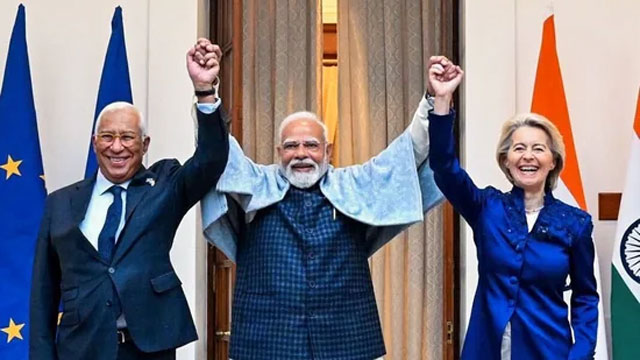
Prime Minister Narendra Modi hosted European Council President Antonio Costa and European Commission President Ursula von der Leyen at the India-EU Summit, a day after EU leaders were chief guests at India’s Republic Day celebrations — an honour reserved for New Delhi’s closest strategic partners.
Under the agreement, the EU will eliminate tariffs on 99% of Indian exports by value over seven years, with duties on $33 billion worth of labour-intensive goods — including textiles, leather, footwear, gems and jewellery — set to be removed immediately once the pact is signed. India, on its part, will cut tariffs on 96.6% of EU exports, with nearly one-third of the reductions taking effect as soon as the pact becomes operational in early 2027, while the rest will be phased over five to 10 years.
The deal comes at a time when both sides are looking to counter what von der Leyen called a world where “trade is increasingly weaponised”, as global commerce faces uncertainty due to fluctuating tariff regimes.
Calling it India’s biggest trade pact so far, Modi said, “Today, India has concluded the largest free trade agreement in its history,” noting that two-way trade currently totals €180 billion, while over 8 lakh Indians reside in the EU region.
The full text of the agreement is expected to be published in mid-February, followed by legal review and translations, with formal signing likely in August 2026. The pact is expected to become operational in early 2027, nearly two decades after negotiations first began in 2007.
“This historic agreement will facilitate access to the European market for our farmers and small industries, create new opportunities in manufacturing, and further strengthen cooperation between our services sectors,” Modi said.
Indian service providers have secured access to 144 EU sub-sectors, while India has opened 102 sub-sectors to European firms, expanding opportunities in IT, professional services, education and business consulting.
Von der Leyen hailed the pact as a major breakthrough, stating, “Prime Minister, distinguished friend, we did it. We delivered the mother of all deals. We are creating a market of two billion people,” adding that the agreement sends a strong message that cooperation is the best response to global challenges.
The agreement is expected to cut €4 billion in annual tariffs for exporters and generate large-scale employment across India and Europe.
Key consumer benefits in India include a sharp reduction in import duties on European goods. Car tariffs will fall from 110% to 10% for 2.5 lakh vehicles annually under calibrated liberalisation, while wine duties will drop from 150% to 20-30%, and spirits from 150% to 40%. Major tariff cuts are also expected on EU machinery, pharmaceuticals and medical devices.
The EU remains India’s largest trading partner, accounting for €120 billion in goods trade in 2024 and 11.5% of India’s total trade, while services trade reached €59.7 billion in 2023. The pact is also expected to provide a boost to Indian textile and jewellery exports impacted by steep US tariffs in recent months.
Commerce Minister Piyush Goyal said the agreement opens vast potential, noting that India currently accounts for just 1.5% of the EU’s goods imports and 2.5% of services imports, leaving significant room for growth. He added that in marine products, nearly 94% of tariff lines will get duty-free access, while in textiles and apparel, 100% of the European market will be open from day one.
On the contentious EU Carbon Border Adjustment Mechanism (CBAM), Commerce Secretary Rajesh Agrawal said both sides will launch technical dialogue to ensure Indian industries retain market access, and that any flexibility granted by the EU to other countries will automatically apply to India.
Beyond trade, India and the EU also signed a Security and Defence Partnership, enhancing cooperation in counter-terrorism, maritime security, cyber security, and defence industrial collaboration, including co-development and co-production of military hardware.
A comprehensive mobility framework was also finalised to facilitate the movement of Indian students, researchers and skilled workers, while the EU will set up its first Legal Gateway Office in India to support talent migration aligned with member state policies.
A new roadmap titled “Towards 2030: A joint India-European Union comprehensive strategic agenda” will guide cooperation across five pillars — prosperity and sustainability, technology and innovation, security and defence, connectivity and global issues, and enablers such as skills mobility and simplified Schengen visa procedures.
Costa, who highlighted his Goan roots during the interaction, said the agreement signals that both sides “stand together as strategic and reliable partners” in a changing global order.
The leaders also reaffirmed support for the India-Middle East-Europe Economic Corridor (IMEC) to strengthen connectivity, while a joint statement reiterated commitment to peace through dialogue in Ukraine and called for unhindered humanitarian access and a two-state solution in Gaza.
Industry leaders welcomed the agreement, with Bharti Enterprises chairman Sunil Bharti Mittal calling it a sign of trust and stability, and CII director general Chandrajit Banerjee describing it as a “strategic breakthrough” that strengthens India’s global competitiveness.
However, economists noted that the pact will still require approval from the European Parliament and that CBAM could potentially reduce gains for carbon-intensive sectors such as steel, even though pharma and textiles are expected to be less affected.