Daijiworld Media Network - Tehran
Tehran, Jan 19: Iran’s national police chief has announced a short deadline for people who were “misled” into taking part in what authorities describe as riots to surrender, promising leniency if they do so within three days. Speaking on state television, Police Chief Ahmad-Reza Radan said young participants who became involved unintentionally would not be treated as enemy combatants but as deceived individuals, provided they turn themselves in promptly.
The protests erupted across Iran in late December amid a rapidly deteriorating economic situation and soon escalated into open challenges to the ruling theocracy. Anger over soaring prices, unemployment and economic insecurity pushed traders, students and urban residents onto the streets in major cities such as Tehran, Mashhad and Isfahan. In some areas, demonstrators directly targeted Supreme Leader Ayatollah Ali Khamenei, with graffiti and chants calling for his death appearing in parts of the capital.
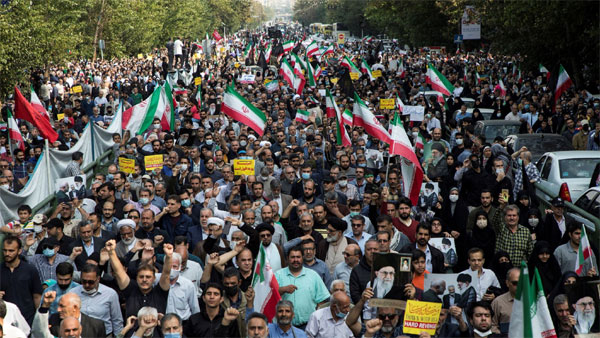
The unrest has come at a heavy cost. Iranian officials have issued conflicting figures on casualties, with one regional official claiming that at least 5,000 people were killed, including around 500 members of the security forces. Some of the fiercest confrontations were reported from Kurdish-populated regions in northwestern Iran. Human rights organisations and activist groups have offered even higher estimates, citing thousands of confirmed deaths and more than 24,000 arrests nationwide.
In a rare public acknowledgment of the scale of the violence, Supreme Leader Ayatollah Ali Khamenei admitted that “several thousand” people had been killed during the unrest. In a televised address, he blamed the United States and Israel for fomenting the protests and described US President Donald Trump as a criminal for voicing support for demonstrators. Khamenei said Iran would not be dragged into war but vowed that those he termed domestic and foreign criminals would not escape punishment. He instructed authorities to deal decisively with what he called sedition, warning that those responsible would face severe consequences.
Iran’s judiciary has since signalled a tough stance, cautioning that individuals accused of leading violent acts could face expedited trials and capital charges, including the offence of Mohareb, or waging war against God, which carries the death penalty under Iranian law.
Tensions have been further inflamed by comments from US President Donald Trump, who has intensified his attacks on Iran’s leadership. Trump labelled Khamenei a “sick man,” called for new leadership in Iran and accused the supreme leader of destroying the country through extreme violence. He also urged Iranians to continue protesting and seize control of institutions, claiming that external support was forthcoming. Trump asserted that Iranian authorities had paused planned executions of hundreds of detainees, though analysts and observers have questioned the accuracy of those claims.
Iranian President Masoud Pezeshkian has responded sharply, warning that any attack on the Supreme Leader would be treated as a declaration of war against Iran. He reiterated the government’s position that the unrest was fuelled by foreign interference, a view he also conveyed during a phone call with Russian President Vladimir Putin.
Meanwhile, Iranian authorities say the situation is gradually stabilising. State media has reported a return of relative calm in several cities, with streets reopening, businesses resuming operations and schools restarting after weeks of disruption. Internet access, which had been heavily restricted during the protests, has begun to return in parts of the country, although filtering and limitations remain in place as security forces continue to monitor the situation closely.