Daijiworld Media Network – Kundapur
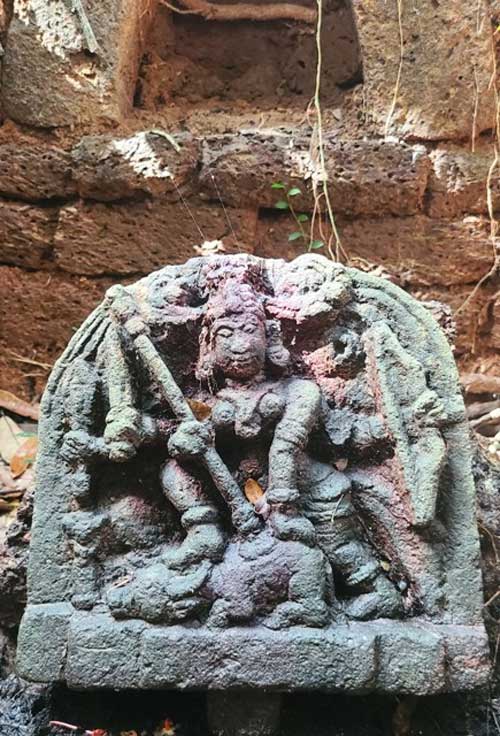
Kundapur, Jan 13: A rare and unique form of Mahishamardhini has been discovered in a ruined temple at Melmutt in Kundabarandadi village of Kundapura taluk in Udupi district, according to archaeologist and Adima Kala Trust founder trustee Prof Murugeshi T.
In a press release issued here, Prof Murugeshi said that mother cult is one of the oldest belief systems in the world. In Udupi district too, the earliest rock art mother figures date back to the prehistoric period. The mother goddess has been worshipped in various forms across India, with the Mahishamardhini cult emerging in the early centuries of the present era in north-western India before spreading rapidly to southern regions.
He noted that Udupi district is an important centre of the Mahishamardhini cult. The oldest Mahishamardhini temple in the district is the Belman Mahishamardhini temple, dated to the 7th century AD. The Belman copper plate inscription of Aluvarasa II, considered the earliest Kannada copper plate inscription, praises the goddess as Vindhyagirivasini and Mahamunisevite.
Describing the newly identified sculpture, Prof Murugeshi said the Mahishamardhini image, which is currently under study, has six arms. In her right hands, she holds a trident, a sword and an upright gadha, while on the left she places one hand on the back of Mahisha, one hand is mutilated, and the third holds a bow. The goddess places her right leg on the head of Mahisha and pierces his body deeply with the trident.
The facial features of the sculpture are striking, with a flat and thick nose, prominent lips, protruding eyes and a karanda mukuta as headgear. The figure strongly reflects the local Dravidian art tradition and resembles a mother figure of the Dravidian clan. A small female figure carved below the gadha on the right side is believed to represent Mahisha’s wife.
Prof Murugeshi further explained that the Mahishamardhini temple at Kundabarandadi holds great historical significance. Mahishamardhini temples are located in all four cardinal directions in the region, and the Kundabarandadi temple, situated in the south, reflects the demon aspect. This grouping indicates that the temples belong to the Panchadurga tradition, symbolising the five elements of nature, with Shiva representing the fifth element as male power. Stylistically, the sculpture is datable to the 15th century.
He expressed gratitude to Nagendra Poojary, Raghuram Poojary, Sitarama Poojary and Sanjeeva Billava of the temple renovation committee for their support in the study. He also thanked Adima Kala research team members Murulidhara Hegade, Shreyas, Gowtham and Bhanumati for their tireless assistance.