Media Release
Mangaluru, Nov 26: Sahyadri College of Engineering & Management organised a one-day pre-conference workshop on November 26 ahead of the third edition of the International Conference on Computing, Semiconductor, Mechatronics, Intelligent Systems and Communications (COSMIC-2026), in association with IEEE Bangalore section and IEEE Mangalore subsection.
The workshop, titled ‘Advancing research excellence and technological impact through generative AI, scholarly publishing and intellectual property,’ focused on the evolving role of generative artificial intelligence in research, the significance of scholarly publishing and the importance of intellectual property in fostering innovation and technological advancement.
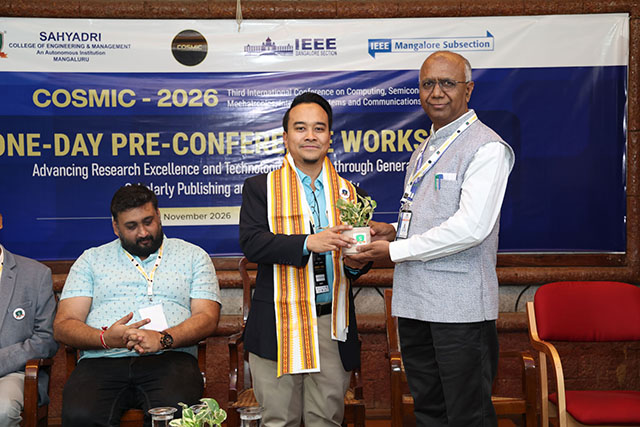
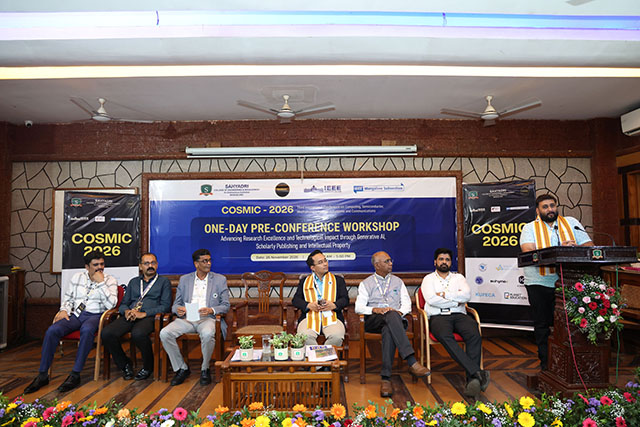
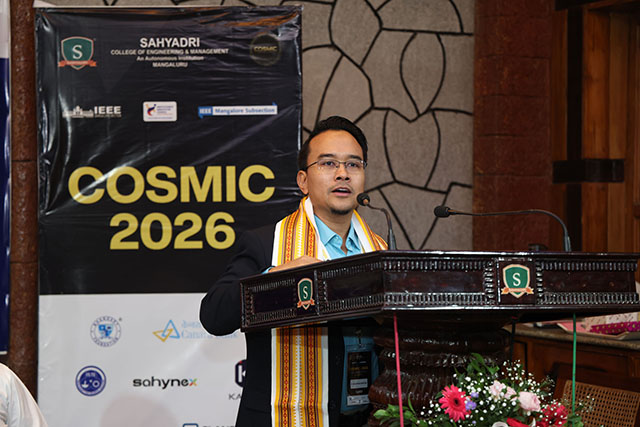
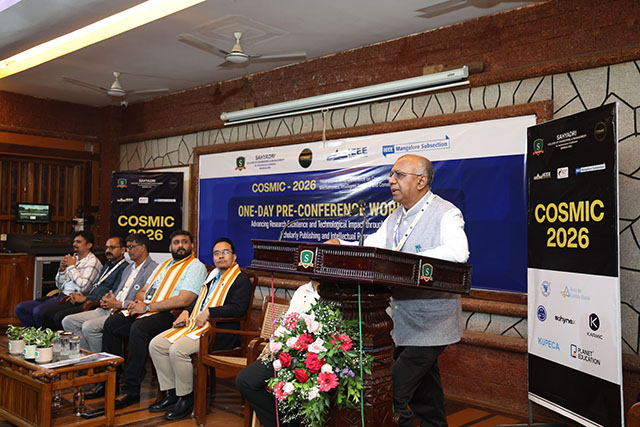
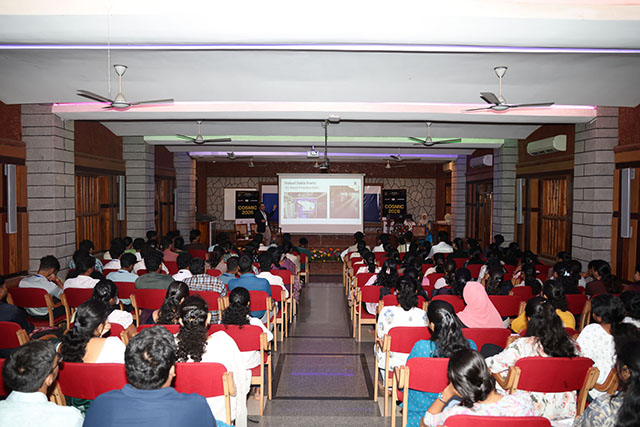
The programme featured distinguished resource persons, including:
• Dr Hasan Firdaus Mohd Zaki, director of the Centre for Unmanned Technologies (CUTe) and professor of Mechatronics Engineering at IIUM - Malaysia.
• Dr Chengappa Munjandira, chair-elect of the IEEE Bangalore section, Academic Senate member - VTU, and senior technologist at HP.
• Dr Krishnaraj Chadaga, Manipal Institute of Technology, MAHE, Manipal, recognised among the World's Top 2% of scientists in the Stanford University–Elsevier ranking.
Dr Mustafa Basthikodi, professor and head of the department of CSE and organizing chair of COSMIC-2026, delivered the welcome address, extending a warm welcome to the gathering.
He expressed his enthusiasm for hosting the Third International Conference on COSMIC-2026 and highlighted its role in fostering knowledge exchange and collaboration among researchers, academicians, and industry professionals while exploring emerging technological advancements.
Addressing the gathering, Dr Hasan Firdaus Mohd Zaki emphasised the importance of translating research into practical applications that benefit society. He highlighted the role of Artificial Intelligence in enhancing research capabilities, accelerating innovation, and addressing real-world challenges.
Dr Chengappa Munjandira highlighted the need to bridge the gap between research and real-world implementation. He discussed Technology Readiness Levels (TRL) as a framework for evaluating technological maturity and transforming research ideas into market-ready solutions. He also stressed the importance of translating research publications into practical innovations that contribute to society.
In his presidential address, Dr S S Injaganeri, principal of Sahyadri College of Engineering & Management, encouraged students and faculty members to look beyond conventional classroom learning and explore opportunities for innovation through hands-on laboratory experiences. He emphasised the importance of improving research quality through the effective utilisation of Artificial Intelligence and encouraged the academic community to transform innovative ideas into tangible products.
Reinforcing this vision, he conveyed an inspiring message to the participants: ‘Walk in with ideas, walk out with products.’ The message underscored the institution's emphasis on experiential learning, innovation and translating knowledge into practical solutions.
The event was attended by Sudheer Shetty, vice principal; Krishna Hegde, trustee & administrator, along with the deans and heads of various departments, faculty members and participants.
The programme concluded with the vote of thanks proposed by Dr Anush Bekal, professor and head of the department of ECE and organizing co-chair of COSMIC-2026, who expressed gratitude to the dignitaries, resource persons, organisers and participants for their contributions to the successful conduct of the programme.
The programme proceedings were coordinated by Madhura, who served as the master of ceremonies and guided the event through its various segments.
The workshop was coordinated by faculty coordinators Dr Deepthi Rai and Dr Joyline D'Sa from the department of CSE.
Session 1: Physical AI for unmanned systems
Speaker: Prof Hasan Firdaus Mohd Zaki
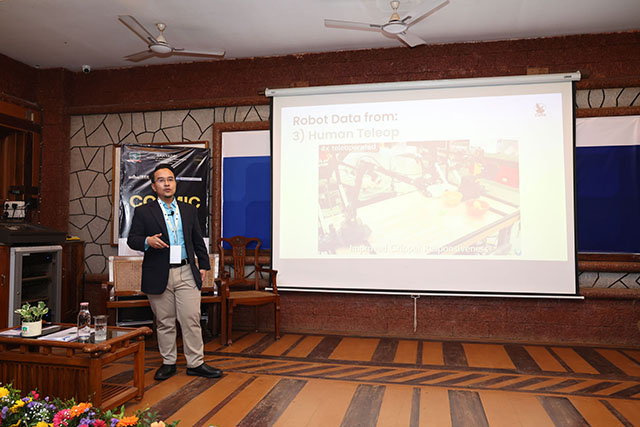
The session explored the evolution of AI from Large Language Models (LLMs) and Vision-Language Models (VLMs) to AI agents and physical AI, focusing on applications in robotics and unmanned systems. The speaker explained how Vision-Language-Action (VLA) models enable robots to understand instructions and perform autonomous tasks. Discussions covered multi-task AI models, human supervision, real-world training data challenges, simulations, world models and Reinforcement Learning. He also showcased SURAYA, an Unmanned Surface Vehicle (USV) equipped with LiDAR, cameras and edge computing. Highlighting the challenges of Physical AI, he noted that even a 2.5-second processing delay can affect autonomous systems, stating, “On-screen mistakes can be undone, but in the real world, they cannot,” emphasising the need for faster and more responsive AI systems.
Session 2: Introduction to artificial intelligence, machine learning and explainable AI
Speaker: Dr Krishnaraj Chadaga
The session covered the fundamentals of Artificial Intelligence (AI), Machine Learning (ML), Deep Learning (DL) and Explainable AI (XAI), highlighting their concepts, applications, and significance. The speaker explained supervised, unsupervised and reinforcement learning, along with various real-world applications of AI in healthcare, fraud detection, virtual assistants, and facial recognition. He discussed the machine learning lifecycle, including data preprocessing, feature scaling, data balancing, model training and evaluation, and introduced algorithms such as linear regression, decision trees, random forests and support vector machines. The session also highlighted Explainable AI techniques such as SHAP and LIME, career opportunities in AI and key challenges related to model accuracy, interpretability, and data privacy.
Session 3: Hands-on session on prior art search and patent drafting
Speaker 1: Dr Rathishchandra Gatti
The session focused on Intellectual Property Rights (IPR), particularly patent searching, drafting and online filing. The speaker explained the key patentability criteria of novelty, non-obviousness, and usefulness, along with prior art search techniques using platforms such as Google patents, WIPO and Espacenet. The hands-on session covered patent drafting, application forms, abstracts, drawings, and the online filing process through the Indian Patent Office.
Speaker 2: Dr Manjunath Patel
The session focused on the World's Top 2% Scientists list and the criteria used to evaluate research impact and academic contributions. The speaker explained key research metrics, including citations, h-index, and citation indicators, along with research integrity measures such as self-citation percentage and citations per distinct citing paper. He emphasised the importance of quality publications, meaningful citations, and consistent research contributions in building a strong academic profile and gaining recognition in the global research community.