ACs can be quite intimidating to buy. You will find many options with varied capacities, costs, and specifications in each shop. However, the fact is that selecting an AC should not be determined by brands or technical specifications alone. There are three critical factors to consider when choosing an AC. They are size, usage, and cooling capacity.
Room Dimensions Decide How Much Cooling Power You Need
Every room requires a specific cooling capacity for comfort. Small rooms will heat and cool more rapidly. Larger rooms take longer to heat up and cool down. That is why you have to consider the size of the room before you go ahead and compare different machines.
A wrongly sized machine results in wastage of money either through excessive power usage or through ineffective performance of the cooling appliance.
Cooling Capacity: Matching the Ton Rating to Your Room
AC Capacity is measured in tons (sometimes BTUs) and indicates the amount of heat that can be taken away by an AC in one hour. More does not always mean better; it depends on the match.
As a general rule, 120 sq ft and below require a 1-ton AC, 120-180 sq ft require a 1.5-ton AC, and above 180 sq ft require a 2-ton AC or more. Walls facing the sun and high usage during the day increase the requirement. Small units will continuously work without cooling adequately, whereas large units will turn off without dehumidifying.
Why a Split System Suits Bigger or Open Layouts
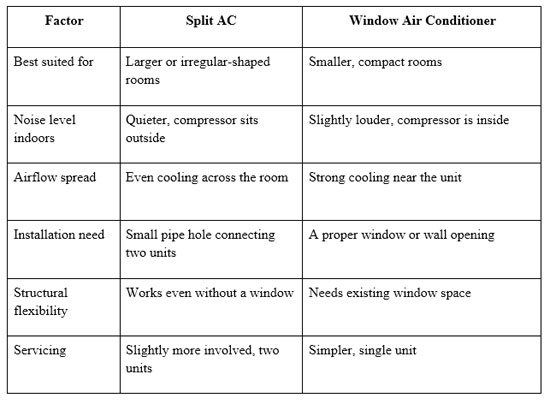
A split system has two parts, one inside the room and one outside. Since the compressor sits outside, it runs quieter indoors. It also spreads air more evenly across bigger or open-layout rooms. A 1.5-ton split AC unit, mounted higher on the wall, cools corner to corner rather than just one section.
Why a Window Unit Works Well for Smaller Rooms
A window air conditioner fits everything - compressor, fan, and cooling coil - into one unit. This makes it ideal for smaller rooms needing quick, direct cooling. It cools strongly near the unit but takes longer to reach far corners. For compact spaces, this is rarely an issue, and it's simpler to service too.
Split AC vs Window Air Conditioner: A Quick Comparison
Here's a simple side-by-side look at how the two compare on the things that matter most:
How Daily Usage Should Guide Your Choice
Size and design aside, think about how the room is really used day to day, not just its dimensions.
- A bedroom for nighttime rest is well served by moderate, comfortable cooling.
- A living room used through the day, with more people and heat from electronics, needs steadier, heavy-duty, and convertible cooling.
- A home office running through afternoon heat needs consistent, uninterrupted cooling without frequent switching off
Matching the AC type to this daily pattern, rather than just square footage, leads to better comfort and smarter energy use.
Installation Fit and Long-Term Cooling Steadiness
- Homes with a proper window opening can go for either option easily
- Newer apartments with limited window space suit a split system better, since it only needs a small pipe hole
- A window air conditioner works well where a suitable window already exists, keeping installation simple
- A correctly sized AC unit, split or window, cools steadily through a long afternoon while keeping the compressor running smoothly
- Right-sized units cycle on and off at a steady, natural pace, keeping comfort and electricity bills in check
Questions to Ask Before You Buy
What size and shape is your room? How many hours will the AC operate each day? Can your room accommodate a window air conditioner, or should you get the split one? Are people going to sit near the air conditioner or all over the room?
Getting answers to these queries is essential to simplify your shopping process. Whether it is a window air conditioner because of its convenience or split type owing to wider area coverage, the main idea behind it all is to pick an air conditioner based on your requirements.