Daijiworld Media Network - New Delhi
New Delhi, Nov 24: Prime Minister Narendra Modi and his Nepalese counterpart Balendra Shah on Monday agreed on a comprehensive joint vision document aimed at reimagining bilateral relations and strengthening cooperation across 10 key sectors, including trade, connectivity, energy, technology, education, sports, health and agriculture.
Titled ‘Viksit Bharat and Samunnat Nepal: Re-imagining the Partnership’, the document seeks to give the relationship a contemporary framework, taking into account changing regional and global realities. The two leaders agreed that existing bilateral agreements could be reviewed by mutual consent and that the partnership should be supported by an updated legal framework.
The document also stated that all outstanding issues, including those relating to water resources, energy, trade and commerce, and the boundary, would be addressed through mutual discussion and dialogue.
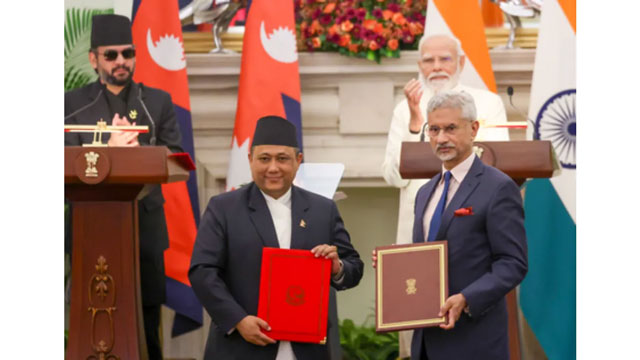
The agreement marks a significant diplomatic development, as Shah, who assumed office in March this year, had initially indicated that he would not undertake foreign visits for a year. His decision to visit India followed sustained back-channel discussions involving the Nepal Prime Minister's Office, government ministries and officials on both sides.
The two leaders also discussed Nepal's reconstruction requirements following the floods and debris flows in the Rasuwa-Trishuli basin and other areas in August 2026. Nepal conveyed its appreciation for India's prompt humanitarian assistance and search-and-rescue support, while both sides agreed to remain engaged on further assistance for reconstruction.
To ensure effective implementation of the agreed initiatives, the Prime Ministers decided to activate the High-Level Monitoring Group, headed by Nepal's Foreign Secretary and India's Ambassador to Nepal. The group will meet at least once every six months to review progress.
The first pillar, covering a comprehensive economic and development partnership, envisages reviewing existing trade and investment agreements, opening new transit connectivity and air routes, and developing cross-border special economic zones and information technology parks near the India-Nepal border. The proposed zones are expected to encourage export-oriented manufacturing and investment.
Under the physical and digital connectivity pillar, both countries agreed to expedite the construction of Integrated Check Posts at Bhairahawa in Nepal and Sunauli in India, besides developing new facilities at Banbasa in India and Dodhara Chandani in Nepal.
The two sides will also work towards completing the remaining sections of the Jayanagar-Bardibas and Jogbani-Biratnagar railway lines and explore collaboration on Nepal's East-West Rail Link. A new petroleum pipeline connecting Siliguri in India with Jhapa in Nepal is also proposed. Cooperation will be strengthened to facilitate faster cross-border retail payments by building on the existing linkage between India's Unified Payments Interface (UPI) and Nepal's national payment system.
Energy, water resources and climate resilience form another important pillar. The two countries agreed to accelerate ongoing and proposed hydropower and multipurpose projects while strengthening cooperation in disaster risk reduction, early warning systems and post-disaster recovery to protect lives, livelihoods and infrastructure.
The good governance pillar provides for training opportunities for Nepalese civil servants in India and the sharing of experiences and best practices between legislatures at national and provincial levels.
In technology, space and innovation, the vision document proposes expanding the India-Nepal Startup Partnership Network through training and mentorship for Nepalese startups in India. It also envisages a Startup Centre of Excellence in Kathmandu and a Digital Nomads and Innovation Hub in Pokhara.
Both countries will explore the development of digital parks and data centres in Nepal, enhance cooperation in artificial intelligence and strengthen collaboration in satellite development, earth observation, remote sensing for disaster management and capacity building.
Education and skill development will receive fresh attention, with both sides exploring the possibility of opening branches or campuses of reputed Indian higher educational institutions in Nepal, beginning with an Indian Institute of Technology (IIT). Scholarship and training opportunities for Nepalese students will also be expanded to include emerging disciplines such as law, technology and artificial intelligence.
Sports cooperation is another key component. India will support the establishment of a national cricket academy in Nepal and assist in developing cricket infrastructure. Players from Nepal's provincial cricket teams will be given opportunities to train at national-level academies in India.
Similar training and development opportunities will be explored in badminton, tennis, shooting and athletics, along with the development of modern multi-sport centres in Nepal.
The culture and tourism pillar envisages developing religious tourism circuits connecting important sites in both countries. These include a Ramayana circuit linking Janakpur and Ayodhya, a Buddhist circuit connecting Lumbini, Bodh Gaya, Sarnath and Kushinagar, and a Shiv-Shakti circuit linking Kathmandu's Pashupatinath temple with Varanasi.
Cooperation between Nalanda University and Lumbini Buddhist University will also be strengthened through the proposed establishment of a Nalanda Centre at the Nepalese university.
In the health sector, the two countries plan to collaborate on upgrading Nepal's National Medical Laboratory, establish India-Nepal Jan Aushadhi Kendras to improve access to affordable and quality medicines, and encourage institutional partnerships and student and faculty exchanges between leading medical institutions.
Agriculture forms the tenth pillar, with plans to establish an Agro-Industrial Park in Chitwan with grant assistance from India. The facility is expected to support value addition to Nepalese agricultural products. Both sides also agreed to expedite the implementation of the 2026-30 work plan between the Indian Council of Agricultural Research and the Nepal Agricultural Research Council, besides establishing an ICAR Centre of Excellence in Nepal.
The two Prime Ministers expressed confidence that the joint vision document would provide a blueprint for an ambitious, modern and mutually beneficial partnership between the neighbouring countries. They directed officials from both governments to work towards translating the commitments into concrete outcomes.