Daijiworld Media Network - Texas
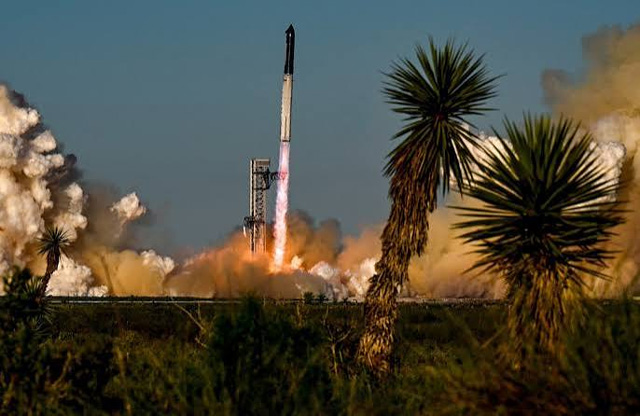
Texas, Nov 15: SpaceX has achieved a major breakthrough in rocket technology after its Starship spacecraft successfully returned from orbit and was caught by the giant mechanical arms of its launch tower in Texas.
The historic manoeuvre, carried out on Saturday, marks the first time an orbital rocket's upper stage has returned from space and been captured at its launch site using mechanical arms, popularly known as 'Mechazilla'.
The achievement represents a significant step towards SpaceX's ambition of developing a fully reusable rocket system, which could eventually reduce the cost of space travel and enable more frequent launches.
The spacecraft completed its 15th flight, successfully reaching orbit, deploying satellites and returning to Earth. SpaceX CEO Elon Musk congratulated the engineers and teams behind the mission, acknowledging their efforts in executing the complex operation.
NASA Administrator Jared Isaacman also congratulated Musk and the SpaceX team, describing the achievement as an extraordinary moment that brings space exploration closer to new possibilities.
According to SpaceX, Starship lifted off from Starbase in Texas on Friday for its 15th flight. After reaching orbit, the spacecraft deployed 26 Starlink V3 satellites. The company confirmed that contact was established with all the satellites shortly after deployment as they began raising their orbits to join the Starlink constellation.
Starship remained in orbit for more than 20 hours while the flight control team monitored its systems and prepared for its return. It subsequently reignited one of its Raptor engines to perform a deorbit burn and begin its descent towards Earth.
During the final stage, the spacecraft approached the launch site after completing a manoeuvre over the Gulf of Mexico. Three Raptor engines ignited to execute the landing flip and slow its descent before the spacecraft was successfully guided towards the waiting mechanical arms of the launch tower.
Unlike conventional rocket recovery systems that rely on landing legs, SpaceX's Mechazilla system uses two massive mechanical arms attached to the launch tower to capture the returning spacecraft.
Meanwhile, the Super Heavy booster encountered a technical issue during its return sequence. SpaceX said the booster initially ascended using 33 Raptor engines before separating from Starship through a hot-staging manoeuvre.
The booster subsequently reignited 32 engines for its boostback burn. However, the burn ended earlier than planned due to low fuel mass, with the root cause being investigated. An automated abort was triggered by its guidance, navigation and control system, diverting the booster towards an offshore landing location.
It successfully performed its landing burn over the Gulf before its flight termination system was activated.
The successful recovery of Starship's upper stage marks an important development in SpaceX's efforts to make both stages of its launch system reusable. While the company has already demonstrated the recovery and reuse of its first-stage boosters, retrieving the upper stage presents a considerably greater technical challenge.
If the technology can be repeated reliably, it could significantly reduce launch costs and make space missions more economical. The latest achievement is also expected to support SpaceX's long-term ambitions for lunar exploration and future missions beyond Earth.