Daijiworld Media Network - New Delhi
New Delhi, Oct 22: Congress president Mallikarjun Kharge has criticised the continued prevalence of caste discrimination and untouchability in India, arguing that such practices have contributed to divisions within Hinduism.
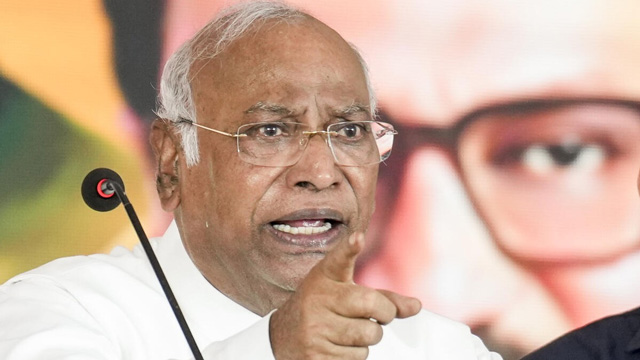
He was speaking at the 70th Dhamma Chakra Pravartana Day celebrations held at Buddha Vihara on Vijayadashami on Tuesday. The event was organised by the Siddhartha Vihara Trust.
Kharge recalled that Dr BR Ambedkar had declared in 1935 that he was born a Hindu but would not die one, citing the discrimination and untouchability prevalent within the religion.
Highlighting the persistence of caste-based discrimination, Kharge referred to an incident in Uttarakhand, where he claimed that the spot where he had delivered a speech was washed two days later.
“Casteism has not been eradicated from the country even today. In Uttarakhand, the very spot where I delivered a speech was washed clean two days later. Had it been washed immediately, one might have assumed it was simply to clean away dirt. But what kind of blind superstition is it to wash it two days later? Is this not a form of mental torture?” he asked.
Kharge also questioned the exclusion of marginalised communities from equal access to basic facilities and social participation.
“You invite Martin, Mohammad, but not Mallikarjun. Why do you exclude my people? Don’t you provide us with water or education? Are we not human beings? Is this not the very reason why divisions emerged within Hinduism?” he said.
Referring to Ambedkar’s decision to embrace Buddhism, Kharge said it offered a path towards liberation from religious discrimination and social oppression.
He said Ambedkar chose Buddhism because it was an ancient Indian religion, adding that adopting a faith originating in another country could have posed challenges to national unity.
“People were kept in bondage in the name of religion. Ambedkar showed the path to liberation to all of them by embracing Buddhism. He chose India’s ancient religion of Buddhism precisely because adopting a religion originating from a foreign country might have posed a threat to the nation’s unity,” Kharge said.