Daijiworld Media Network - New Delhi
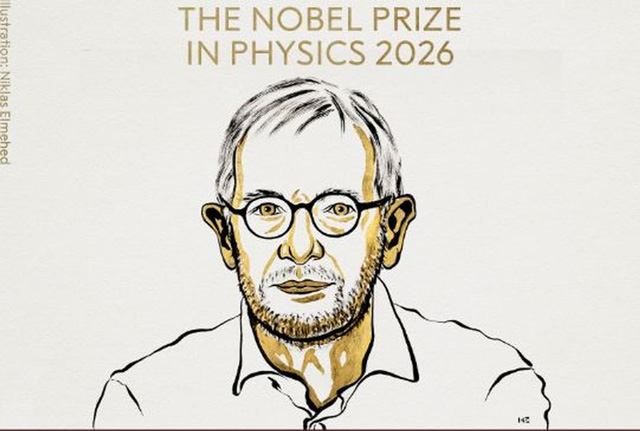
New Delhi, Oct 6: The 2026 Nobel Prize in Physics has been awarded to Francis Halzen for his decisive contributions to the IceCube Neutrino Observatory and the discovery of high-energy neutrinos of astrophysical origin.
The Royal Swedish Academy of Sciences announced the prestigious award in Stockholm on Tuesday. The prize recognises Halzen's central role in developing IceCube and establishing neutrinos as a new way of studying the universe.
Neutrinos are extremely elusive particles that can travel vast cosmic distances while interacting only rarely with matter. Halzen's work with IceCube helped scientists detect high-energy neutrinos originating from sources beyond Earth, opening a new window into some of the most energetic phenomena in the universe.
What is the IceCube Neutrino Observatory?
The IceCube Neutrino Observatory is a massive neutrino detector embedded deep beneath the Antarctic ice at the South Pole. It uses a huge volume of ice and an array of light sensors to detect faint signals produced when neutrinos interact with matter.
Halzen conceived the idea of using Antarctic ice as a giant particle detector and has been closely associated with the development and scientific leadership of IceCube. The observatory has enabled researchers to study high-energy neutrinos produced in powerful astrophysical environments and trace some of them back to their cosmic sources.
The award recognises Halzen's contribution to neutrino astrophysics and the development of an observatory that has significantly expanded scientists' ability to investigate the high-energy universe.
The 2026 Nobel Prize announcements began on Monday with the Nobel Prize in Physiology or Medicine. The Chemistry Prize is scheduled to be announced on Wednesday, followed by the Literature Prize on Thursday. The Nobel Peace Prize will be announced on Friday, while the Sveriges Riksbank Prize in Economic Sciences in Memory of Alfred Nobel is scheduled for Monday.