Daijiworld Media Network - Kathmandu
Kathmandu, Aug 31: Rescuers in Nepal and China battled mud, swollen rivers, unstable terrain and the threat of newly formed lakes on Sunday as they searched for thousands of people missing after a massive wall of water and debris swept through the Himalayan border region on August 26.
At least 797 people have been confirmed dead across Nepal and Tibet, while more than 3,000 remain missing. Nepal reported 781 deaths and 2,502 missing people, while China's state broadcaster CCTV said 16 people had died and 546 remained missing in Tibet. The figures are expected to change as search and rescue operations continue.
The disaster is believed to have been triggered by the collapse or avalanche of ice and rock near the Nepal-Tibet border. The resulting torrent of water, mud and debris swept through towns and villages, destroying homes, vehicles, roads, bridges and hydropower infrastructure. The Bhotekoshi River carried the floodwaters downstream into Nepal.
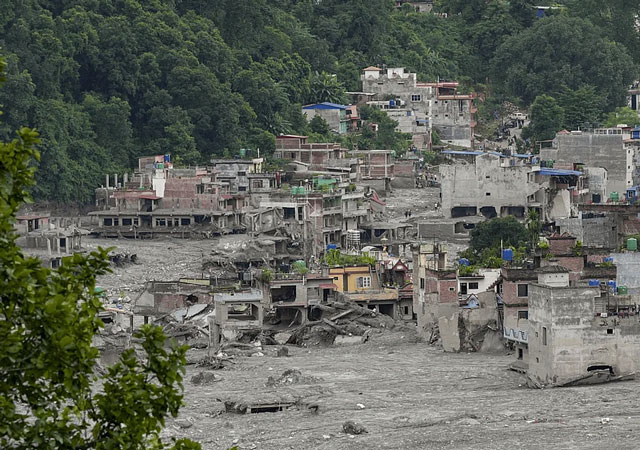
Nepal's disaster agency said bodies had been recovered from all eight affected districts as rescuers continued to search for missing people and evacuate those stranded in remote areas. More than 9,500 people had been rescued from the affected areas by Sunday night, including local residents and tourists from several countries.
Rescue teams reach hydropower tunnels
Nepali Army troops and engineers intensified efforts to reach hydropower workers believed to be trapped inside tunnels at the Trishuli 3A hydroelectric project.
Rescuers successfully inserted a pipe into a tunnel passage and began sending air through a small opening in an attempt to keep those trapped alive. An 11-member specialised tunnel rescue team from India joined the Nepali Army in the operation.
The Indian Embassy in Nepal said the Indian team worked with Nepali personnel on search and rescue operations at hydropower tunnel sites in the Chilime and Langtang areas and would continue working in coordination with the Nepali Army.
An Indian team also entered a tunnel near the Langtang hydroelectric project and recovered the mortal remains of one person despite difficult weather conditions, according to India's Ministry of External Affairs.
As many as 537 workers and employees remained unaccounted for at nine hydropower projects in the flood-hit Rasuwa and Nuwakot districts, including Trishuli-3A. The disaster damaged eight operational hydropower projects with a combined capacity of 354 MW and five projects under construction, according to the Independent Power Producers' Association Nepal.
Reuters reported that rescue teams from Nepal, India and China were using heavy machinery and specialised equipment at hydropower sites, with particular attention on tunnels where hundreds of workers were feared trapped.
India expands rescue and relief operation
India has significantly expanded its assistance to Nepal, sending specialised tunnel rescue personnel, forensic experts and relief supplies.
A 19-member Indian forensic team began work in Kathmandu on Sunday to assist with DNA analysis and identification of victims' remains. The team met the Indian Ambassador to Nepal before holding discussions with officials from Nepal Police's Central Forensic Science Laboratory and the Forensics Department of Tribhuvan University Teaching Hospital.
The MEA said 403 Indian nationals had safely crossed into Nepal from China on Sunday, according to local government sources on the Chinese side. It also said hundreds of Indians remained on the Chinese side and were safe and in contact with authorities.
India has so far sent 68.5 tonnes of relief materials to Nepal. The fourth Indian flight carrying 11 tonnes of supplies arrived in Nepal, with the materials handed over to the authorities. The supplies include blankets, sleeping bags, tarpaulins, plastic sheets and hygiene kits.
Thirty-seven trucks and 35 SUVs carrying food supplies, along with eight helicopters carrying food and non-food materials, have also been dispatched to affected areas.
Bodies buried after DNA samples collected
With hospitals crowded by relatives searching for missing family members, authorities have begun shifting their focus towards identifying the dead.
Photographs of missing people have been displayed outside hospitals as families search for their loved ones. Police said only 17 recovered bodies had been identified because many were badly decomposed or had suffered severe injuries.
Bagmati Province Police spokesperson Rajendra Prasad Dhamala said 96 bodies had been buried after completion of the required legal procedures. DNA samples were collected and preserved before burial to allow families to identify and reclaim the remains later.
Nepal Foreign Secretary Amrit Bahadur Rai said unidentified and unrecognisable bodies, including those that were decomposed or amputated after prolonged exposure to floodwaters, were being buried according to accepted procedures.
Medical teams collected DNA samples from every victim before burial, allowing families to match records later. Families would also be permitted to exhume remains for necessary religious rituals, he said.
Fresh flood threat raises concern
Rescue efforts faced another threat on Sunday after authorities warned that water levels in the Bhotekoshi River had risen again.
Nepal's disaster agency urged residents and rescue personnel to take precautionary measures. The warning came amid continuing rainfall and thunderstorms forecast for flood-hit areas.
Fears of another major flood also grew after a lake formed on the Chinese side following the glacier collapse. Chinese media had reported that the original barrier lake was shrinking, reducing the immediate threat. However, a landslide near the natural dam subsequently led to the formation of another lake, prompting rescue personnel to evacuate the area.
More than 20,000 security personnel have been mobilised for search and rescue operations, while helicopters continue to evacuate stranded people and deliver essential supplies.
Roads, bridges and power projects destroyed
Transport services remained halted along the Prithvi Highway, a crucial road linking Kathmandu with Pokhara and western Nepal, after a section at Krishnabhir was washed away by the swollen Trishuli River.
A roughly 20-metre section of the highway collapsed because of erosion caused by the surging river, bringing traffic to a standstill. Officials said restoration would take time and urged travellers to use alternative routes.
Nineteen motorable bridges and several highways and arterial roads were destroyed or washed away by the floods.
The disaster has also disrupted Nepal's hydropower sector, with eight operating projects and five projects under construction damaged in Rasuwa and Nuwakot. The affected operational projects had a combined capacity of 354 MW.
Foreigners among those missing
The disaster agency said 592 foreigners were unaccounted for in Nepal, an increase from 517 reported on Friday. No complete nationality-wise breakdown was immediately available.
China reported that 261 foreign nationals were among those missing on its side of the border. Chinese authorities said missing foreigners included citizens of Nepal, India, Latvia, the United States and the United Kingdom, among others.
Among those missing in Nepal are 933 hydropower workers, 45 Nepali Army personnel, 38 police and armed police personnel, and 19 customs and immigration officials.
Preliminary figures from Nepal's Education Ministry also indicated that 238 students and 18 teachers from schools in three affected districts remained missing.
In India, seven bodies believed to be victims of the Nepal floods were recovered from rivers flowing into the country. The bodies had not been included in Nepal's official death toll.
Survivors begin facing long road to recovery
The disaster has left large parts of the Himalayan region buried under mud and debris, while thousands of families remain separated from loved ones.
As rescue teams continue searching tunnels, riverbanks and devastated settlements, survivors have begun returning to villages to recover documents, belongings and whatever remains of their homes.
The immediate priority remains finding those still missing, identifying recovered bodies and preventing further loss of life as rain, unstable terrain and rising rivers continue to threaten the region. At the same time, Nepal is beginning the enormous task of rebuilding roads, bridges, hydropower facilities and communities devastated by one of the region's worst recent natural disasters.