Daijiworld Media Network - Taybeh
Taybeh, Aug 14: Fear and uncertainty have gripped Taybeh, one of the last predominantly Palestinian Christian communities in the occupied West Bank, as residents say repeated attacks by Israeli settlers have disrupted daily life, damaged livelihoods and pushed some families to leave.
Sandra and Roland Basir now keep two fire extinguishers inside their home after settlers allegedly set fire to a neighbour's car outside their house. Sandra checks the doors repeatedly before going to bed and the family keeps a dog outside to alert them to possible intruders. Their seven-year-old son has stopped playing outdoors and, for months, asked his father not to go to work because he feared he would not return.
Roland, who spent more than two decades building a stone quarry and concrete-block factory on the outskirts of Taybeh, said he invested about $5 million in the business and employed around 40 local Palestinians. He alleges that settlers repeatedly chased him and his workers away at gunpoint during the past three years and set fire to heavy machinery at the quarry.
The most serious incident, according to Roland, occurred in March when around 30 to 40 settlers entered the quarry in what he described as a coordinated attack. Photographs and videos showed Israeli flags being raised on the property and people praying on the land. Roland said his office was later smashed, electrical panels were destroyed and security cameras were ripped from the walls.
He said he reported the attacks to the police, liaison office and other authorities and documented the damage, but the settlers returned the following day. Roland has now stopped trying to operate the quarry, saying the business and much of his land have effectively been taken over.
Taybeh, traditionally identified with biblical Ephraim, is home to about 1,200 people and the ruins of the fifth-century Church of St George. It is considered the last Palestinian town in the West Bank with an entirely Christian population.
Madees Khoury, who runs the family-owned Taybeh Brewery, said she never imagined the town would face such insecurity. She recalled living through the second Intifada, the Arab Spring and wars in Gaza without Taybeh experiencing the kind of violence residents now fear.
Residents say the situation began deteriorating as Israeli settler outposts expanded around the town. Mayor Suleiman Khourieh estimates that about seven settler outposts now surround Taybeh, with four or five located on land belonging to the municipality.
Residents have reported settlers bringing cattle, sheep and camels onto privately owned agricultural land. Christian leaders have also alleged that fires were deliberately started near a church and cemetery. Local residents said armed settlers recently started large fires in farmland and prevented fire engines from reaching the affected areas.
Access to agricultural land and water resources has also become increasingly difficult. Residents say settlers have taken control of the Ein Samiya spring, which supplies water to Taybeh Brewery and other Palestinian communities.
Khourieh said settlers recently took over his vineyard and its well after establishing an outpost nearby. He alleged that they cut his locks, brought sheep to graze on the land, installed a tent near the well and used the water intended for his vines. Although the army later removed the tent, he said settlers continued returning to the well to water their animals.
The latest settler outpost was established on the western edge of Taybeh last week in Area B of the West Bank, where Palestinians have civil administrative control but security responsibilities are coordinated with Israel.
Israeli officials have acknowledged concerns over outposts in Area B. Prime Minister Benjamin Netanyahu said earlier this year that such outposts should be evacuated. However, enforcement has faced opposition from members of his far-right government. Peace Now has counted about 390 illegal outposts and farms across the West Bank, including at least 21 in Area B.
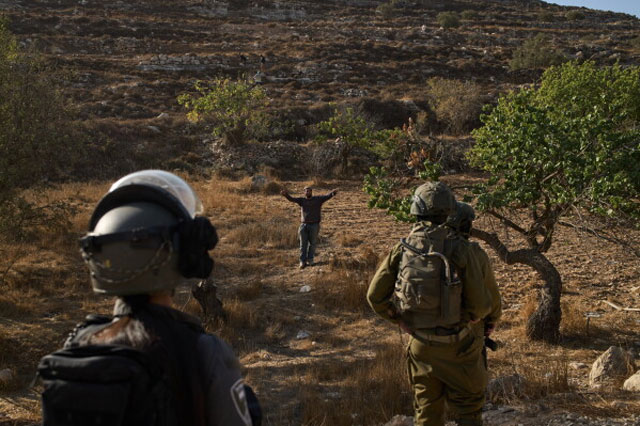
Following recent attacks, including the reported entry into an empty Taybeh family home on August 5, the Israeli army on August 9 declared Taybeh and neighbouring Rammun a closed military zone. Reuters reported that the order was aimed at preventing further attacks by Israeli settlers and applies to Israelis rather than Palestinians.
Residents, however, remain doubtful about the effectiveness of the measure. Madees Khoury described the order as unclear, while the mayor said it had made little practical difference because settlers remained in place. Father Bashar Fawadleh, priest of Taybeh's Christ the Redeemer Church, said residents did not feel that settlers were actually being prevented from entering the town.
Roland said that on the day the military closure was announced, settlers again entered his quarry and damaged cabinets, equipment and other property. When he returned the next morning, he said settlers confronted him again. He called police and alleged that officers arrived about two and a half hours later, after the settlers had already left.
The growing insecurity is also affecting Taybeh's economy. Tourism has sharply declined, and the hiking trail beginning near the brewery now attracts very few visitors. Madees said Taybeh Brewery's revenues have fallen by about 80 per cent compared with before October 2023.
Residents also face movement restrictions and growing concern over checkpoints and encounters with settlers on roads. Father Bashar said 15 families had left Taybeh during the past two years, while dozens of individuals had also departed, mainly for the United States and Europe.
Despite the departures, many residents say they do not want to leave. Father Bashar said the community wanted to remain rooted in its land "for dignity, for security, for peace, and for justice."
Mayor Khourieh also insisted that Palestinian Christians would remain in Taybeh, describing it as their historic home and holy ground.
Father Bashar said the community's suffering reminded him of the cross carried by Jesus, but added that residents must hold on to hope even during the most difficult times.
The situation in Taybeh comes amid a broader rise in settler violence across the occupied West Bank. Al Jazeera reported that the United Nations recorded more than 1,330 settler attacks during the first half of 2026, while Palestinian rights groups say the figure may be an underestimate.
The Israeli authorities have been approached for comment on the allegations concerning attacks in Taybeh and claims that the official response has been inadequate, but no response had been received at the time of publication. The recent military closure of Taybeh was described by the Israeli military as a measure taken because of violent attacks by Israelis in the area.