Daijiworld Media Network - Kolkata
Kolkata, Jun 21: Prime Minister Narendra Modi on Sunday underscored the importance of maritime strength for national development, asserting that lasting peace is possible only when a nation has the capability to safeguard its interests. Speaking in Kolkata during the commissioning ceremony of three naval warships, he said India is steadily strengthening its position as a major maritime power.
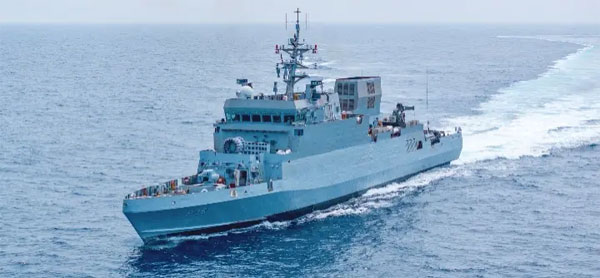
The Prime Minister formally inducted the stealth guided missile frigate INS Dunagiri, the survey vessel INS Sanshodhak, and the anti-submarine warfare shallow water craft INS Agray into the Indian Navy. All three vessels were constructed by Garden Reach Shipbuilders and Engineers (GRSE) and handed over to the Navy on March 30.
Addressing the gathering, PM Modi said maritime security and economic growth are closely intertwined, noting that global communication networks, underwater cables and access to critical minerals all depend heavily on the oceans.
He said India has recognised the strategic significance of the maritime domain and is making substantial investments to strengthen its capabilities.
Referring to the commissioning of the indigenous aircraft carrier INS Vikrant, the Prime Minister said it had demonstrated India's growing self-reliance in defence manufacturing. He added that the induction of the three warships further reinforces the country's commitment to achieving self-sufficiency in shipbuilding.
Highlighting the indigenous content of the vessels, PM Modi said INS Dunagiri contains nearly 75 per cent indigenous components, while INS Sanshodhak and INS Agray have more than 80 per cent indigenous content.
He emphasised that the ships were designed and built entirely in India using domestic expertise, resources and technology, reiterating that the country aims to emerge as a manufacturer rather than remain dependent on imports.
The Prime Minister also pointed out that shipbuilding has a far-reaching impact on multiple industries, including steel, electronics and component manufacturing. He said over 200 micro, small and medium enterprises (MSMEs) contributed to the construction of the three warships, creating significant employment opportunities.
Describing shipbuilding as a major employment-generating sector, he said the government has placed renewed emphasis on expanding domestic production capabilities. He added that nearly Rs 70,000 crore has been allocated to boost shipbuilding, while ports across the country are being modernised and integrated with multi-modal logistics networks.
PM Modi also highlighted India's transformation in the defence sector. He said that while the country was once among the world's largest importers of defence equipment before 2014, it is now increasingly manufacturing systems for both domestic use and international markets.
According to him, India's defence exports have risen dramatically from around Rs 700 crore in 2014 to approximately Rs 40,000 crore, with Indian defence products now reaching more than 80 countries.
However, he said this progress marks only the beginning, stressing that India still has significant ground to cover in its journey towards becoming a global defence manufacturing hub.
The Prime Minister also acknowledged West Bengal's longstanding contribution to India's maritime industry, praising the state's skilled workforce and technical expertise, which he said are vital for the country's shipbuilding ambitions.
Among those present at the event were Admiral Krishna Swaminathan, Chief of the Naval Staff, West Bengal Governor R.N. Ravi, Leader of Opposition Suvendu Adhikari, and GRSE Chairman and Managing Director Cmde P.R. Hari (Retd).
During his address, Admiral Swaminathan noted that INS Dunagiri was completed in 33 per cent less time compared to the previous frigate in its class. He also commended the increasing role of private shipyards in strengthening India's naval shipbuilding ecosystem, particularly in projects such as INS Agray.