Daijiworld Media Network - Ankara
Ankara, Jun 4: A new genomic study has revealed that the ancient Neolithic settlement of Çatalhöyük in present-day Türkiye may have been a rare matrilineal and matrilocal society, where women remained closely connected to their family homes while men were more likely to move away in adulthood.
Located southeast of Konya, Çatalhöyük is regarded as one of the world's earliest large settlements and has fascinated archaeologists since its discovery in 1958. The site, occupied between approximately 7000 BC and 6000 BC, is considered one of the most significant Neolithic archaeological discoveries of the 20th century.
The findings, published in the journal Science, were based on genomic analysis of hundreds of human remains unearthed at the site. Researchers found evidence suggesting that female offspring often remained associated with their ancestral homes for generations, while adult males were more likely to relocate.
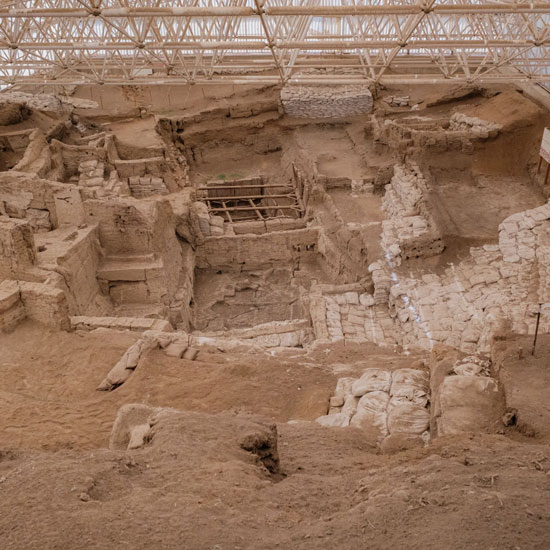
The study analysed 395 skeletons recovered from beneath house floors and examined the genomes of 131 individuals from 35 houses. Researchers concluded that between 70 and 100 per cent of female descendants remained connected to family dwellings, a pattern rarely seen in other Neolithic communities of Europe, which were generally patrilineal and patrilocal.
Çatalhöyük, recognised as a UNESCO World Heritage Site, is believed to have housed between 3,500 and 8,000 people at its peak. The settlement consisted of densely packed houses built directly beside and on top of one another, with no streets or front doors. Residents entered homes through openings in the roofs, which also served as pathways and communal spaces.
Archaeologists found no clear evidence of palaces, temples or elite residences, suggesting a relatively egalitarian social structure. However, some buildings featured elaborate wall paintings, decorative installations and bull horns embedded into walls and platforms, indicating their possible ceremonial significance.
The genomic study also uncovered evidence supporting the elevated social status of women. Young girls, including infants, were buried with significantly more grave goods than boys, often receiving up to five times as many ornaments, beads and decorative objects.
Polish archaeologist Arek Marciniak, one of the study's contributors, said researchers were able to determine the sex of children's skeletons for the first time and found a striking difference in burial practices.
Although female descendants appeared to hold a central place in family and social structures, researchers emphasised that the evidence does not suggest female dominance over men. Instead, earlier studies found little difference between men and women in terms of diet, health and living conditions.
Archaeologist Ian Hodder, who directed excavations at the site for more than two decades, said the findings point towards a highly egalitarian society in which women played an important but not dominant role.
The discovery also adds new significance to the famous Seated Woman of Çatalhöyük, an 8,500-year-old clay figurine depicting a seated woman with prominent features, found at the site in 1961. The figurine has long fuelled debates about the possible importance of women, fertility and female symbolism in early societies.
Researchers noted another unusual aspect of Çatalhöyük: the apparent absence of large-scale organised violence. Unlike some contemporary Neolithic settlements in Europe that show evidence of deadly conflicts, the site offers few indications of warfare despite its large population.
The eastern mound of Çatalhöyük was eventually abandoned around 5700 BC, and archaeologists have found no direct link between its unique social structure and later societies in the region.
Today, matrilineal traditions survive in only a few communities worldwide, including the Mosuo of China, the Minangkabau of Indonesia and the Khasi of northeastern India.
Researchers say the findings from Çatalhöyük provide valuable insights into the diversity of human social organisation and challenge long-held assumptions that early agricultural societies were predominantly patriarchal.