Daijiworld Media Network - Surat
Surat, May 26: A farmer from Gujarat’s Surat district has become a prominent face of natural farming after transforming his agricultural practices following a personal tragedy linked to chemical-based cultivation.
Kalpesh Patel, a resident of Saras village in Olpad taluka, shifted to chemical-free farming in 2019 after losing his father, Ramanbhai Patel, to cancer. According to Patel, years of exposure to pesticides and chemical fertilisers during farming deeply influenced his decision to adopt natural agriculture methods.
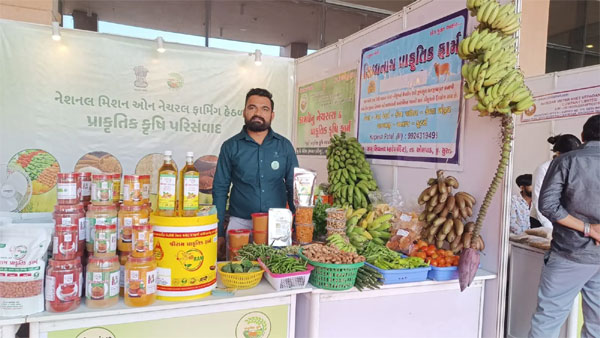
Today, Patel cultivates more than 50 varieties of bananas and has emerged as a notable example of sustainable farming in Gujarat, attracting visits from farmers and agricultural experts from across India.
Apart from farming, Patel also works as a chemical operator in an industrial unit in Surat. He said his father’s illness changed his perspective on the harmful effects of chemical usage in agriculture.
Recalling the experience, Patel said the persistent smell of pesticides on his father’s body after spraying chemicals in the fields left a lasting impact on him.
After deciding to move away from conventional farming practices, Patel underwent training organised by the state Agriculture Department, where he learned natural farming techniques, including the preparation of Jeevamrut — a traditional organic soil treatment used to improve fertility naturally.
Patel inherited around eight bighas of farmland, with nearly three-and-a-half bighas currently dedicated to banana cultivation.
His orchard now grows several banana varieties including Puvan, Adhapuri, Rasthali, Red Banana, Blue Java, Basrai, Mahalaxmi and Elaichi bananas.
According to Patel, the switch to natural farming significantly reduced cultivation costs while improving soil quality and crop yield. He said expenses on chemical fertilisers and pesticides — previously ranging from ?15,000 to ?20,000 per bigha — have been completely eliminated.
In 2025, one banana bunch harvested from his farm reportedly weighed 73 kilograms, far above the average 20 to 30 kilograms typically seen in conventional banana cultivation.
Patel said the average bunch weight in his orchard consistently remains above 30 kilograms and added that he now earns between ?10 lakh and ?12 lakh annually from banana farming on just three-and-a-half bighas of land.
To avoid wastage and increase income, he also processes unsold bananas into value-added products such as banana wafers and banana powder.
His produce is sold at a natural farming market in Vesu established under a Gujarat government initiative promoting chemical-free agriculture.
Patel’s farming success has drawn national attention, with farmers, scientists and agriculture experts regularly visiting his village to study his methods.
Union Agriculture Minister Shivraj Singh Chouhan also interacted with Patel and highlighted his work on social media.
Patel said he now receives banana orders from multiple states and dispatches produce directly from his village through parcel services.
He added that his focus remains on expanding natural farming, increasing value addition and following the principle of “my produce, my price” in agricultural marketing.