Daijiworld Media Network - New Delhi
New Delhi, May 5: The government on Tuesday highlighted India’s growing focus on tackling rare diseases, noting that the issue first gained policy attention under the National Health Policy, 2017 and was later formalised through the National Policy for Rare Diseases, 2021, establishing a comprehensive national framework.
Speaking at a conference, Punya Salila Srivastava, Union Health Secretary, said the government aims to better understand stakeholder challenges, promote innovation, and strengthen systems for managing rare diseases across the country.
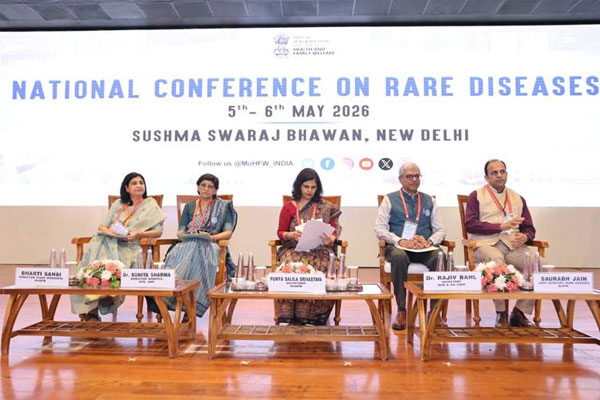
She explained that the policy is being implemented through a network of Centres of Excellence (CoEs), which are leading tertiary care hospitals. The number of such centres has grown from eight to fifteen, including two in the northeast, enhancing access to specialised care nationwide.
Financial assistance for patients has also been significantly increased, with support of up to ?50 lakh now available for treatment of identified rare diseases, helping improve affordability and access.
Addressing the high cost of therapies, Srivastava noted that the government has exempted several life-saving drugs from basic customs duty, with further exemptions announced in the latest Union Budget. She also invited stakeholders to recommend additional drugs that could be considered for such relief.
She acknowledged the role of the Indian Council of Medical Research in advancing indigenous research and therapy development for rare conditions.
Rajiv Bahl, Secretary of the Department of Health Research and Director General of ICMR, reflected on how the rare disease landscape has evolved over the past three decades. He pointed out that in the 1990s, diagnosis was extremely difficult and treatment options were almost non-existent, often leaving doctors with limited options.
He stressed that India must develop its own context-specific approaches to diagnosis, treatment, and prevention, rather than depending entirely on Western models. He added that ICMR is actively working to expand diagnostic tools and treatment capabilities.
Meanwhile, Sunita Sharma, Director General of Health Services, underlined the importance of strengthening healthcare systems for early detection and comprehensive care. She called for better integration of rare disease services across all levels of healthcare to ensure timely referrals and continuity of treatment through an efficient network.