Daijiworld Media Network - Islamabad
Islamabad, Feb 17: Battling snow-clad mountains, treacherous terrain and long hours of walking, Pakistan’s frontline polio workers continue their relentless mission to protect children from a crippling disease that has no cure.
“We climb mountains and walk through the snow for hours with great difficulty. There is also a risk of snow falling on us from the mountains. Yet we do not give up. We reach our assigned area to vaccinate all children and protect them from polio,” says Rabia, a polio worker from Upper Chitral in Khyber Pakhtunkhwa.
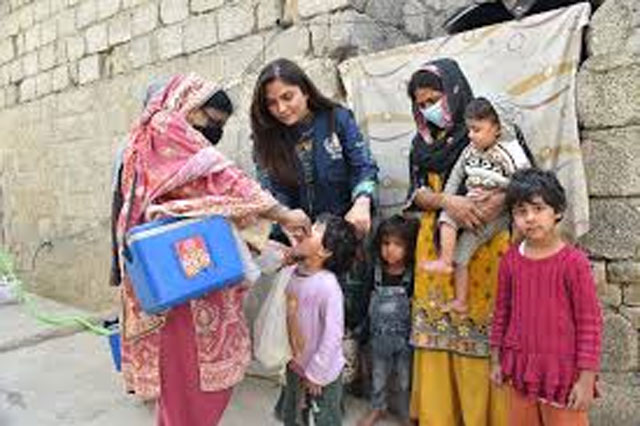
Rabia is among nearly 400,000 frontline workers trained and mobilised by the World Health Organization (WHO), in partnership with Pakistan Polio Eradication Initiative, during the first national polio vaccination campaign of 2026 held from February 2 to 8. The campaign aimed to administer life-saving vaccines to 45 million children across the country.
Over the past three decades, Pakistan has reduced polio cases by 99.8 per cent — from an estimated 20,000 cases annually in the early 1990s to 31 reported cases in 2025. Health experts say that ending wild polio in Pakistan and globally is within reach, provided response efforts are intensified in the two remaining endemic countries — Pakistan and Afghanistan.
The WHO-prequalified oral polio vaccines are considered safe and effective, having been used in 195 countries to protect millions of children from paralysis and death.
During the February campaign, Rabia trekked across steep mountainous terrain in remote Upper Chitral, visiting 146 households and vaccinating 85 children.
In Booni, Upper Chitral, Momina works as part of a two-member polio team. “I thank Allah that I have gotten this opportunity to serve and I am trying my best to eradicate polio in my country,” she says.
Nearly 400 kilometres away in Rawalpindi’s Khayaban-e-Sir Syed area, Zeenat walked through narrow alleys and climbed multiple floors of residential buildings, covering 242 houses to ensure that every eligible child received two drops of the oral polio vaccine.
“I am a mother too and I have also gotten my own children vaccinated for polio. Thank God, they are healthy and protected now,” she says. “This disease has no cure. I want all parents in the country to vaccinate their children with polio drops so they don’t fall prey to paralysis.”
As a founding partner of the Global Polio Eradication Initiative (GPEI), WHO provides technical and operational support to Pakistan’s polio programme, launched in 1994. The initiative leads one of the largest and most complex public health operations in the world.
The operation includes science- and evidence-based vaccination drives, training and deployment of frontline workers, outbreak response, poliovirus surveillance and monitoring and evaluation mechanisms.
During 2024–25, WHO polio operations in Pakistan were supported by contributions from Pakistan, the United Arab Emirates, the United Kingdom, France, Canada, the Kingdom of Saudi Arabia, Germany, the United States, the Gates Foundation and Rotary International.
Neelum, another polio worker from Rawalpindi, underscores the urgency of the mission. “The vaccine is very important for children in Pakistan because polio can infect children and paralyze them. This is why we go house-to-house to vaccinate them so that no child is paralyzed,” she says.
From snow-covered mountain slopes to congested urban neighbourhoods and remote deserts, thousands of workers like Rabia, Momina, Zeenat and Neelum continue their door-to-door efforts — carrying not just vaccine vials, but hope.
Two drops at a time, they are striving to secure a polio-free future for Pakistan and the world.