If you've been looking through job portals over the last few weeks, you have probably noticed it - there is a change in the air. While product management job openings requiring "a couple of years of experience and good communication skills" were previously commonplace, today's recruiters ask for data skills, AI proficiency, and tangible proof of your ability to deliver.
That is precisely why it is becoming increasingly popular among the masses to ask this very question: is product management certification worth the time, money, and effort? Fair question. And the honest answer is, it depends on what you're trying to fix in your career. Some certifications are just decoration for a resume. Others genuinely close the gap between where you are now and where hiring managers expect you to be.
This article is about telling the two apart, so you don't waste your money finding out the hard way.
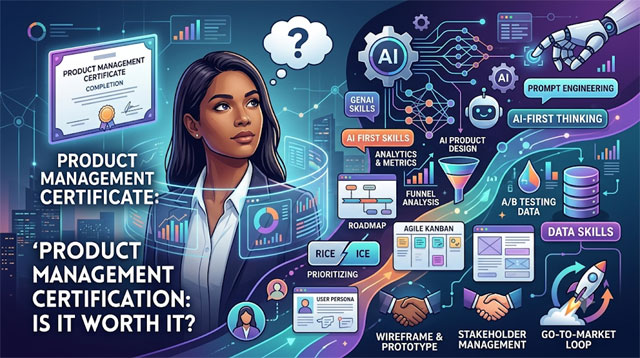
Why Product Management Looks Different Today
A decade ago, the main tasks of a product manager were meeting facilitation, a good PRD, and avoiding conflicts between engineering and design. This role exists today; however, it comes with an additional level of complexity. The modern PM should work with AI-powered tools during the product lifecycle, not just discuss the potential of artificial intelligence during a roadmap presentation. Think about prototype-driven thinking, artificial intelligence-supported user research, and AI-natural rather than AI-additive features.
This is the context in which a certificate programme either justifies its worth or fails to. A generic training programme, which will teach you framework-based skills from 2015, won’t help you when you need to answer the questions asked by the interviewers about scoping out an AI feature. A course built around current tools and real product teardowns will.
What a Good Certification Should Actually Teach You
Before you join any course, it will help if you know what is considered “good.” A good course should take you through the entire product life cycle and not just a part of it. For example, a good certification programme focuses on ten sequential stages:
- Product thinking and product discovery: how to frame problems using JTBD and create personas based on user research.
- Product Roadmapping, Prioritisation & OKRs: How to create an outcome-based roadmap by using techniques like RICE, ICE & Kano.
- Agile, Scrum, and PRD writing: Practical experience in Jira, where user stories and sprints are created to facilitate the execution process.
- Design thinking and prototyping: building wireframes and MVPs in Figma, then testing them with real users.
- Stakeholder management: communicating decisions clearly so alignment doesn't fall apart between meetings.
- Analytics and metrics: reading funnels and retention data, and running A/B tests with tools like Mixpanel.
- Tech foundations: understanding APIs and system design well enough to scope features with engineering.
- AI-driven product management: use of GenAI and prompt engineering for designing AI-native features and PRDs.
- B2B SaaS product management: solving the problem of enterprise onboarding using a sprint-based project.
- Go-to-market strategy: development of launch brief that includes audience, channels, pricing, and growth loops.
If a course skips most of these stages, it is teaching product management as it existed years ago, not as it is practised now.
Is a Product Management Certification Worth It? Weighing the Real Trade-offs
Here's where most people get stuck: self-study is free, so why pay for structure? The honest comparison looks something like this.
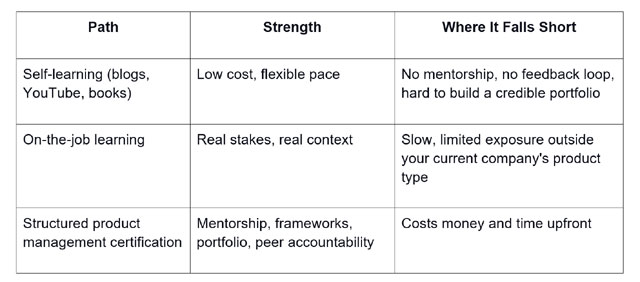
None of these tracks will always be right for everyone. If you’re already a PM who just wants to sharpen your skills, then perhaps the right combination of reading and project work within can get you there. However, if you’re in a career change or coming from outside the tech industry, or if you want to get those PM roles in companies that keyword-filter your resume, then an organised programme gets you closer.
There is also a market reality worth naming. According to a report cited by Emeritus, product roles in India now offer salaries that run significantly above the national average income, and job openings in the space number well into the tens of thousands. That kind of demand does not automatically make a course "worth it," but it does mean the competition for these roles is real, and credentials plus a portfolio genuinely help you get shortlisted.
Where Product Management Jobs Are Actually Growing
Not every sector is hiring PMs at the same pace. If you are evaluating product management jobs right now, a few patterns stand out:
- B2B SaaS companies are hiring aggressively for PMs who understand enterprise workflows and internal tooling constraints.
- Consumer technology companies and D2C require PMs who can analyse funnels and think about retention and not just feature launches.
- Fintech and healthtech are adding AI-focused PM roles as they build compliance-aware, data-heavy products.
- Traditional IT services firms are creating PM roles for clients transitioning legacy systems into product-led models.
A certification that includes actual case work in these areas, not just theory, gives you something concrete to point to in an interview.
How Imarticus Learning Prepares Product Managers for an AI-First Workplace
For anyone weighing structured learning, it's worth seeing how a programme like the AI-First Product Management ProDegree from Imarticus Learning is built. It runs for six months in weekend batches for people who cannot pause their job to study full-time. What stands out is the depth of industry involvement:
- Built in direct collaboration with IBM, including access to the IBM Skills Network and its AI Product Manager Professional Certificate.
- IBM holds over 1,591 GenAI patent applications, more than Google or Microsoft, and learners study frameworks shaped by that research.
- Learners work with Watsonx, IBM's AI platform used by more than 100 million users, alongside 15+ AI-powered tools across the curriculum.
- The programme includes hands-on work across product teardowns, failure sprints, and a capstone Demo Day in front of industry mentors.
- Graduates earn 10 stackable course certifications in addition to the main credential.
This course structure has been created in such a way that it resembles a product development team rather than lectures, with mentoring by experienced PMs of Flipkart, Zepto, and Microsoft.
The Bottom Line
A certification process is never going to be a quick fix, and any course worth its salt will never promise employment. However, what it can achieve is condensing many months and years of failed experiments and experience into a few productive months, providing you with actual projects to present to prospective employers, and introducing you to those who have already performed this job. Whether or not such a deal is worth making, however, is up to your personal choice. Both fresh graduates and professionals find it worthwhile to treat upskilling as an investment. The various programmes provided by organisations like Imarticus Learning prove that this trend towards skill-based learning is on the rise.