Daijiworld Media Network – Kolkata
Kolkata, Aug 30: Veteran actor-filmmaker Aparna Sen has recalled the personal experiences and influential friendships that shaped her directorial debut 36 Chowringhee Lane, which went on to become one of the landmark films of Indian parallel cinema.
Sen, now 80, said her connection with elderly people living alone began during her school days at Modern High School for Girls in Ballygunge, Kolkata. On her way to school and back, she would often see elderly residents on the balconies of an old-age home run by the Little Sisters of the Poor and said she would “feel deeply for” them.
She also remembered elderly Anglo-Indian teachers at her school, many of whose relatives had migrated abroad. One teacher, Ms Stoneham, particularly remained in her memory. She lived alone at Karnani Mansions on Lower Circular Road and, after falling and breaking her elbow, had nobody to look after her except some sympathetic neighbours.
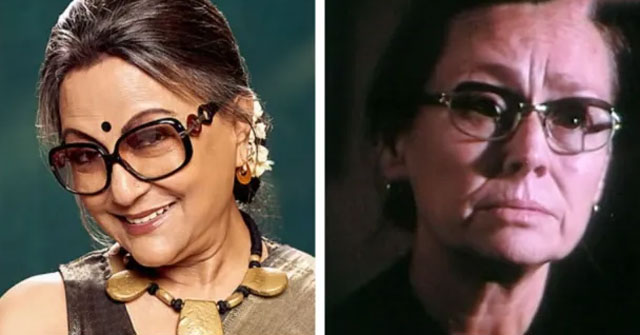
Years later, Sen borrowed the teacher’s name for Violet Stoneham, the protagonist of 36 Chowringhee Lane. “I had always been able to relate to, and feel deeply for old people who lived alone waiting for death,” Sen recalled.
Sen said the character was also influenced by several subconscious impressions, including books, paintings and music. While writing the screenplay, she repeatedly listened to The Beatles’ Eleanor Rigby, a song that reflects on loneliness and isolated lives.
Sen had begun acting soon after finishing high school and made her screen debut in Satyajit Ray’s Teen Kanya in 1961 at the age of 16. She later worked with Ray in Aranyer Din Ratri and Jana Aranya. However, after years of acting in Bengali and Hindi films, she became frustrated with roles in films that did not connect with her interests.
Having grown up watching world cinema as a film society enthusiast, Sen eventually turned to writing while working on a Hindi film in Mumbai. A short story she wrote gradually became a screenplay, and she decided that she wanted to direct it herself.
However, friends and family members discouraged her from making an entirely English-language Indian film, which was considered commercially difficult at the time. They advised her to treat the screenplay as an intellectual exercise and put it away. Sen agreed reluctantly, but decided to first show it to Ray, whose opinion she greatly valued.
Ray, a longtime friend of Sen’s father, encouraged her instead of asking her to abandon the project. He reportedly told her that the time had come for India to make English films and suggested that she approach actor-turned-producer Shashi Kapoor, who was beginning to support unconventional cinema.
Sen contacted Kapoor, with whom she had earlier shared screen space in James Ivory’s Bombay Talkie. After receiving the synopsis, Kapoor said that he and his wife, actor Jennifer Kendal, liked the story but were unsure whether Sen could direct the film.
Kapoor invited her to Mumbai to narrate the complete screenplay. Sen travelled to his residence at Atlas Apartments at Malabar Hill and narrated the story to Kapoor, Kendal and filmmaker Govind Nihalani. Nihalani was initially considered for cinematography, but Ashok Mehta eventually took charge of the camera work.
After hearing the screenplay, Kapoor and Nihalani began discussing the proposed budget. Sen recalled that nobody formally told her that the film had been approved. Instead, she was simply handed a contract.
On her journey back to Kolkata, she said she kept hugging the contract and repeatedly looked at it in disbelief, realising that she was actually going to make her first film and would even be paid for it.
Kapoor also helped Sen find the actor who would bring Violet Stoneham to life. Jennifer Kendal played the ageing Anglo-Indian schoolteacher with a performance that became central to the film’s emotional power.
Released in 1981, 36 Chowringhee Lane follows Violet Stoneham, a lonely Anglo-Indian teacher living by herself in Kolkata. She develops a relationship with a young couple, only to discover that people she considered friends had taken advantage of her affection and her home.
The film explored loneliness, ageing, betrayal and the changing Anglo-Indian community in Kolkata. It won the National Film Award for Best Feature Film in English, while Sen received the National Award for Best Director and Ashok Mehta was honoured for Best Cinematography.
Kendal, however, did not win the Best Actress National Award despite the acclaim for her performance. The film became her final screen appearance before her death from cancer in 1984.
Sen said Kendal’s death at a relatively young age was deeply tragic and described Shashi Kapoor as the “best producer” she had worked with. She also recalled that the National Award decision had deeply affected Kendal’s family, the film unit and those who admired her acting.
According to Sen, Kendal herself once recalled a reported comment from the jury chairperson that she should not receive the Best Actress award because she had not “acted” but simply “behaved”. Kendal regarded the remark as a greater compliment than the award itself.
Actor Rekha, who won the Best Actress National Award that year for Muzaffar Ali’s Umrao Jaan, also acknowledged Kendal’s performance. Years later, Sen’s dAugusthter Konkona Sen Sharma dedicated her National Award for Mr. & Mrs. Iyer to Kendal.
One of the most memorable sequences in 36 Chowringhee Lane comes towards the end, when Stoneham, after discovering the betrayal of people she trusted, walks alone and recites Shakespeare’s King Lear to a stray dog on a Kolkata street.
Sen said she considers the ending positive despite its sadness because Stoneham chooses to continue living independently after experiencing betrayal. She said the character gradually begins to understand Shakespeare through her own life experiences.
Sen particularly praised Kendal’s delivery of the final lines, saying the actor raised her voice on the word “live”, bringing a note of hope to a scene otherwise filled with loneliness and heartbreak.
For Sen, the story of 36 Chowringhee Lane therefore goes beyond the making of her first film. It takes her back to her school days, when she was drawn to elderly people living alone, and to the memories, friendships and artistic influences that eventually shaped one of the most celebrated films of her career.
The film also marked the beginning of Sen’s journey as a filmmaker, a career that would establish her as one of the prominent voices of Indian parallel and art cinema.