Daijiworld Media Network - New Delhi
New Delhi, Aug 6: The Supreme Court on Thursday questioned amendments made to the Shiv Sena constitution, observing that the party had evolved from a democratically structured organisation into "virtually a one-person structure" as it continued hearing the Uddhav Thackeray faction's challenge to the Election Commission's decision recognising the Eknath Shinde-led group as the "real Shiv Sena".
A Bench comprising Chief Justice of India Surya Kant and Justices Joymalya Bagchi and V Mohana observed that when constitutional institutions are expected to uphold democratic values, political parties must also function in accordance with democratic principles.
"Originally, the party (Shiv Sena) Constitution was founded on democratic principles. Subsequently, it was amended and became virtually a one-person structure," the Bench observed.
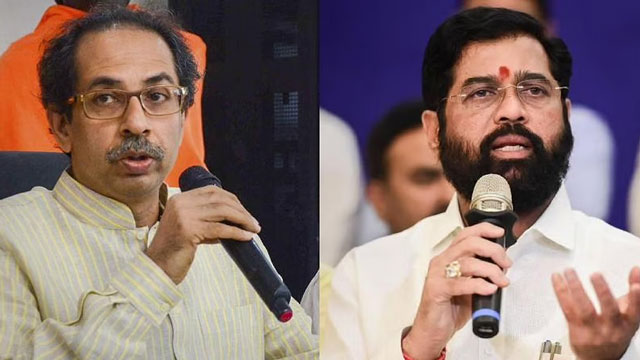
Appearing for the Thackeray faction, senior advocate Kapil Sibal argued that the Election Commission had exceeded its jurisdiction by examining the validity of the party's constitution while deciding the dispute over the party symbol.
"The real question is that this is not within the Election Commission's remit," Sibal submitted.
Responding to the argument, the Chief Justice said the issue extended beyond the Commission's statutory powers.
"When we speak of democratic principles and institutions safeguarding democratic values, the question naturally arises whether a political party is itself expected to function democratically," the Chief Justice observed.
Sibal agreed that political parties should function democratically but argued that constitutional authorities and political parties cannot be judged by the same standards.
"Constitutional institutions perform constitutional functions, whereas political parties perform political functions. The standard of institutional integrity is necessarily much higher when a constitutional authority exercises its powers," he said.
He further contended that even if deficiencies existed in the Shiv Sena constitution, the Election Commission could only have directed the party to amend it rather than treating it as invalid.
"We know of several political parties that have not held organisational elections for years," Sibal said.
"Has the Commission ever held that their constitutions are undemocratic and therefore refused to recognise them? That is precisely the reasoning by which it refused to rely upon the 2018 constitution here," he added.
Justice Joymalya Bagchi also questioned the Commission's approach, referring to its emphasis on constitutional morality.
"It repeats Dr. Ambedkar's observations and also refers to the view that defection is a constitutional sin. Today, however, it appears to have become a badge of honour rather than a sin... Dr. Ambedkar had said that however good a Constitution may be, it is bound to turn out bad if those who are called upon to work it happen to be bad," Justice Bagchi observed.
"This is exactly our case," Sibal replied.
Launching a sharp attack on the Commission's methodology, Sibal argued that it had no legal authority to invalidate the Shiv Sena's 2018 constitution and instead relied upon the party's 1999 constitution to resolve the symbol dispute.
"The EC has no adjudicatory power to pronounce upon the validity of a party constitution," he argued.
"Under Section 29A and its own guidelines, the Commission cannot hold a party constitution invalid. By assuming a jurisdiction it does not possess, the Commission decided this dispute on an impermissible basis," he submitted.
Sibal also contended that the Commission's decision effectively treated the legislative wing as the political party by giving greater weight to the strength of elected legislators than to the organisational structure.
He told the court that while the Shinde faction enjoyed majority support among MLAs, the Thackeray faction retained overwhelming organisational backing, with around 19.4 lakh primary members compared to 4.48 lakh supporting the Shinde camp.
"If the EC decides who the political party is before disqualification is settled, the horse has already bolted from the stable," he said.
Referring to the expansion of the Shinde camp after the 2022 political crisis in Maharashtra, Sibal argued that prolonged disqualification proceedings naturally encouraged more legislators to join the ruling side.
"People in power are like a magnet. Power attracts people. If disqualification proceedings are allowed to linger, this expansion is the inevitable consequence," he said.
The Thackeray faction argued that the Election Commission's ruling effectively reduced a political party to its legislative wing, creating a precedent under which governments could be altered through defections rather than through the electoral mandate.
The Supreme Court will continue hearing the matter on August 11.