Daijiworld Media Network - New Delhi
New Delhi, Jul 22: India has become the country with the world's largest electrified railway network, with 99.6 per cent of its broad gauge railway tracks now electrified, Union Railway Minister Ashwini Vaishnaw informed the Lok Sabha on Wednesday.
In a written reply, the minister said India now ranks second only to Switzerland, which has achieved 100 per cent railway electrification but operates a much smaller rail network. India's electrification level also surpasses that of several major economies, including China (82 per cent), Spain (67 per cent), Japan (64 per cent), France (60 per cent) and the United Kingdom (39 per cent).
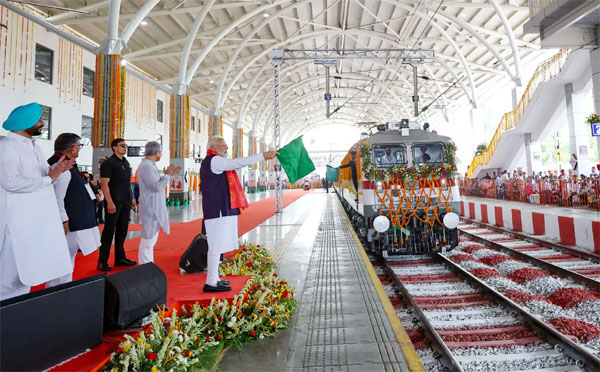
Vaishnaw said Indian Railways has carried out one of the fastest railway electrification drives globally by adopting a mission-mode approach aimed at electrifying the entire broad gauge network rather than limiting the exercise to high-density passenger and freight corridors, as many other countries have done.
According to the minister, 48,072 route kilometres have been electrified between 2014 and 2026, marking a significant acceleration compared to the 21,801 route kilometres electrified during the previous six decades.
He said the large-scale electrification programme has substantially reduced the railways' dependence on fossil fuels while improving operational efficiency.
Electrified rail lines enable greater hauling capacity, higher train speeds and shorter travel times, contributing to more efficient railway operations across the country.
The minister also highlighted the environmental and economic benefits of the initiative. Diesel consumption for railway traction has fallen dramatically from 293 crore litres in 2015-16 to 108 crore litres in 2024-25, resulting in a reduction of 185 crore litres.
This decline has helped lower carbon emissions while also saving valuable foreign exchange that would otherwise have been spent on importing diesel.
To further strengthen its clean energy transition, Indian Railways has commissioned more than 1,260 megawatts of solar and wind power capacity to support its operations.
Vaishnaw noted that rail transport is significantly more environment-friendly than road transport, emitting nearly 89 per cent less carbon dioxide, making it a key component of India's sustainable transport strategy.
He added that an electrified railway network is ideally suited for integrating renewable energy sources such as solar and wind into traction power systems, enabling Indian Railways to move towards low-carbon operations.
The minister said Indian Railways remains committed to sustainable growth through near-complete electrification, greater use of renewable energy and strategic power procurement, helping reduce its overall carbon footprint while improving efficiency and energy security.