Media Release
Udupi, Dec 19: Kasturba Medical College (KMC), Manipal, marked an important milestone in international academic collaboration with a SPARC-supported Continuing Medical Education (CME) program and Hands-on Workshop, along with the release of a research monograph, organized by the Departments of Ophthalmology and Microbiology, in collaboration with the Manipal School of Life Sciences (MSLS) and the Centre for Ocular Nanomedicine, MAHE, Manipal.
The one-day International CME with hands-on workshop, titled 'Translating ocular microbiome research into precision drug delivery for ocular diseases', was held on December 17, and witnessed the participation of 125 delegates, including clinicians, researchers, faculty members, and postgraduate students from across the region.
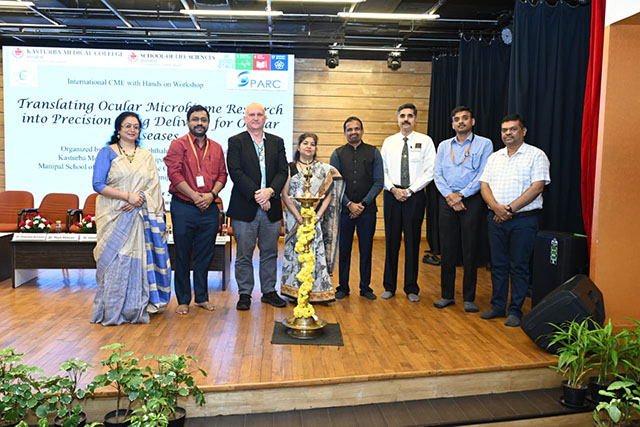
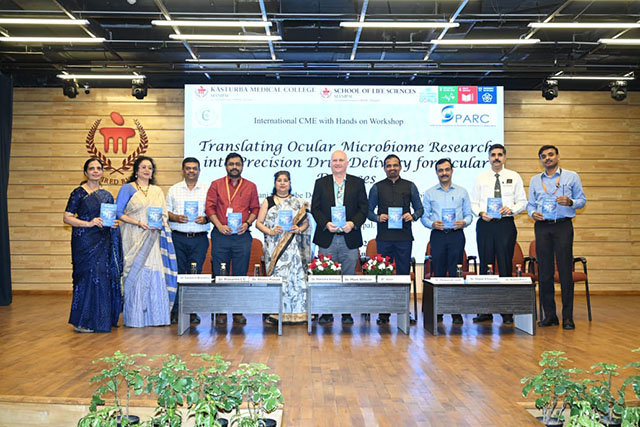
The inaugural session commenced with a welcome address by Dr Vinod Nayak, associate dean, KMC Manipal. This was followed by an overview of the programme by Dr Sulatha V Bhandary, professor, who outlined the objectives, scope, and academic significance of the initiative under the Scheme for Promotion of Academic and Research Collaboration (SPARC) of the Ministry of Education, Government of India.
The inaugural session featured an address by the guest of honor, Dr M Shama Prasad, director (Research), MAHE, Manipal, who emphasized the importance of international research partnerships in strengthening India’s academic and translational research ecosystem.
A key highlight of the event was the release of a research monograph by Dr Manisha Acharya, cornea consultant at Dr Shroff’s Charity Eye Hospital, New Delhi, which reflected the outcomes of sustained collaborative research and scholarly engagement under the SPARC initiative.
The chief guest for the occasion was professor Dr Mark Willcox, professor of Ocular Microbiology and Vision Science at the University of New South Wales (UNSW), Sydney, and the International Principal Investigator of the SPARC grant. Professor Willcox is an internationally recognized researcher with significant contributions to ocular microbiology, contact lens–related infections, antimicrobial resistance, biofilms, and translational eye research. It was noted that he played a pivotal role in conceptualizing the project, securing SPARC funding, and making substantial contributions to the development and writing of the monograph. He has travelled from Sydney and will be associated with KMC Manipal for a period of 15 days, during which he will be actively involved in academic sessions, teaching, mentoring, and research discussions.
The programme concluded with a vote of thanks by Dr Yogish S Kamath, head, department of ophthalmology, KMC Manipal. The proceedings of the inaugural session were moderated by Meghana Prabhu.
The academic programme featured expert lectures that focused on the ocular surface microbiome, metagenomics, antimicrobial strategies, and precision drug delivery approaches for ocular diseases. This was followed by an intensive hands-on workshop conducted at the Manipal School of Life Sciences, providing practical training in Mass spectroscopy, confocal imaging, tissue engineering, and 3D printing, aimed at bridging basic science with clinical ophthalmology.
The event reaffirmed KMC Manipal’s commitment to fostering international research collaboration and advancing excellence in medical and translational research.