Daijiworld Media Network - Business
Mumbai, Oct 19: Asian stock markets declined on Monday as concerns over massive artificial intelligence (AI) investments weighed on investor sentiment ahead of a busy week of corporate earnings, while the euro weakened amid political unrest in France.
Falling oil prices offered some support to bond markets and US stock futures, limiting losses across Asia. Crude prices declined after US President Donald Trump announced a waiver of certain sanctions on Russia, although he later clarified that a final decision had not been made.
US Secretary of State Marco Rubio said on Saturday that Trump would take up to 60 days to assess the economic impact of the proposed move.
Brent crude futures fell 1.6% to $108.06 a barrel, while US crude futures declined 0.7% to $100.70 a barrel.
Meanwhile, Iran reported that another tanker had struck a mine in the Strait of Hormuz, adding to concerns over geopolitical tensions and disruptions to global energy supplies.
Amid uncertainty, investors moved towards safer assets, extending a rally in government bonds. The yield on the 10-year US Treasury fell three basis points to 5.0645%, following its biggest weekly decline in more than eight months.
US stock futures edged higher, with S&P 500 futures gaining 0.5% and Nasdaq futures rising 0.8%.
Technology stocks under pressure
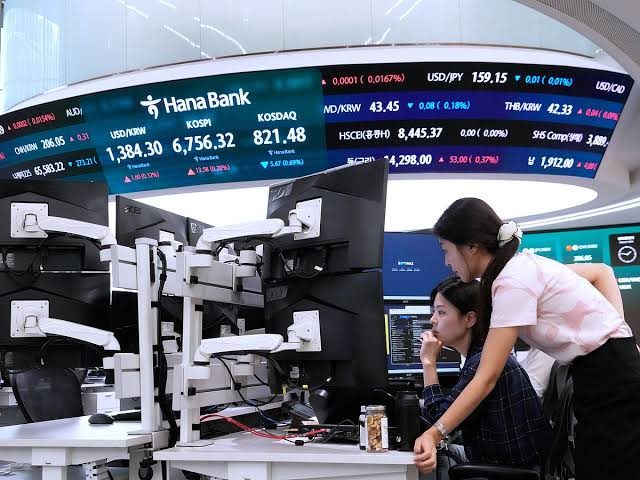
Asian markets remained under pressure from concerns over the technology sector. Japan's Nikkei index fell 2% on Monday after losing 5.4% last week, while South Korea's stock market declined 1.6% following a weekly drop of more than 14%.
MSCI's broadest index of Asia-Pacific shares outside Japan slipped 0.3%.
Investors are increasingly concerned that the revenue generated by AI may not justify the enormous upfront investments required to develop the technology and its supporting infrastructure.
My Bui, an economist at fund manager AMP, said investors had long worried that AI revenues might be insufficient to recover the massive initial investments. She also warned that AI infrastructure could lose value as it ages and depreciates, potentially reducing companies' book values.
Rising government bond yields and wider corporate credit spreads are also increasing financing costs, making it more difficult for companies to borrow, refinance debt and sustain their AI infrastructure expansion, she said.
The Philadelphia Semiconductor Index plunged 11.4% last week, marking its longest losing streak since 2008.
Earnings in focus
Investors are closely watching a series of corporate earnings announcements this week for indications of whether the technology sector can sustain its growth and justify its high investment levels.
Meta is scheduled to report its results on Wednesday, alongside semiconductor companies Lam Research and Texas Instruments. Investors will also monitor results from Tesla and developments involving Elon Musk-led SpaceX.
Meta is among five major AI hyperscalers expected to increase their combined capital expenditure to around $1.2 trillion next year, according to Goldman Sachs.
Other major companies reporting earnings include Netflix, Procter & Gamble, General Motors and GE Aerospace.
Despite concerns about AI spending and market volatility, overall corporate earnings are expected to rise by around 30%, supported largely by strong profits from technology companies.
Euro weakens amid french unrest
European markets also faced pressure from political uncertainty in France. EURO STOXX 50 futures fell 0.4%, while Germany's DAX futures declined 0.3%. Futures linked to the UK's FTSE index remained largely unchanged.
The euro weakened 0.2% to $1.1212, moving closer to last week's 16-month low of $1.1113.
The US dollar slipped 0.1% against the Japanese yen to 157.75. The dollar-yen pair has traded within a relatively narrow range this month as the possibility of Japanese authorities intervening in the currency market has discouraged speculative selling of the yen.
In commodity markets, gold gained support from falling bond yields. The price of the non-interest-bearing precious metal rose 0.4% to $4,181 an ounce.
Investors will continue to monitor corporate earnings, developments in AI investments, geopolitical tensions and currency movements for signals on the direction of global markets in the coming days.