Daijiworld Media Network - New Delhi
New Delhi, Sep 28: The 2016 surgical strikes carried out by the Indian Army following the Uri terror attack led to a shift in Pakistan's infiltration strategy, with terror networks moving away from traditional launchpads in the Kashmir Valley towards difficult terrains in the Jammu division, according to security officials.
The Army had conducted the September 29, 2016 operation against terrorist launchpads along the Line of Control (LoC), following specific intelligence inputs about preparations for infiltration and attacks in Jammu and Kashmir and other parts of India.
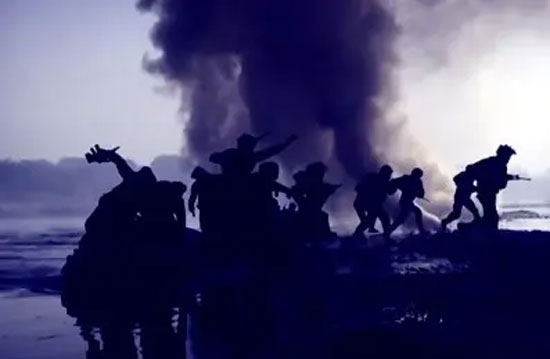
An official said the strikes established what was described as a new normal, with the Indian Army demonstrating its willingness to conduct such operations against infiltration preparations. The official said the action also challenged Pakistan's earlier assumption that India would maintain strategic restraint.
According to security officials, terror launchpads that were traditionally located near dense forests in the Kashmir Valley were subsequently shifted towards sectors such as Poonch, Rajouri and Kathua in the Jammu region.
“These terrains are extremely challenging, and terrorists face a lot of difficulties while trying to infiltrate owing to riverine gaps and broken topography,” the official said.
An Intelligence Bureau official said the counter-infiltration strategy was subsequently strengthened through intensified security grids and greater deployment along the LoC.
The security infrastructure has also increasingly incorporated technology. The government has described the counter-infiltration system as a combination of technology and human resources, including surveillance and monitoring devices and anti-infiltration obstacles.
High-tech border surveillance systems deployed in difficult terrain use multiple sensors, including thermal imagers, ground sensors, fibre-optic systems, radar and sonar, with data relayed to command and control centres for real-time monitoring.
Security officials also said terror groups had attempted to use cross-border tunnels in the Jammu sector. To counter such attempts, surveillance measures including ground-based sensors and imaging technologies have been deployed to detect signs of underground activity.
Another official said the pattern of infiltration had changed following the surgical strikes and subsequent strengthening of counter-infiltration measures.
Earlier, large groups of comparatively poorly trained terrorists were allegedly pushed across the LoC in bigger numbers. According to the official, the pattern has since shifted towards smaller groups of highly trained terrorists, including attempts involving pairs of infiltrators.
The Indian Army had already been operating a multi-tiered counter-infiltration grid along the LoC before the 2016 strikes. In a September 2016 statement, the Army said the grid had helped neutralise infiltration attempts, while later government data said infiltration incidents had declined significantly following the surgical strikes.
Security officials said Pakistan-backed terror networks have continued attempts to rebuild their presence in Jammu and Kashmir. They claimed that security forces have disrupted overground worker networks and eliminated several top commanders, their deputies and terrorists operating on the ground.
“Pakistan, which is desperate to piece together a large force of terrorists in Jammu and Kashmir, is unable to do so. This is mainly because the infiltration pattern has changed and attempts are being made to push terrorists into J&K in very small numbers,” the official said.
The officials also pointed to the 2019 Balakot air strike and the 2025 Operation Sindoor as further instances of India's response to cross-border terrorism. The government has described the 2016 surgical strikes, Balakot air strikes and Operation Sindoor as part of a broader shift towards a more proactive counter-terrorism approach.
According to the officials, the tactics used by terror networks have also evolved, with greater reliance on propaganda and disinformation, along with targeted attacks and ambushes.
Security agencies have also attributed attacks in Jammu and Kashmir to proxy groups linked to Pakistan-based Lashkar-e-Taiba (LeT) and Jaish-e-Mohammed (JeM), including The Resistance Front (TRF) and People's Anti-Fascist Front (PAFF). The officials said the use of such groups is aimed at creating an appearance of locally driven militancy and providing Pakistan with plausible deniability.
An official said the change in India's counter-terrorism doctrine has also been a factor in Pakistan's calculations, with any major terror attack potentially drawing a direct Indian response rather than being treated solely as a conventional cross-border terror incident.