Daijiworld Media Network - New Delhi
New Delhi, Sep 27: Army chief General Dhiraj Seth on Sunday said victory on land remains the only “tangible factor” of success in warfare despite rapid technological advancements in the defence sector.
Addressing the NDTV Defence Summit 2016, General Seth said the growing use of technology and information warfare had created a complex battlefield environment, but the importance of ground forces remained unchanged.
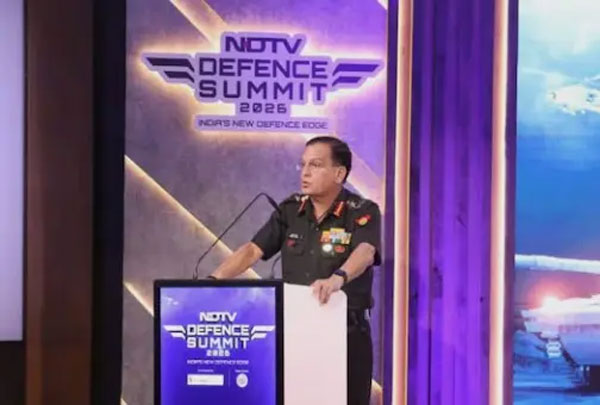
“We see salvo after salvo in today's social media covering warfare across the globe, where information narratives and warfare are being fired to fog the real battle picture, creating uncertainty and confusion,” he said.
“However, I strongly feel, through all this clutter, one reality that does not change: land will always be the one and only tangible and useful factor of success,” he added.
The Army chief said victory had always been measured in territorial terms and that territory could be occupied, secured and defended only by forces on the ground.
“Every capability must address one question: how does it help that soldier who puts his boots or tracks on the ground? That is why I would place him at the heart of the capability development that you're looking at,” he said.
Recalling the iconic photograph taken on December 16, 1971, showing Pakistan’s surrender at the end of the Bangladesh Liberation War, General Seth said the image represented a defining moment when the conflict formally ended.
He noted, however, that modern conflicts often lacked a clear point marking the end of hostilities.
“The reason I allude to this today is that that photo gave us a very defining moment, because that was the precise moment when the war came to an end. But there is no demarcating moment; there is no termination point which indicates an end to the hostilities,” he said.
General Seth said conflict timelines were becoming “increasingly indefinite”, with periods of intense fighting being interrupted by intermittent pauses.
“Technology is certainly shortening the battles, but it is not necessarily shortening the war. These millennium wars can best be described as wars with pause. Pause, in fact, is becoming a part of military strategy, with the pause representing not the domination of conflict but merely a change in its intensity and manifestation,” he said.
Emphasising the importance of self-reliance, the Army chief said prolonged crises could make ‘atmanirbharta’ or self-reliance a decisive factor in determining whether a country could sustain its war effort.
“Atmanirbharta must be about ensuring that we have the capability to endure without being constrained by what others can or cannot provide. That gives us a good reason to take a hard look at the very pathways of our indigenous capability,” he said.
At the same time, General Seth cautioned against what he described as “indigenous obsolescence”, saying efforts to reduce dependence on foreign suppliers should not result in domestically developed equipment becoming outdated by the time it is inducted.
“The challenge is not just to reduce dependencies on others but also to ensure that what we develop indigenously does not become outdated by the time it is dumped. I would like to term it as indigenous obsolescence or that kind of a trap that can get created,” he said.
According to government data, the value of India’s indigenous defence production rose from Rs 46,429 crore in 2014-15 to a record Rs 1.78 lakh crore in 2025-26.