Daijiworld Media Network - New Delhi
New Delhi, Sep 27: Defence Minister Rajnath Singh on Sunday called for strengthening India's domestic defence manufacturing capabilities and gaining greater control over critical technologies to achieve strategic autonomy amid an increasingly complex global security environment.
Addressing the NDTV Defence Summit 2026 here, Singh said India's approach was to manufacture domestically whatever could be produced within the country instead of depending on imports.
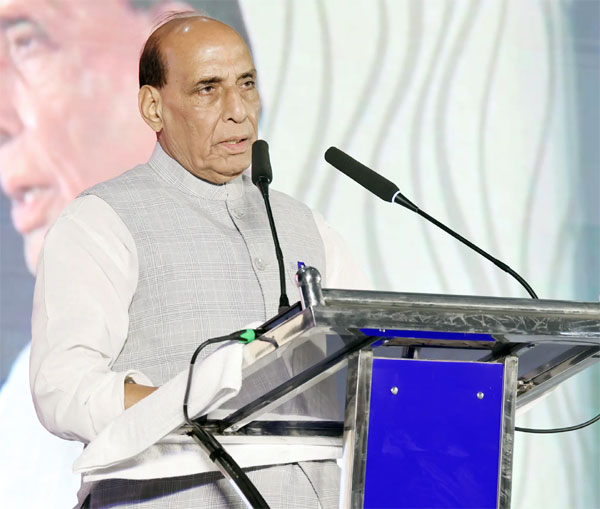
“From chips to ships, from screws to complete weapon systems, this will take India to strategic autonomy,” he said, stressing the need to promote indigenous design, innovation and adaptation across the defence sector.
Singh said the ability to manufacture and control critical components of the defence supply chain would be crucial for national security and help reduce dependence on overseas suppliers.
He said long-term defence preparedness would require mastery of critical technologies and greater self-reliance across the entire manufacturing ecosystem.
Highlighting recent policy initiatives, the Defence Minister said the government had introduced structural and transformative reforms to strengthen India's domestic defence industry, giving the sector significant momentum in recent years.
“We are not limited to meeting current needs; we are self-reliant and future oriented,” he said.
Drawing a parallel with the evolution of telecommunications from 2G to 5G, Singh said warfare had also entered a fifth-generation phase, with advanced technologies increasingly determining military capabilities and outcomes.
He said artificial intelligence, quantum technologies, robotics, autonomous systems and cybersecurity were becoming integral to modern warfare.
Singh said India was actively promoting indigenous quantum technologies while strengthening the policy framework needed to encourage innovation in emerging defence technologies.
He added that India was enhancing its capabilities for both contact and non-contact warfare, as well as kinetic and non-kinetic operations, while diversifying critical energy resources required for national security.
According to the Defence Minister, future battlefields would span multiple domains and become increasingly technology-driven. Countries that gain an edge in cutting-edge technologies would be better equipped to address evolving security challenges and maintain superiority in modern conflicts, he said.
Singh also highlighted the contribution of India's youth to technological innovation, saying young Indians were working in areas such as artificial intelligence, drone technology, robotics, quantum computing, cybersecurity and autonomous systems.
“India's youth are no longer just preparing for future jobs. They are preparing technology for India's future wars,” Singh said.