Daijiworld Media Network - Washington
Washington, Sep 26: The US Supreme Court has allowed the Trump administration to resume expanding a federal immigration database into a nationwide system for checking voter eligibility, setting aside a lower court order that had cited concerns over privacy and data accuracy.
In an unsigned order, the Supreme Court permitted the Department of Homeland Security to expand its Systematic Alien Verification for Entitlements (SAVE) system using Social Security and other government records covering US citizens.
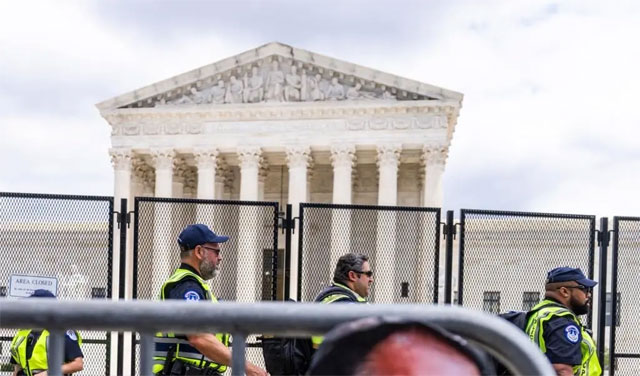
The decision allows the expanded database to be used for voter-eligibility checks ahead of the November midterm elections.
The court said the lower court’s injunction had prevented the federal government from using the system it considered best suited to verify voter information.
“The order below prevents the Federal Government from using the program it believes is best suited to the task,” the Supreme Court said.
However, the decision is an interim order and does not constitute a final ruling on the legality of the administration’s programme. It lifts restrictions imposed while the broader legal dispute continues.
The Supreme Court also noted that federal law restricts large-scale changes to voter-registration lists shortly before an election. The restriction, it said, “limits the potential impact” of the expanded database during this year’s midterm elections.
States will still be able to conduct individual searches using the system.
The ruling could have implications for naturalised US citizens, including Indian-origin voters, whose records may be checked against immigration and Social Security information. Critics have argued that incomplete or inaccurate data could result in eligible citizens being wrongly identified as noncitizens.
The administration’s initiative stems from Trump’s March 2025 executive order titled “Preserving and Protecting the Integrity of American Elections.”
SAVE was originally created to verify the immigration and citizenship status of people applying for certain public benefits. Its database previously contained information primarily relating to immigrants and naturalised citizens.
The Trump administration sought to combine the existing information with other federal records and expand the system to allow officials to conduct searches involving large groups of people rather than checking individual records separately.
A federal appeals court in Washington had blocked the expansion after finding that the proposed changes were likely to violate federal privacy and administrative laws. The court also raised concerns about the accuracy of the information that could be used in the expanded system.
The Supreme Court’s conservative majority subsequently set aside that decision.
Justice Ketanji Brown Jackson dissented from the order, with Justices Sonia Sotomayor and Elena Kagan joining her.
Jackson argued that the lower court had correctly determined that the proposed changes were likely to violate federal law. She also warned that permitting mass searches could increase the risk of naturalised citizens losing their voting rights because of errors in government data.
“In my view, however, the harm caused by burdening or disenfranchising even a few lawful voters outweighs the nonexistent harm that the Government experiences when it is prevented from taking an action that it likely lacks the authority to take,” Jackson wrote.
Other provisions of Trump’s March 2025 election order remain blocked by lower courts. These include a nationwide requirement for voters to provide documentary proof of citizenship when registering to vote.
The SAVE database dispute is separate from another executive order issued by Trump in March 2026, which sought additional citizenship-verification measures and changes affecting federal elections.
Earlier in September, the Supreme Court blocked a US Postal Service rule stemming from that later order that would have imposed restrictions on mail voting.
The court’s decisions mean the Trump administration can proceed with the expansion of the SAVE database, while the separate postal restrictions cannot be implemented for the November midterm elections.